• Skip to primary navigation
  • Skip to main content
  • Skip to primary sidebar

  • Basketball Plays
    • Ball Screen Sets
    • Horns Sets
    • Man to Man Post Up
    • Man to Man Isolations
    • Backdoor Plays
    • Man to Man 3 Point Shot Plays
    • 2-3 Zone Attack
    • Baseline Inbound Plays
    • Sideline Inbound Plays
    • Combination Defense Attack
  • Drills
    • Defensive Drills
    • Offensive Drills
    • Competitive Drills
    • Passing Drills
    • Rebounding Drills
    • Shooting and Scoring Drills
    • Toughness Drills
    • Transition & Conversion Drills
    • One on One Drills
  • Blueprint
  • Practice
  • Mental Toughness
  • Skill Development
  • Offense
  • Defense
  • Store

Basketball Coaching Great vs. Destructive Teams

Basketball Coaching Great vs. Destructive Teams

By Brian Williams on March 14, 2013

This article came from the University of Washington Women’s Newsletter.

If you would like to subscribe, email me and I will forward your interest on to their staff.

Great Teams

“Prepare for every game like you just lost your last game.” – Lon Kruger

There is a difference between readiness and preparation; readiness doesn’t get it done. You must prepare – Marine boot camp philosophy

“Treat people nice, even when they don’t deserve it.”

Have Positive Captains


– Work hard
– Take care of things on the floor
– Let the coaches take care of everything else

Have Great Team Attitudes

– Listen to each other
– Are courteous
– Say what they feel, but watch how they say it.
– Don’t talk behind each others back
– Don’t put each other down

Have players and coaches who accept and appreciate their roles on the team.

Work on skill development.

Share ownership in both victory and defeat.

We before Me Attitude

– Trustworthy
– Disciplined
– Unselfish
– Help teammates up
– Know roles

Push each other in practice to better prepare each other for the next game.

Self Destructive Teams

Your Four Toughest Opponents

– Negative attitudes in your program
– Injuries
– Illness
– Ineligibility

“What is your attitude?”

“What do others perceive as your attitude?”

Have loss the love of the game.

Are not willing to practice everyday, especially when times are tough.

Lose track of their short term and long term goals. – What are the team’s goals?

Are more concerned with individual goals than the team goals.

– Who is starting the game?
– Whose name is in the paper?
– Who gets more playing time?

Lack leaders who will lead by example.
– “Can talk the talk but WON’T walk the walk”

Criticize teammates ”Run each other down rather than lift each other up”

Are not coachable

When you are not getting better each day, you are telling your teammates that you don’t care OUR team.
Basketball Coaching Bob Knight

By Brian Williams on March 13, 2013

I recently read the book, “The Power of Negative Thinking” by Bob Knight. I have listed some of my takeaways from it on this post. If you are interested in finding out more about the book or reading a sample, you can do so on the Amazon web site by clicking on the book cover below.

  • Coach Knight states that “I’m not arguing for being a strict negativist, for always seeing the dark side, always expecting failure. That is not the intent of the book. Being alert to the possible negative in any situation is the very best way to bring about positive results.
  • Paying attention to the potential downside is a difficult but essential quality for achieving long-term success
  • Ignoring or failing to spot potential hazards in advance makes failure all the more likely.
  • Planning beats repairing.
  • Good planning avoids the need for fixing up a project that plowed ahead without thought about potential pitfalls.
  • We need to at least consider how our next move could produce an unexpected chain reaction down the line.
  • Most basketball games are not won, they are lost.
  • When preparing for a game look at ways you can lose. Most have nothing to do with the opponent, but what needs to be correced about our own execution to keep from beating ourselves.
  • Ask each season in each game: “What vulnerabilities do we have?” “What can we do to minimize them, get around them, or to survive them?”:
  • Ask yourself ” How do you eliminate the wasted energy, and unnecessary mistakes to build a cohesive and a successful team that can play within its strengths?”
  • Victory favors the team making the fewest mistakes.
  • Mistakes he sought to eliminate were poor ballhandling, bad shots, slow recovery from offense to defense, bad fouls and poor foul shooting, for blocking out, uncoordinated defense.
  • If you play with passion you are more likely to play with precision.
  • The difference is not that the winner wanted it more than loser did.
  • Discipline is recognizing what has to be done, doing it as well as you can do it, and doing it that way all the time.
  • The power of negative thinking comes into play by recognizing, addressing, and removing the obstacles to winning.
  • Have a plan to recover after a loss, to learn from a loss, to eliminate those things that caused the loss.
    • Bad calls injuries or unusual occurrences are not the reason for losses mistakes are.
    • The mark of success or failure in handling victory is what happens the next timeout
    • Don’t let the upcoming game take away what you earned the last game.
    • The greatest victory is eliminated by lack of follow-up.
    • Success is a grind, its perseverance, it is operating at a high level of performance on a constant basis.
    • You cannot be distracted by last night . The first job that we have today is putting yesterday aside to be remembered later. Tony LaRussa
    • Eliminating ideas that are no longer relevant is essential to growth and achievement
    • Part of the art in coaching is changing the game plan when necessary.
    • Leadership is getting people out of their comfort zone.
    • Asking questions is the essence of learning
    • There isn’t always a right way and wrong way that there’s usually a higher percentage way.
    • Players need to recognize what they can do in games and good as they can at it. Recognize what they don’t do well now, but that they can do well with work. And finally recognize what they cannot do now or and will never be able to do.
    • Coaches Need to think about why they won in a similar way that they think about why they lost.
    • The guy who knows all going into a game usually forgets it all in the face of the crisis.
    • Pardon one offense and you encourage the commission of many.

    Click the play arrow and make sure your sound is on to watch the video. If you are interested in learning more about the basketball coaching DVD that this sample came from, click this link: The Essentials of Coaching Basketball

Basketball Plays Pistol

By Brian Williams on March 12, 2013

Half-court man-to-man play that you can tweak or take parts of to fit your team.

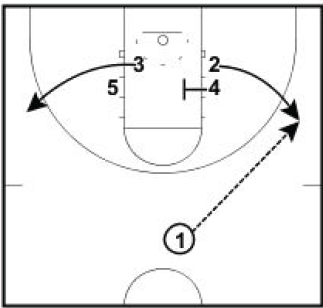
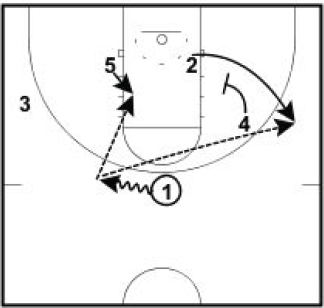
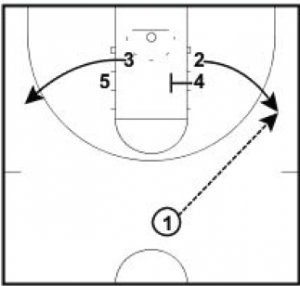
The play starts out in a 1-2-2 stack alignment.

5 and 4 set turn out screens for 2 and 3


Basketball Plays

1 enters the basketball to 2 to start the play


Basketball Plays

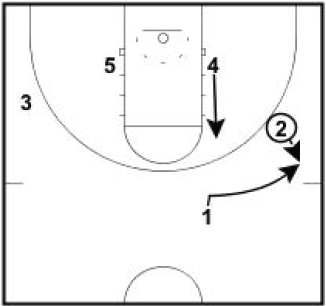
4 moves to the ballside elbow.

1 receives a hand back from 2


Basketball Plays

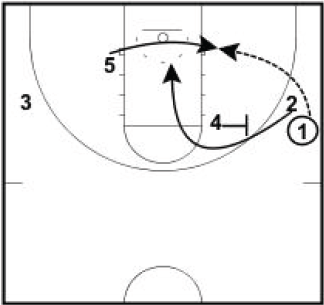
5 cuts to the ballside block. If 5 is open, 1 will feed the post.

4 screens for 2 going to the rim for a lob


Basketball Plays

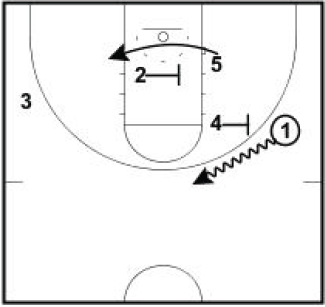
4 sets an on ball screen for 1 dribbling to the middle

2 cross screens for 5


Basketball Plays

1 can feed 5 at the midpost, or throw back to 2 coming off a turnout screen from 4.


Basketball Workouts Guards 2

By Brian Williams on March 11, 2013

These are four more guard basketball workout drills are from a back issue of the Xavier Men’s basketball newsletter.

If you would like to see the archives and/or sign up for their newsletter, you can here:

Xavier Newsletter

Here is a link to the previous four drills:

Basketball Workouts Guards

At the end of this post, I have listed some more skill development drills.


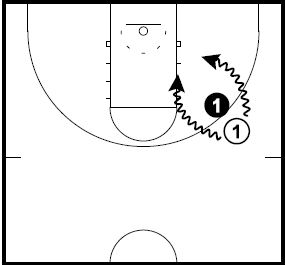
Guard Attack Drill

Diagrams created with FastDraw

Basketball Workouts

Great attacking drill.

RULES:

Guard starts on the wing with the ball and drives hard to the hoop.
The defender in the post can attack after the guard has taken one dribble.
Guard must go by the defender and score.

Guard NBA Sprint Drill

Basketball Workouts

Outstanding shooting drill that stresses cutting hard.

RULES:

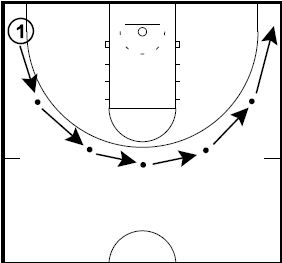
Guard runs from corner to corner around the 3 point line getting as many shots up as he can in one minute.


The guard must SPRINT from sport to spot.
He may not leave the previous spot until the rebounder has the ball.
Player should get in the neighborhood of 20 shots
Can also do with pull ups off of a shot fake. The guard must cover HUGE ground with step after shot fake. Work In straight lines!

Guard Iso Drill

Basketball Workouts

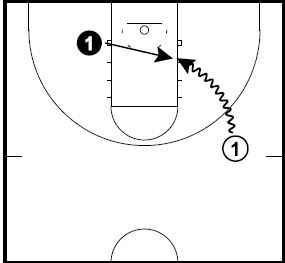
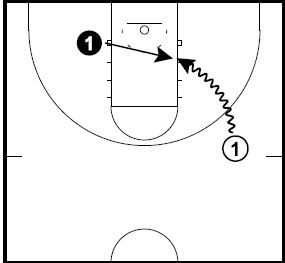
The defensive player is guarding Player 1 very tight, fouling and reaching. Player 1 must be ball tough and sweep through several times.

After 4 or 5 seconds, Player 1 sweeps through strong and tight to the defender on a straight line to the basket. The defender is stationary.

Player 1 must get past the defender and execute a one dribble pull up — covering as much ground as possible with one bounce.

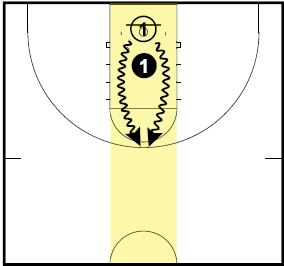
Guard Cage Drill

Basketball Workouts

The guard must stay within the edge of the boundries while trying to get past the defender (See Highlighted Area). The goal is to get to halfcourt.

RULES:

The defender cannot foul – but they should be very aggressive.
The guard cannot turn his back or spin dribble.
The guard can go between his legs, cross in front or hop-back to create room.

Sheridan Perimeter Individual Skills

By Brian Williams on March 7, 2013

I received this basketball workout from Coach Steve Smiley formerly Head Coach at Sheridan College and currently an Assistant at Northern Colorado.

PERIMETER WARM-UP (Approximately one minute on each of these, SIT INTO YOUR GAME)

Two ball dribbling sequence + Shelton drills, Sendek drill, Hardaway between legs crossover
Dribbling and juggling
Back dribble technique, pullback crossover progression, and pullback crossover on circle
Imaginary Defense (Talk your defense, yell it out)
Moving without the ball (Work independently, work in pairs, work in goups of 3, 4, 5)
Break Package Sprints (To rim for crunch)
Shooting Progression

REMEMBER

*Keep it straight, aim for the BACK HALF OF THE BASKET.
*Get it up. Top of the shot; top of the board (WE WANT A CONSISTENT ARC ON EACH SHOT)
*Hold a one second high follow through
*Land six inches closer for body balance

Spin yourself a pass moving out from behind the arc to practice ball in air, feet in air.
You may dribble dribble bust out to the arc, quick stop, rear turn and execute the move.
Catch facing in triple threat. CALL OUT RIM, POST, ACTION.
Respect the three-point arc.
Put 60% of your weight on your permanent pivot foot.
Visualize going against your opponent’s momentum. DRIVE THE FRONT HAND.
All drives are preceded by a one inch shot fake.
Explode with the circle tight movement of the ball. MEDIUM CENTER OF GRAVITY TO A LOW CENTER OF GRAVITY
Direct drive; put him in jail on the second step.
Cross over drive; put him in jail on the first step.

GUIDELINES
If you have trouble with a move, break it down and spend extra time on just that move.
BE A SKILL COACH/PLAYER NOT A DRILL COACH/PLAYER.
The technique and the quick and proper execution at game speeds is what we care about.
Periodically check players heart rates with a ten second count and multiply by 6.
220-Age=Maximum Heart Rate Get to 90% of maximum heart rate. E.g. 180+

All lay-ups must be clean to be a make, worth 2 points
Mix up power and one foot lay-ups
Swished jump shots you add a point (2=3, 3=4)
Call out your score on every shot attempt, made or missed.
Put back all misses. Long rebounds are usually jump shots. These putbacks do not count.
Use free throw swish rules in counting your free throws

Swish=+1 Make Hitting Rim=0 Miss=-1

MOVES FROM EACH WING (Middle drive is our drive of preference)
Three
Middle drive to rim (Cross rim)
Baseline to rim (Ten toes to baseline power shot)
Middle drive, quick stop and quick shot
Middle drive, quick stop, step across and power shot
Middle drive pull-up
Baseline drive pull-up
Middle drive hop back separation
Baseline drive hop back separation
Middle drive hesitation or rocker off hop back move to rim
Baseline drive hesitation or rocker off hop back move to rim
Jab step to a three
Free throw (4) Swish=+1 Make With Rim=0 Miss=-1 (Swish Everything=64 Points)

MOVES FROM THE TOP

Three
Direct drive to rim
Crossover drive to rim
Direct drive to a quick stop and quick shot
Crossover drive to a quick stop and quick shot
Direct drive to a quick stop, step across, power
Crossover drive to a quick stop, step across, power
Direct drive pull-up
Crossover drive pull-up
Direct drive hop back separation

Crossover drive hop back separation
Direct drive hesitate or rocker off hop back to rim or quick shot
Crossover drive hesitate or rocker off hop back to rim or quick shot
Jab step to a three
Free throws (4) Swish=+1 Make With Rim=0 Miss=-1 Swish everything=52 Points

FREE THROW SWISH +2/-2
If you lose (-2), do push-ups or a down and back sprint
If you win (-2), shoot a string of made free throws. If you miss, a swish lets you continue on.

PARTNER PASSING AND SHOOTING with one, two, and three passes is excellent. Six makes on one pass, six makes by each player on two passes, and six makes on three passes.

50 POINTS FOR TIME
Shoot from inside the arc and count a two as three if it is swished PLAY FREE THROW
Shoot from the arc and count a three as four if swished SWISH BETWEEN
Two games of twos and two games of threes gives a chance to improve scores GAMES

THREE OR MORE PLAYERS WORKING OUT TOGETHER

THREE PERSON ONE ON ONE
The extra guy plays help side defense. Play from various spots on the floor.
Be explosive, read your defender’s front hand, beat him and then play the helper .

FULL COURT ONE ON TWO DEFENDERS (Full-court pick-up and one man at half line)

HALF COURT ONE VERSUS TWO TRAPPERS (If four or more, use a high post release man)

TWO BALLS AND THREE CLOSERS OUT

*****MAKE 25 THREES WITHOUT MISSING TWO IN A ROW (Our key drill this year)
If you miss two in a row, you can keep the streak by swishing the next shot.
Record when you went out in each sequence. E.G. 7, 16, 4, 25…….Keep going if you hit 25!!!!!
This is very tough and will greatly improve your three point shooting ability.

ENDING WORK-OUT

X-Lay-ups and reverse X-Lay-ups versus time………20 seconds
You can choose to end with two five pound weight plates and do one minute segments of

    • Imaginary defense


    • Moving without the ball


    Break package sprints

YOU CAN’T DO ALL THE DRILLS EACH DAY BUT YOU CAN DO ALL THE SKILLS

BE A PRACTICE PLAYER FIRST.
PROPERLY AND QUICKLY EXECUTE THE FUNDAMENTALS OF THE GAME FOR THE WELFARE OF THE TEAM
PRACTICE AND PLAY WITH THE INTENSITY AND POISE OF A NATIONAL CHAMPIONSHIP TEAM

Basketball Plays DHO Elbow

By Brian Williams on March 6, 2013

Coach Vonn Read has submitted several plays from his playbook series The Basketball Encyclopedia of Plays to the Coaching Toolbox. Vonn is currently serving as an assistant coach in the Women’s at Houston.

He has also served as an assistant coach in the WNBA with the Phoenix Mercury, Orlando Miracle, and San Antonio Silver Stars. He was an advanced scout for the Orlando Magic as well as The Charlotte Sting.

Please like this page or use the Twitter button to share!


Basketball Plays


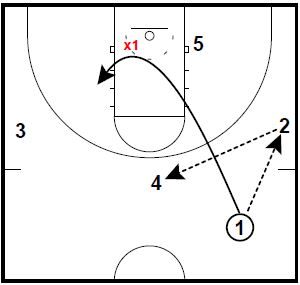
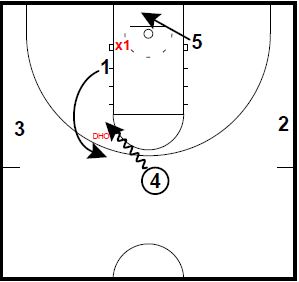
Right out of transition, the 1 player will pitch ahead to the 2 player, who will reverse the ball to the 4 player.

The 1 player will cut through the lane to the mid post area.


Basketball Plays

The 4 player will dribble the ball to elbow area to set up the Dribble Handoff to 1.

The 1 player will come up the lane to receive the Dribble Handoff.

The 5 player will put their head under the basket to read the action.


Basketball Plays

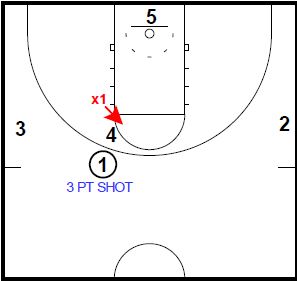
If the X1 defender goes under the Dribble Handoff, the 1 player will stop behind the screen and shoot the open 3-pointer.


Basketball Plays

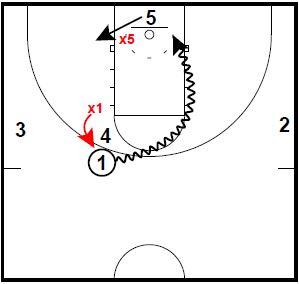
If the X1 player chases the 1 player on the Dribble Handoff, the 1 player will drive to the basket for the layup.

The 5 player will relocate and receive a dump off pass if X5 helps on the drive.


Basketball Plays

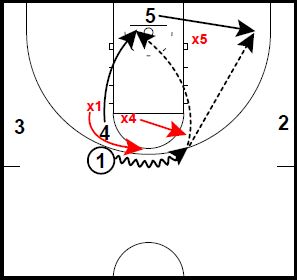
If the X1 player chases the 1 player on the Dribble Handoff and the X4 player helps on penetration, 1 will pass to 4 rolling hard to the basket for a layup.

The 5 player will space out to take away the help by X5 in the paint


Coach Read has also put together The Basketball Encyclopedia of plays. You can check them out here: The Basketball Encyclopedia of Plays or read more about the books:

Any coach looking for the latest and innovative plays from the Professional, College, or High School levels can stop looking. With a compilation of over 7,700 different plays, you will never need to purchase another basketball playbook again. These playbooks can be used as a great reference tool for years to come. This 2 Volume Book includes plays from 19 different play categories, and they are the most extensive playbooks on the market.

The Basketball Encyclopedia of Plays (Platinum Series) contains over 7,700 Plays (Both Volumes combined) from the NBA, WNBA, USBL, and College levels from someone who has worked as an Advanced Scout or Coach on each level!!! This book has been intensely compiled over the last 21 years, with plays taken from a lot of NBA Coaches (past and present), WNBA coaches, and College coaches (Men’s and Women’s) from around the country.

Any coach that is serious about improving their knowledge of the game from an X and O standpoint will benefit tremendously from these books. These Books can be used to discover New Quick hitters, add a New Package to your playbook, or develop an entire Offensive System. There are a lot of new ideas and concepts in these books to study, and the Basketball Encyclopedia of Plays can be a great resource for coaches on all levels!!! This book is definitely for those X and O junkies who are always looking to improve as a Coach.

“THE GAME IS ALWAYS CHANGING? ARE YOU?” Vonn Read

Here is the link: The Basketball Encyclopedia of Plays

  • « Go to Previous Page
  • Page 1
  • Interim pages omitted …
  • Page 237
  • Page 238
  • Page 239
  • Page 240
  • Page 241
  • Interim pages omitted …
  • Page 288
  • Go to Next Page »

Primary Sidebar

  • Twitter
  • Facebook
  • Linkedin
coachestoolbox
personaldevelopmenttoolbox
basketballplayerstoolbox
basketballtrainer
athleticperformancetoolbox
coachingbasketball

© Copyright 2026 Coaching Toolbox

Privacy Policy