• Skip to primary navigation
  • Skip to main content
  • Skip to primary sidebar

  • Basketball Plays
    • Ball Screen Sets
    • Horns Sets
    • Man to Man Post Up
    • Man to Man Isolations
    • Backdoor Plays
    • Man to Man 3 Point Shot Plays
    • 2-3 Zone Attack
    • Baseline Inbound Plays
    • Sideline Inbound Plays
    • Combination Defense Attack
  • Drills
    • Defensive Drills
    • Offensive Drills
    • Competitive Drills
    • Passing Drills
    • Rebounding Drills
    • Shooting and Scoring Drills
    • Toughness Drills
    • Transition & Conversion Drills
    • One on One Drills
  • Blueprint
  • Practice
  • Mental Toughness
  • Skill Development
  • Offense
  • Defense
  • Store

Coaching Basketball Eliminate Losing

Coaching Basketball Eliminate Losing

By Brian Williams on August 14, 2013

This article was written by Arkansas women’s head coach Mike Neighbors

Eliminate Losing

Good coaches that I have observed over the years have always done this with their teams. The GREAT coaches that I have observed over the years do this in their practices on a daily basis in all things that they do. So, as I was preparing for my first 5 practices as a college head coach.

I made sure that in every single drill and skill I put on the preparation plan reflective that thinking. If we can eliminate beating ourselves first, then the outcome of our games is completely in our control.

POOR PREPARATION: I have never seen a team who had a poor week (or day) of preparation win a big contest. Whether it is a poor scouting report, a shoot around that lacks focus, a pre-game warm-up full of distractions, a star player showing up late for bus, not sleeping the night before, eating an uncharacteristic pregame meal that upsets a stomach, etc.

POOR SHOT SELECTION: All teams will have nights when the ball won’t go in the hole. Not much you can do to control that. But you can control the quality of the shots your team gets. If you allow players/teams to take poor shots in preparation, they will do the same in games. WE GET WHAT WE TOLERATE. You have to be very clear with your team what YOU consider a good shot. Make sure your players/team understand it clearly, then defend that in every skill/drill that you do.

FOULING: This could be fouling too much. It can be too many fouls on an individual player, especially an impact player. It can be fouling at inopportune times. Either way, it can get you beat. You must “officiate” your skills/drills and scrimmages as your games would be called. We have goals to never put a team in the bonus in a first half. We have goals of only doing it in second half of games that we are trailing in. If we can keep teams from the FT line, we won’t beat ourselves.

UNCHARACTERISTIC TURNOVERS: You are going to turn the ball over. Some games more than others depending on the number of possessions you/your opponent pace the game. When your teams/players make turnovers they normally don’t or shouldn’t then you put yourself in a position to lose. In preparations we have a ball rack that has 8 basketballs on it. When we turn the ball over in one of the above situations, we remove a ball from the rack. This is a visual to our players what we consider UNCHARACTERISTIC. When the rack is empty, we stop our drill and “remind” the team (running, stairs, pushups, situps, etc), fill the rack back up and start again.

If we can eliminate losing before we deal with our opponents play, then you can coach. The next time you feel like saying after a game that “we beat ourselves” take inventory on why you feel that way. Then go about eliminating those issues in your practices. Sometimes you are just going to lose. It happens to every coach and every team. But, try to eliminate beating yourself.
Mental Toughness Plan of Action

By Brian Williams on August 13, 2013

These thoughts on clutch performance are from Spencer Wood Icebox Sports Performance Resources.

Click the link below to see his website. There are some articles on mental training and other resources as well. Icebox Athlete

Developing a Mental Skills & Toughness Training Plan of Action

By Spencer Wood

Ask any athlete, coach or sports fan ‘of all the athletic attributes, which is the most important?’ Even the most casual athlete, coach or sports fan will provide an answer that in some way relates to the mental toughness, potential and power locked away in our mind. Yet, for so many coaches and athletes, unlocking the incredible athletic potential and power held in our minds is sometimes as much a mystery as it is a source of constant heartache and frustration. Many teams and individual athletes know what it feels like to bring their ‘A’ game against one program one day, and then almost unexplainably, they bring their ‘C’ or ‘D’ game against the very next program. Even worse, for those athletes who have experienced a major performance or skills slump in a big game or even over the course of a season – the frustration can feel like a slow death. Unfortunately, far too many coaches and athletes know this feeling all too well. For the progressive coach the response to these challenges is more than just extra running or longer practices.

While extra running, longer drills and additional conditioning can build certain aspects of mental toughness, and under a select few conditions may be suitable response for a lack of effort, games are not always won or lost because of a lack of effort. Games are often won or lost due to a lack of execution vs. lack of effort. The smart response then is to develop a mental skills and toughness training program that pinpoints the particular components of mental toughness that resulted in a lack of execution FOR EACH ATHLETE. Better still, coaches who proactively put such a plan in place before the start of the season will experience greater consistency and a significant competitive edge.

So how does a coach and team begin to implement a mental skills and toughness training program for clutch performance? It has been said that “sometimes things do not go according to plan because a plan did not exist in the first place.” For mental skills this plan begins with an honest assessment of each athlete’s mental skills and toughness strengths and weaknesses. But what kind of mental skills and toughness traits should you assess? While a seemingly endless stream of words and phrases can be used to broadly describe mental skills and athletic toughness traits, a useful summary traces each of these traits to one of more of the 4 C’s of Peak Performance – Composure, Concentration, Confidence and Commitment.

The 4 C’s of Peak Performance

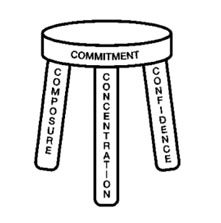
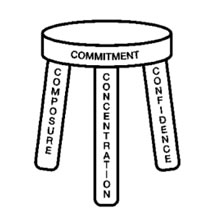
Together, these “4 C’s of Peak Performance,” Composure, Concentration, Confidence, and Commitment – work like a model of a 3 leg stool. The first 3 C’s of Peak Performance – Composure, Concentration, and Confidence are like the legs of the stool. Lose one or more legs and the integrity and balance of the stool is compromised. Translation – our performance suffers. And the 4th C of Peak Performance – Commitment – is the seat or platform of the stool that takes our weight and sustains us. No commitment or motivation, no stool. Each of these 4 C’s of Peak Performance profoundly affects the others. Developing tremendous composure allows us to better perform our concentration skills. A composed athlete who is able to effectively concentrate whenever necessary, will be a confident and highly effective athlete. And finally, a fully committed athlete will have harnessed the necessary drive and motivation to passionately pursue their mental and physical potential – committing to the necessary physical and mental training, maximizing their composure, concentration and confidence, and striving for Peak Performance. The “4 C’s Stool” diagram illustrates this Peak Performance Model.

4 C’s of Peak Performance

Mental Toughness for Basketball

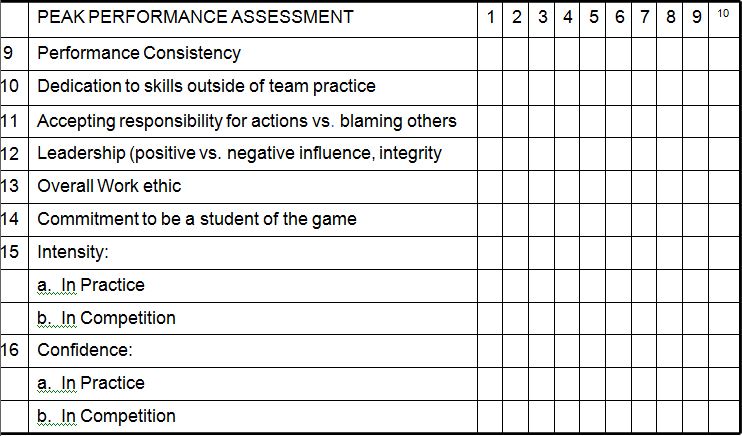
The Peak Performance Assessment examines current levels of practice and competitive composure, concentration, confidence and commitment, in addition to a number of other factors that can profoundly affect each of the 4 C’s of Peak Performance. These questions are scored on a scale from 1-10. A score of 1 = a “strongly disagree/very low” score. A score of 9 = a “strongly agree/very high” score. A score of 10 is a very rare “near perfect” score and should only be used sparingly. Encourage each of your players to complete the Peak Performance Assessment with complete honesty. Great athletes are great because they work on their strengths AND their weaknesses.Only complete honesty will allow your players to objectively identify these strengths and weaknesses before they are able to effectively improve these skills. The coach should also complete an assessment on each player, and should be compared with the player’s self-assessment in a one-on-one meeting with each player.

Any question with a score below a 7 should send up a ‘red flag’ and you should strongly consider working on this weakness with the athlete in question and turning the weakness into a future goal for improvement.

Developing a mental skills and toughness training plan for your team will certainly involve a time commitment. But this critical skill set will add a new, challenging and fun component to your practice schedule. In addition, the more you continue to train your team’s competitive mental muscle and refine your player’s mental training skills, the closer you will come to your team’s real potential. The pay-off in consistent peak performance, individual player improvement and your overall win column can be significant.

Mental Toughness for Basketball

Mental Toughness for Basketball

130 Great Ideas to Make Your
Basketball Team More Mentally Tough”
basketball practice

Click here for 12 ideas from the e-book

“This is great information that will help any coach to make their team more mentally tough and focused. I found sections 6 and 7 to be helpful to me as well as to our team. “

Brandon Sorrell
Assistant Girls Basketball Coach
Lawrence North (Indianapolis) High School

Basketball Plays Mid Post Punch

By Brian Williams on August 12, 2013

Coach Vonn Read has submitted several plays from his playbook series The Basketball Encyclopedia of Plays to the Coaching Toolbox. Vonn is currently serving as an assistant Women’s Coach at Houston.

He has also served as an assistant coach in the WNBA with the Phoenix Mercury, Orlando Miracle, and San Antonio Silver Stars. He was an advanced scout for the Orlando Magic as well as The Charlotte Sting.

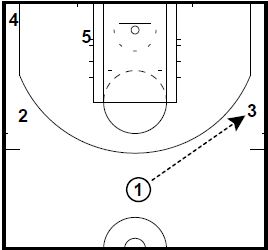
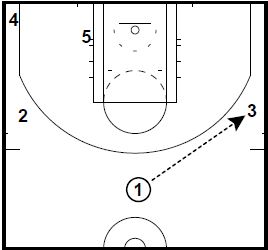
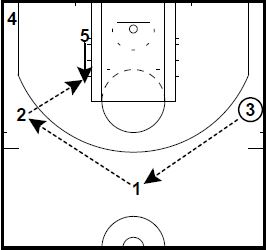
This play is a quick hitter to run against a 2-3 zone.


1 Passes to the 3 Player on the wing.


The offense will quickly swing the ball around the perimeter to the 2 player to get the Zone moving.

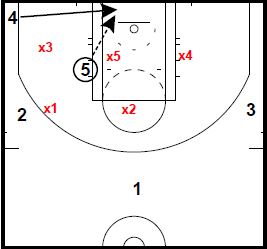
The 2 player will pass to the 5 player in the Mid Post.


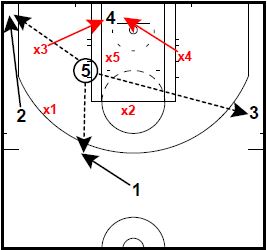
The 4 player will cut baseline for the backdoor pass from the 5 player.

X3 would have to cut all the way to the basket to stop the pass.

X3 is usually caught staring at the ball when passed to the 5 player.


X3 or X4 would have to help on the pass to the 4 player, leaving the 2 player open sliding to the corner or the 3 player open on the wing.


Coach Read has also put together The Basketball Encyclopedia of plays. You can check them out here: The Basketball Encyclopedia of Plays or read more about the books:

Any coach looking for the latest and innovative plays from the Professional, College, or High School levels can stop looking. With a compilation of over 7,700 different plays, you will never need to purchase another basketball playbook again. These playbooks can be used as a great reference tool for years to come. This 2 Volume Book includes plays from 19 different play categories, and they are the most extensive playbooks on the market.

The Basketball Encyclopedia of Plays (Platinum Series) contains over 7,700 Plays (Both Volumes combined) from the NBA, WNBA, USBL, and College levels from someone who has worked as an Advanced Scout or Coach on each level!!! This book has been intensely compiled over the last 21 years, with plays taken from a lot of NBA Coaches (past and present), WNBA coaches, and College coaches (Men’s and Women’s) from around the country.

Any coach that is serious about improving their knowledge of the game from an X and O standpoint will benefit tremendously from these books. These Books can be used to discover New Quick hitters, add a New Package to your playbook, or develop an entire Offensive System. There are a lot of new ideas and concepts in these books to study, and the Basketball Encyclopedia of Plays can be a great resource for coaches on all levels!!! This book is definitely for those X and O junkies who are always looking to improve as a Coach.

“THE GAME IS ALWAYS CHANGING? ARE YOU?” Vonn Read

Here is the link: The Basketball Encyclopedia of Plays

Basketball Drills Duke 3 on 3 Defense

By Brian Williams on August 9, 2013

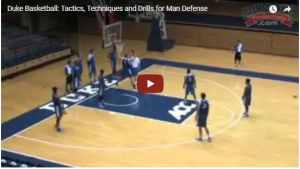
This basketball drill “3 on 3 contest and interchange” is used by Duke to work on contesting passes, and then on defensive rotations.

In the video, former Duke Associate Head Coach (Now Marquette Head Coach) Steve Wojciechowski is putting the players through the drill.

The video is a YouTube video. Make sure that you are on a server that does not block YouTube videos.

Click the play arrow to start the video.

I have a list of links below to other defensive drills that are posted on the site.

The rotations on drivers portion of the drill begins around 1:30 on the video.


The video is 3 minutes and 26 seconds. You will need to click the play arrow on the video to watch it.

Make sure your sound is on.

If you are interested in learning more about the entire DVD that this sample came from, click this link Duke Basketball: Tactics, Techniques, and Drills for Man Defense. Anyone who purchases anything from the store receives one of my basketball coaching eBooks as a bonus. Just email me and let me know which one you would like to receive!

If you would like to purchase a downloadable format of the entire DVD, you can do so by clicking here and selecting “Instant Download” as your format.

Make sure your sound is on as you watch.

If you are interested in learning more about the entire DVD that this sample came from, click this link Duke Basketball: Tactics, Techniques and Drills for Man Defense. Anyone who purchases anything from the store receives one of my basketball coaching eBooks as a bonus. Just email me and let me know which one you would like to receive!

Basketball Workouts: Crean Finishing Drills

By Brian Williams on August 8, 2013

These basketball drills were posted by FastModel’s plays and drills library. You can check it out here: Fast Model Plays and Drills Library

The drills were posted in the library by Kyle Gilreath. They are from notes he took during a clinic presentation that Coach Crean gave.

If you are interested in seeing all of the notes, I have a link at the bottom of this post for you to click to see all of them.

Also, I have a link to another basketball coaching resource from Tom Crean called “Game Situation Skills and Drills.”


Basketball Drills

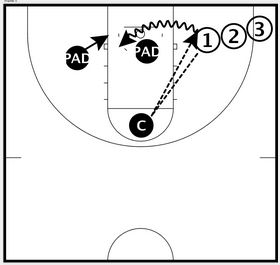
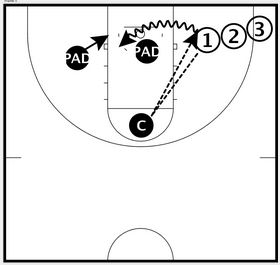
Player starts with the ball and he passes it to the coach who passes it back.

The player rips the ball baseline and drives underneath the rim (through the pad of the coach and underneath the rim) to finish on the other side of the rim as a coach whack down with an arm pad.


The player puts back any misses (next guy in line waits for him to score).

Basketball Drills

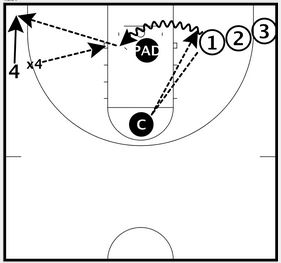
The player catching and driving now reads the Weakside Defense to see if X4 will help or not. If he does, then he throws a pass to 4 relocation to the corner.

On 4’s catch, the pass will make a half-circle underneath the rim to get to the weakside for the rebound. If X4 stays home on 4, than 1 finishes the lay-up.

Click this link to see information about another basketball coaching resource from Tom Crean called

“Game Situation Skills and Drills.”

Undervalued Keys to Great Defense

By Brian Williams on August 7, 2013

I received this article from Coach Steve Smiley.

These defensive concepts were written by Coach Kevin Eastman.

He was an assistant with Doc Rivers for the Boston Celtics and on the Clippers’ coaching staff.

His area is player development. He also speaks and writes on leadership.

Coach Eastman is a partner in the Coaching U program.

Here is a link to the website: Coaching U

He is a really good follow on Twitter: @KevinEastman

10 Undervalued Keys to Great Defense

By Kevin Eastman

Most of us agree that defense is critical to team success and championship play. Here are some things to think about as you go about your defensive work. You can apply these no matter what defense you play.

  1. FIRST 3 STEPS: The key to all great defenses is getting back in transition and setting your defense so the opponent has to play against your “set defense” all night. The first 3 steps must be an all-out sprint.
  1. LOAD TO THE BALL: It’s vitally important to make sure that the great perimeter players in today’s game don’t see any seams in your defense in transition. Guards today are so good that they will take advantage of any little gap they see while you’re getting back. Pull your defense over to take away these seams, but also be aware of your man.
  1. LOW MAN WINS: Simply put, the lower man between the offensive player and the defensive player usually wins that possession. The lower man has the advantage of the leverage game, the reaction game, and the relative quickness game. Get down and be in a stance, ready to move and adjust.
  1. GET YOUR ANTENNAE UP: Players must be alert to what’s going on around them. Alertness is a trait all the great defensive teams share. This demands readiness in your eyes, your feet, your hands, and your mind.
  1. SNIFFING THINGS OUT: Knowing what’s likely to happen next is an ingredient to all great defensive teams and players. To be able to “sniff things out,” you have to study the game and listen intently during scouting reports.
  1. PLUGGING HOLES: Offenses are very good as well, so they will create problems and find holes in the defense. The great defensive teams are always ready to plug that hole and players have a trust that someone will have their back.
  1. TALK INTIMIDATES: Teams that talk always seem to play with more energy and intensity. Talking lets the opponent know that you see everything they’re doing and that you know their stuff every bit as much as they do. Talking teams also always seem to be the more aggressive teams.
  1. FIRST TO THE FLOOR: There will be a number of possessions in a game that come down to “who wants it more.” Being first to the floor is very important, as is being first to the long rebound. We call this the 50-50 game; we want to win the 50-50 game every night.FINISH YOUR
  1. DEFENSE: How many times have we had a great possession and the opponent gets an offensive rebound? It’s a killer. Finish all slides, finish getting over screens, and finish every possession with a block out and rebound. We never want to start something that we won’t finish.
  1. *TRUST: I’ve saved this for last because it’s the most important component of all great defenseive teams. It’s so important for players to know they can be intelligently aggressive. Players who know they have someone behind them to cover their backs can defend with intelligent abandon (NOT careless adandon). Turst actually makes your defense quicker and more alert because there’s no hesitation; a hesitant athlete is a non-athlete.
  • « Go to Previous Page
  • Page 1
  • Interim pages omitted …
  • Page 220
  • Page 221
  • Page 222
  • Page 223
  • Page 224
  • Interim pages omitted …
  • Page 288
  • Go to Next Page »

Primary Sidebar

  • Twitter
  • Facebook
  • Linkedin
coachestoolbox
personaldevelopmenttoolbox
basketballplayerstoolbox
basketballtrainer
athleticperformancetoolbox
coachingbasketball

© Copyright 2026 Coaching Toolbox

Privacy Policy