• Skip to primary navigation
  • Skip to main content
  • Skip to primary sidebar

  • Basketball Plays
    • Ball Screen Sets
    • Horns Sets
    • Man to Man Post Up
    • Man to Man Isolations
    • Backdoor Plays
    • Man to Man 3 Point Shot Plays
    • 2-3 Zone Attack
    • Baseline Inbound Plays
    • Sideline Inbound Plays
    • Combination Defense Attack
  • Drills
    • Defensive Drills
    • Offensive Drills
    • Competitive Drills
    • Passing Drills
    • Rebounding Drills
    • Shooting and Scoring Drills
    • Toughness Drills
    • Transition & Conversion Drills
    • One on One Drills
  • Blueprint
  • Practice
  • Mental Toughness
  • Skill Development
  • Offense
  • Defense
  • Store

Basketball Coaching Evolution

Basketball Coaching Evolution

By Brian Williams on February 28, 2014

I received this from Creighton Burns. It was written by Mike Dunlap, Colorado Mesa Men’s Head Coach.

The richness of coaching rests within the seemingly insurmountable frustration of watching as a player finds his way. The teachable moments are those that are frequently fraught with poor decisions. Yet that is exactly when an individual needs his coach. Those moments are priceless and a turning point for the athlete. Wonder not why you do what you do and KNOW that you make a difference!!!

10 Steps to Improve Your Coaching

The evolution of a master teacher takes years of skill development. The outstanding coach is an exceptional teacher. We believe that there are fundamental steps that should be considered when teaching your team:

1) Know the five laws of learning
• Explain what you want
• Demonstrate for the learner
• Player demonstrates
• Correct demonstration
• Repetition is lord and master

2) Know how players learn
• Visual
• Auditory
• Kinetic
• Writing/Drawing
• Player as coach
• Cooperative versus competitive technique
• Whole, part, whole versus part whole method
• Feedback system – negative versus positive

3) Teaching techniques
• Universal teaching technique (i.e. find the problem and fix it)
• Praise, prompt, and leave (i.e. find positive, correction, and next step, leave)
• Relay teach – the cooperative method
• Create your own language (e.g. anachronisms)
• Use your voice as a tool
• Speak in word pictures, analogies, and metaphors
• Overload to get conditioned response (i.e. consistently give the student the advantage when they are demonstrating as early success breeds confidence)
• Progression – teach in sequence and then reverse it (i.e. inductive & deductive)

4) Use the four steps of shaping
• Set the stage
• Modeling
• Prompt
• Forms of feedback (i.e. ask questions, make observations, reinforce the correct response)

5) Talk less, do more
• We need to reduce out verbal instruction

6) Recognize the power of observation, listening, and gathering information
• Behavior patterns
• Myers/ Briggs psychological exam, self-aggression evaluation, and the “I am sheet”

7) Role declaration is paramount to a coaches’ success

8) Know your audience, circumstance, and be ready to adapt or change course

9) Competition means time, score, and personal records (e.g. individual/group)

10) Apologize
• We will make mistakes. We humanize ourselves when we go public and our players will accept us more readily.

We are teachers. We are trying to create an environment of learning. Hence, mistakes must be encouraged as a form of discovery. Certainly, we want to correct the problem and move on in a timely fashion. The more teaching skills we have at our disposal – the better. If we are comfortable with our style, the player will adjust quickly. Effective communication is the instructor’s greatest tool. Learning is a step-by-step process. We keep it simple, as we know that the player responds best to precise instruction.

We believe that the coach should work off a blueprint of conceptual teaching. This means teaching cognitive ideas through a specific process (i.e. drills that are directly linked to the whole). Our shooting drills come directly from our offense and they may change from one season to the next, yet the ingredients of competition and effort level are never compromised.

The what, where, how, when, and why are always foremost in our minds when explaining our philosophy. The “when” and “why” are the most important to us. We want thinking players who can react quickly under pressure. Hence, we create that environment in our practices with consequences for actions.

We teach winning basketball. We are not interested in just playing. The enjoyment for the player comes from learning, interaction with others, and measurable improvement. We teach that perfection comes from an all-out effort.

The standards for winning must be defined. The coach should have measurements both offensively and defensively that represent a system. When pressure is applied confusion will reign unless there is structure. Moreover, that is when communication breaks down. We cannot have this. We see the first signs of a successful culture when the players start saying and teaching “Our Way” when times are tough. We like that.

In conclusion, we can only do one thing at a time. Simplicity is our guide. We constantly evaluate our system under the most severe circumstances. Teaching techniques define our system.
Basketball Drills 5 Ganon Baker Drills

By Brian Williams on February 27, 2014

The two YouTube videos on this page have 5 basketball skill development drills from Ganon Baker.

My hope for this post is that you will find a drill or two that you can use in the upcoming spring improvement season to offer some variety to what you are already doing.

I think it is very important to give your players a variety of drills that improve the skill they are working on to maintain their interest and their motivation to work at getting better.

The first video has a very unique two-ball shooting drill that he saw 2 NBA players use.

The second drill in that video is a dribbling drill that includes making a finishing move at the basket.

The videos are YouTube. Make sure that your sound is on and that you click the play arrow to see the drill.

Basketball Drills Video #1

Basketball Drills Video #2

The second video shows a 1) series of cone drills that you could modify to fit your players and your schemes, 2) A drill to work on coming off an onball screen and 3) A way to combine 2 ball dribble and game pace shots.

Basketball Drills Fatigue Shooting Drills

By Brian Williams on February 25, 2014

These basketball shooting drills are credited to Kyle Gilreath.

He is NBA Client Services Manager for FastModel Sports.

He is currently the assistant coach at Fort Meyers High School after serving as an undergraduate manager as well as graduate assistant for the Florida Men’s program.

These drills, along with several other plays and drills from various skill, are located at FastModel’s plays and drills library.

It contains over 2000 drills and plays in the library. Here is the link. FastModel Drills and Plays Library

Kyle also has a very good blog you should check out. Here is the link to it: Words on the Bounce

200 Point Shooting

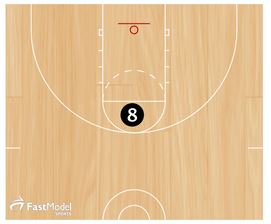
basketball-drills-fatigue-shooting

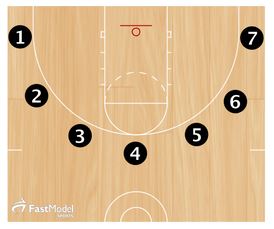
1) Use each of the 7 shooting areas.

2) Each player takes 3 shots from each area
– 3pt shot (behind arc),
– 2pt shot (10-15 feet),
– and a drive for a layup (1pt).

Total of 6 possible pts at each spot.

basketball-drills-fatigue-shooting2

3) Shoot at all 7 spots (42 possible points), then each player shoots 8 free throws, leaving 50 possible points for that quarter (each round is 1 quarter).

4) Keep score for 4 quarters (200 possible points) and determine a winner.

* Can also play 2 halves for 100 points

10 in 1 Shooting Drill

basketball-drills-10-in-1-shooting-drill

1 Minute on the Clock

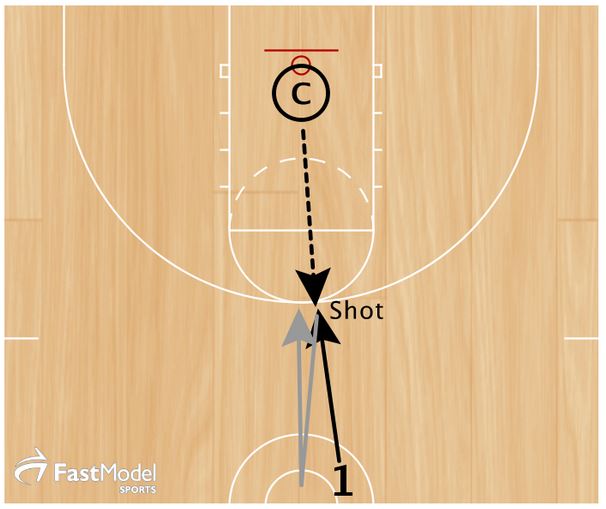
Player starts at half-court with a coach or teammate under the rim with a ball (passer). When the clock starts the player runs in and shoots a 3-pointer. Make or miss the player sprints back and touches half-court and sprints back in for another 3-pointer. This is repeated for 1 minute.

Goal:
Good Players: 10
Great Players: 11
Elite Players: 12+

Basketball Plays Virginia 54 Stack Ice

By Brian Williams on February 24, 2014

Coach Vonn Read has submitted several plays from his playbook series The Basketball Encyclopedia of Plays to the Coaching Toolbox.

Vonn has been the Associate Head Coach for the Women’s program at Syracuse since 2011 as was instrumental in their final four run in the spring of 2016.

Coach Read has also served as an assistant coach in the WNBA with the Phoenix Mercury, Orlando Miracle, and San Antonio Silver Stars. He was an advanced scout for the Orlando Magic as well as The Charlotte Sting.

This play is intended to be saved as a side out play for the end of the game when you need a quick basket.

This is a great End of the game isolation play for a good penetrator.

The numbers are meant to identify the players.

They are not meant to say that you have to have a traditional #4 to run this play, or that the player has to drive to their right hand. You can adjust the play to the opposite side of the floor, if you would want the player to drive left.

It is meant to stimulate your thinking to come up with ways to put your players in positions where they can use their individual strengths for the good of the team.

basktball-plays-virginia-54-stack-ice1

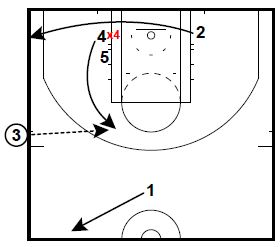
The 1 player will pop high to get the ball, which is a decoy action.

The 2 player will cut hard to the corner off the double screen by the 4 and 5 players.

The 4 player will pop high to the elbow area for the ball.


basktball-plays-virginia-54-stack-ice2


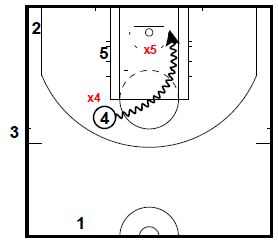
The 4 player can catch the ball and drive hard to the basket for the layup.

The 5 player is in good rebound position if their defender helps on the drive.


Coach Read has also put together The Basketball Encyclopedia of plays. You can check them out here: The Basketball Encyclopedia of Plays or read more about the books:

Any coach looking for the latest and innovative plays from the Professional, College, or High School levels can stop looking. With a compilation of over 7,700 different plays, you will never need to purchase another basketball playbook again. These playbooks can be used as a great reference tool for years to come. This 2 Volume Book includes plays from 19 different play categories, and they are the most extensive playbooks on the market.

The Basketball Encyclopedia of Plays (Platinum Series) contains over 7,700 Plays (Both Volumes combined) from the NBA, WNBA, USBL, and College levels from someone who has worked as an Advanced Scout or Coach on each level!!! This book has been intensely compiled over the last 21 years, with plays taken from a lot of NBA Coaches (past and present), WNBA coaches, and College coaches (Men’s and Women’s) from around the country.

Any coach that is serious about improving their knowledge of the game from an X and O standpoint will benefit tremendously from these books. These Books can be used to discover New Quick hitters, add a New Package to your playbook, or develop an entire Offensive System. There are a lot of new ideas and concepts in these books to study, and the Basketball Encyclopedia of Plays can be a great resource for coaches on all levels!!! This book is definitely for those X and O junkies who are always looking to improve as a Coach.

“THE GAME IS ALWAYS CHANGING? ARE YOU?” Vonn Read

Here is the link: The Basketball Encyclopedia of Plays

Basketball Plays 1-4 High Sets

By Brian Williams on February 20, 2014

Maine Assistant Men’s Basketball Coach Zak Boisvert has put together some short clips of the St. Louis 1-4 high playbook from a few years back.

Many of these sets started with Coach Rick Majerus.

Zak has posted several videos of some of the better schemes he has seen.

His You Tube channel is: Zac Boisvert You Tube Channel

If you are interested in subscribing.

He also is also very active on Twitter:
@ZacBoisvert

The plays are to stimulate your thinking about improving your offense.

They don’ score on every play, there are some calls that you won’t agree with.

Neither of those factors are relevant for this.

If the movements give you ideas that can work for you to put your players in positions to score and or get fouled, that is my objective.

I hope you can find a few that you can save for next season.

Keys to Player Development

By Brian Williams on February 19, 2014

By Fred Castro, Associate Head Women’s Coach at Mississippi State.

One of the things that we really emphasize at the University of Washington and that I pride myself on is player development. At any level of basketball the ability to improve an individual’s skill set should always be a priority. The truth is the elite programs whether its men, women, high school, college, or pros are consistently improving their player’s skill set from year to year. Elite programs do not just recruit great players and leave them as is.

The first thing as a coach that is imperative to player development is being available. I know that sounds obvious but you would be amazed how often other things can get pushed ahead of getting in the gym with a player. Player development is done Monday through Sunday 365 days a year. The willingness to be available when a player wants to work out and not just when it’s convenient for you is the first step.

Not only is it important that you be available to help a player but it helps build the relationship between player and coach. The fact that you make yourself available for a player shows them that you are truly invested in them. This pays huge dividends down the line as you demand players to push themselves and do things they have never done. Obviously you have to prioritize all your duties as a coach and every program is different.

My first week at UW, Coach Neighbors instructed the staff anytime a player requests to workout drop what you are doing and get in the gym even if you are working on something for him. How important is player development to you…?

Identifying the strengths and weaknesses of players, and developing good fundamentals is the next step. I know there are two different schools of thought on this subject. One, focus on the weaknesses and really bring those up to par, a player’s strengths will always be there. Two, don’t worry about the weaknesses, focus on the player’s strengths and make them elite. I believe you work on all of it!

Your strengths are why you are on the team and in the game. Unfortunately I have seen too many players exposed by good coaches and scouts because a player’s weakness was so evident. Either way all players need to learn good fundamentals. I don’t care how highly they are rated or how many points they score. Ask your players to throw a left-handed post feed and let me know if your post player ever receives that pass, good luck!

They need to know how to forward pivot, reverse pivot, throw a good skip pass, and DRIBBLE WITH THEIR HEAD UP!! I know none of that sounds very exciting but what wins games is the ability to do the” mundane” at a high level. Once you have ingrained the fundamentals (it never really stops) you can really begin to advance your workouts.

The next debate is quantity vs quality. My stance on this is it all depends on where you are in your development. If you are a young player in middle school or high school quantity, quantity, quantity is the key. Young players can never do too much ball handling or get enough shots up. Repetition at this age is what is most important even at the cost of technique. They say it takes ten thousand hours to master a skill so you might as well put in the time while you are young.

Once you have progressed past a certain point I am a big believer in quality. I would much rather be in the gym for 30 minutes and work with a high level or urgency versus be in the gym for 1 hour at a lower intensity and possibly get more shots. To me being in the gym is preparing for games; games are fast, intense, and demanding. So individuals should be the same.

If you are taking water breaks all the time you are no longer maximizing your time in the gym and no longer training the mind of a basketball player. That being said there are times when you need to go half speed in order to teach proper foot work, mechanics, etc. but that does not mean you are no longer intense or with a lower state of focus.

This brings me to practice planning, if you want your players to be focused and you want to be able to push their limits you must have a detailed plan for your individual. You should be going from drill to drill with any accessories you may need such as cones, pads, etc. and never skip a beat. You never want a player to think you are making stuff up or just winging it because then it’s no longer an individual.

Individuals are great opportunities to not just develop a skill set but to build self-confidence and mental toughness. Give players drills that you know they will struggle with and allow them to fail initially. Creating opportunities for players to compete with themselves is great especially when season is months away. When they reach a goal that they first felt was unreachable it can be a very powerful thing psychologically. Make sure you plan it out well and that any challenges you do provide are reachable but not without a great deal of work.

One of the things you must do as a coach is always be looking for new ways to teach the same things. Find new ways to do a ball handling drill, passing drills, or shooting drills. The learning plateau is very real when it comes to skill development, especially when dealing with over achievers or kids with high skill sets. Do not let your individuals become boring, your players should always look forward to learning new drills or receiving a new challenge from a coach. Do not hesitate to make up drills; some of the best drills I use have been made up minutes after finishing an individual. That’s when my mind seems to want to create, the rest of the time it stays dormant.

Finally, watch film with players especially the really good ones. In my experience the really good ones need it because they don’t ever think it was their fault or that they have a deficiency until they see it on film. During the off season I like to show film of other players like Steph Curry, Chris Paul, and Tony Parker for point guards. Tim Duncan, Kevin Love, LaMarcus Aldridge, and Roy Hibbert for post players. Showing them a move or technique before going in the gym can really help some players.

It’s difficult for some players to visualize certain moves, especially in the post so this helps the learning process. During the season, I really focus on film of the actual player. Some of the best film and teaching can be done breaking down film of the 30 practices before games start. There is so much to learn from a player’s perspective that you can almost never watch enough. I am also a former video coordinator so please keep that in mind, I am a big believer in film and learning from it.

Film is a great tool to reinforce certain things without ever saying a word. If you want your player to sprint back in transition just show them film of them jogging back with their man over and over and over again. No need for commentary just let them watch, when the film is over let them assess what they saw. The other side of that is even more powerful, show a player diving for loose balls and reinforce that and I promise that habit will continue. Once season is over make highlight videos of your players showing them all the great things they did. Who doesn’t like to see themselves doing great things on the court! If serves two purposes, one player’s genuinely appreciate the fact you took the time to make this for them.

I promise they will go home and watch a million times and if they are guys they will show it to anyone that ever enters their room or apartment! Secondly, it’s a carrot to keep working during the off season and improve for the following year which is really what it’s all about. Get better every day so you can do things you have never done.

As an assistant at the University of Tulsa Britney Brown and I created this video http://www.youtube.com/watch?v=3ZpVIeybJDg&feature=youtu.be for our guards to use during the summer while they were at home in order to keep their skills sharp. There are numerous drills in this video for every stage of player development.

  • « Go to Previous Page
  • Page 1
  • Interim pages omitted …
  • Page 199
  • Page 200
  • Page 201
  • Page 202
  • Page 203
  • Interim pages omitted …
  • Page 288
  • Go to Next Page »

Primary Sidebar

  • Twitter
  • Facebook
  • Linkedin
coachestoolbox
personaldevelopmenttoolbox
basketballplayerstoolbox
basketballtrainer
athleticperformancetoolbox
coachingbasketball

© Copyright 2026 Coaching Toolbox

Privacy Policy