• Skip to primary navigation
  • Skip to main content
  • Skip to primary sidebar

  • Basketball Plays
    • Ball Screen Sets
    • Horns Sets
    • Man to Man Post Up
    • Man to Man Isolations
    • Backdoor Plays
    • Man to Man 3 Point Shot Plays
    • 2-3 Zone Attack
    • Baseline Inbound Plays
    • Sideline Inbound Plays
    • Combination Defense Attack
  • Drills
    • Defensive Drills
    • Offensive Drills
    • Competitive Drills
    • Passing Drills
    • Rebounding Drills
    • Shooting and Scoring Drills
    • Toughness Drills
    • Transition & Conversion Drills
    • One on One Drills
  • Blueprint
  • Practice
  • Mental Toughness
  • Skill Development
  • Offense
  • Defense
  • Store

NBA Shooting Drills: Streak Shooting

NBA Shooting Drills: Streak Shooting

By Brian Williams on April 9, 2021

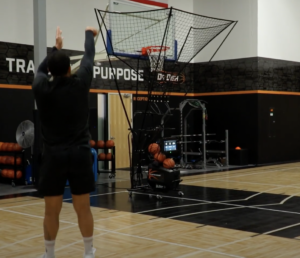
This skill development drill is provided by Dr. Dish Basketball.

The drill is coached by NBA Shooting Coach John Townsend.

You can and should modify any of the drills to make them fit your needs or to add variety to your skill development work.

Please make sure your sound is on to see the video.

This drill is on YouTube, so you will need to be on a server that allows you to access YouTube to see the drill.

Click the play arrow so see the drill.

Leadership Lessons from John Wooden

By Brian Williams on April 9, 2021

Leadership Lessons from John Wooden
Dr. Cory Dobbs, The Academy for Sport Leadership

It’s Been Decades Since “Coach” was on the Sidelines but His Commitment to Character is as Relevant as it Ever Was

March is known for its madness. A time when team greatness is revealed. March is also a time when the best baseball players in the world go back to work— fine-tuning the fundamentals of their game. College basketball’s greatest coach was a tour de force for principled leadership and success. Great teams and fundamentals are of vital importance no matter what your endeavor, no matter what time of year.

Do you need proof that leadership is not about style? The legendary UCLA basketball coach John Wooden suggests that leadership is influence derived from one’s character. For Wooden, the ideal leader is someone whose life and character motivate people to follow. The best kind of leadership derives its capacity from the force of example, not from the power of position or personality.

Much of what passes as leadership today is nothing more than manipulation of people by sticks and carrots—threats and rewards. That’s not effective leadership for the long-term. Authentic leadership seeks to motivate people from the inside, by an appeal to the head and the heart, not by use of command and coercion. Compliance seldom, if ever, leads to authentic commitment.

Wooden influenced players through his character which he displayed in everything he did, from the way he recruited student-athletes to the way he taught them to put their socks on.

For Wooden character is the essential element necessary for great leadership.

Steve Jamison, author of best-selling books on John Wooden and Bill Walsh, has spent the past fifteen years working with Wooden on various books on leadership. He teaches Wooden’s principles to business leaders at UCLA’s Anderson School of Management.

“The reason he resonates with people, relate to him is as a teacher, leader, coach, he was extraordinary and as a person he was even more extraordinary. That’s a tough combination,” Jamison said.

Jamison began working with Wooden to organize and distill his wisdom for coaches and leaders in any industry. At the time he couldn’t find a publisher because most thought Wooden was no longer relevant. As one publisher told him “Coach Wooden is a little dusty on the shelf.”

Character, however, is never a quality to be shelved. Coach Wooden, as Jamison said, “Didn’t seek players who were characters. He wanted players that had character. Character was something that he felt essential to being a good performer, a good leader. Much of the problems we see today we can lay at the foot of leaders that have little character.”

When You’re Through Learning, You’re Through
Coach Wooden practiced life-long learning—as you would expect from a great teacher. Jamison, a leadership expert and educator said, “A lot of leaders get to a position with a lot of authority and power, it’s very easy to become overconfident and arrogant and think you know it all. John Wooden never made that mistake. He was very secure in what he knew but he never stopped learning. Never stopped looking for answers.”
[thrive_leads id=’36827′]
“How willing are you to learn?” Jamison asks. “That doesn’t mean just opening a book or taking a course but how willing are you to challenge your beliefs and the way you do things, examining ways to improve. How willing are you to entertain new ideas? Whatever your level of success, self evaluation is important.”

Jamison said Coach Wooden simply asks leaders “How can you improve if you don’t have the ability to analyze yourself?” Jamison backed up this declaration from Coach Wooden by offering a story that exemplifies his commitment to self-evaluation.

“In Wooden on Leadership, Jamison explained, “ he tells the story of getting to the 1962 semi-finals of the NCAA national championships where UCLA played Cincinnati, the defending nation champs. They lost in the last seconds. On the flight back his assistant coach Jerry Norman says to him ‘coach you know we got some guys coming in next year (Goodrich/Erickson). You know, maybe we should look at bringing in the full court press.’ John Wooden knew what it was, he’d tried it his first two years at UCLA.”

“Maybe it’s time to revisit the press, said Norman.” Wooden, secure in his self, listened to his assistant. The next year UCLA pressed full-court. And the rest, as they say is history.

Wooden on Teaching: The Little Things Make the Big Things Happen
“One of the great abilities John Wooden has and had was his ability to take a complicated issue, distill it, so that, as he said, that ‘little things make big things happen,” said Jamison.
“In my view, what it was that he did to teach leadership, and it’s not complicated, he behaved like a leader. He acted like a leader. The primary teaching tool he used was his own life as an example,” Jamison commented.

Coach Wooden was a proponent of the principle that people don’t care how much you know until they know how much you care. According to Jamison, “John Wooden had an effusive way of letting players know he cared. His practices were ferociously intense. There wasn’t any slack in practice where you could hang out and shoot the baloney. He found time at the beginning when players were coming onto the court to take a moment, to pull someone aside as they were ambling over to the practice and ask about how things were going. ‘How’s your mother.’ ‘How’s that history class going.’ He did this to show his sincere care and concern for his players.”

Pyramid of Success
Coach Wooden’s primary teaching tool has been his leadership model as distilled in his Pyramid of Success. Jamison commenting on this influential model for effective living said, “His definition of success isn’t about big, it isn’t about power, fame, fortune, and prestige. For him the highest level, the highest standard of success is making that effort to become the best that you can become whether it is a coach, teacher, student, member of a team.”

Success, as Coach Wooden says, is the peace of mind which is a direct result of self-satisfaction in knowing you made the effort to become the best of which you are capable.

Basketball Drills: Improvement Season Finishing

By Brian Williams on April 7, 2021

Here are 3 finishing drills to consider for your skill workouts.

There are links to other skill development drills at the bottom of the post.

I think it is good to have a variety of drills to use that still fit your system of play, fit the skills you need the players to develop, and that fit your philosophy.

Diagrams created with FastDraw


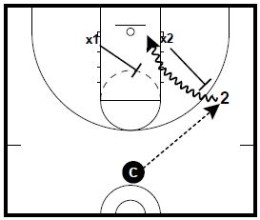
Baylor 1 vs. 2

basketball-drills-baylor

Coach initiates the action by passing the ball to offense with two defenders starting on the blocks.

The defenders move as soon as the ball leaves the coaches hands.

During closeout, offense needs to beat his defender and then get past the help.

Emphasize the attack by limiting dribbles, focusing on first step, step through, and working on a specific finishing move.

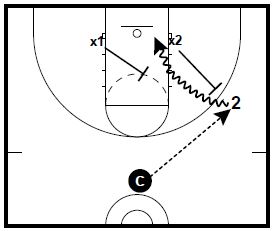
Alabama 1 on 1

basketball-drills-kansas1

From the Kansas women’s program.

Coach has the basketball under the basket. Offense begins on one block, defense begins on the opposite block.

Coach tosses the basketball out,

Offense goes out to get the basketball.

Defensive player touches the opposite block and then closes out on the offense.

Play live 1-on-1 from there.

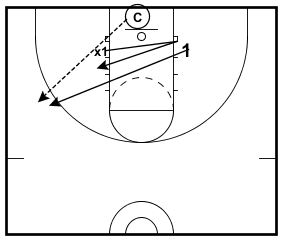
1 on 1 Lane Containment

basketball-drills-kansas2

Also from the Kansas women’s program.

OBJECTIVE: Improve ball-handling in a tight space & improve defensive footwork.

Boundaries are the lane lines. Offense starts with the ball between the free throw line and top of key. Defense begins an arm’s distance away from offense.

Offense’s goal is to beat the defense to the baseline in 6 seconds without going outside the lane lines or turning her back to the defense while dribbling. Defensive goal is to force offense outside the lane lines or don’t get beat to the baseline in 6 seconds. You can progress drill to have offense finish with a one-footed lay-up.

BORING is good when you want to be good

By Brian Williams on April 2, 2021

BORING is good when you want to be good

Written and contributed by Dr. Chris Hobbs ( Follow him on Twitter @Dr_ChrisHobbs)


My youngest daughter is a 14 year old aspiring athlete. Early on in her sport endeavors she’s demonstrated strength, grit, commitment, and some explosive athletic ability. I don’t know how accomplished she’ll become but she puts her all into her athletic participation. She loves it. Practices, games, tournaments, and training sessions are why she gets out of bed each day. Much of me agrees with her; like father, like daughter! She recently came home from an after-school strength training session with the qualified strength coaches we have at our school. I asked her how her session was. ‘Dad, it was boring. We do the same exercises every time.’

This made me smile. We have highly qualified and passionate strength coaches and an elite weight room so the workouts were not my concern. What my daughter was experiencing was the paradox that boring is good when you want to be good. We live in a day and age when we have almost no tolerance for boredom. If something becomes boring, we move on quickly. We can skip commercials, check a different social media network, communicate with whomever we want whenever we want, or scroll our phones while standing in lines.

We have almost completely purged boredom from our lives and that has consequences. One of those consequences is we have forgotten how many boring repetitions it requires to become proficient in a task or skill. Skill development in athletics is a great example, but it has many other applications like earning a degree, losing weight, or saving money for a big purchase. Getting good is boring!
[adinserter name=”Basketball In Article Ad 1 Rebecca”]
As I worked through my doctorate, I would estimate that 75% of the things I was involved in were boring, but it would not have developed the understanding of content or process necessary to do what was required to finish the doctorate (write a dissertation) if I had not navigated a lot of boring. Boring is not bad if you want to be good at something.

There are a couple of ways to navigate boring while pursuing something good.

1. Check off the completion of tasks as you are working through boring phases. Jerry Seinfeld used to keep a calendar above his desk and cross off each day that he spent 30 minutes working on new jokes. His goal was to create as many unbroken rows of x’s on his calendar as he could. I’m sure writing jokes day in and day out go boring, but we don’t have the humor of Jerry Seinfeld without his tolerance for boring.

2. Develop practical reminders of where you are heading. Post it notes on mirrors, home screens on phones, and daily journals are all great ways to remind yourself of why you started on a boring path to something good.

3. Do boring with other people that are headed your same direction. I spent 3 years working towards a particular goal in strength training during my 30’s. There was a lot of boring days, hard lifts, and failed programs. I kept going many times because I was having a blast being miserable with the two guys I was training with. We did boring together and it was quite so boring.

Mother Theresa is quoted as saying, ‘be faithful in the little things because it is them that your strength lies.’ Boring is hard to tolerate when it comes to commercials and lines but that doesn’t mean that boring is bad. Boring is good when you want to be good. Ironically, when you remember that boring is required to be good, boring becomes exciting!

Keep on, keepin’ on, friends!

‘Bite Down and Don’t Let Go’ is a collection of writings on being intentional about life in a way that produces great persistence. Read about it more here.

Dr. Chris Hobbs is an educational leader and Director of Athletics at The King’s Academy in West Palm Beach, Florida. He’s earned a few degrees and won some awards. He’s happily married to his high school sweetheart and they have three teenage children. Life is messy and complicated most of the time. You can follow him on Twitter for all sorts of inspirational thoughts and good laughs.

32 Golden Child Shooting Drill

By Brian Williams on April 2, 2021

This post is a drill from the Arkansas Women’s Basketball program.

This video and other basketball coaching videos are available on the Arkansas Women’s Basketball You Tube Channel

Head Coach Mike Neighbors also has one of the top newsletters for Basketball Coaches and is back sending again. If you are interested in joining his list, email me and I will forward your request on to him.

Like all drills that you see other programs use, you can either modify it or take parts of these ideas for your use and your needs. I hope to provide food for thought for you to use as a place to start for ideas to improve your program.

The drill is a part of his “Green Light Shooting System” that he uses to determine shot selection.

Please make sure your sound is on to see the video.

Click the play arrow to see the drill.

The drill is a YouTube video, so you will need to be on a server that allows you to access YouTube to see the drill.

Dribble Hand-Off Keep Go Next

By Brian Williams on April 2, 2021

These short video clips were put together by Army Men’s Assistant Coach Zak Boisvert showing some actions to consider using in your dribble handoff game.

These short video clips were put together by Army Men’s Assistant Coach Zak Boisvert showing some actions to consider using when running corner step-ups.

Zak has an outstanding site with posts on various coaching topics at www.pickandpop.net

His YouTube channel has several videos with various types of man-to-man plays, zone sets, and inbounds plays as well as clips on various defensive coverages.

You can subscribe to receive an update when he posts a new video Zak Boisvert You Tube Channel

You can follow him on Twitter at this link: @ZakBoisvert

Click play to see the video

This is a YouTube video, so you will need to be on a server that allows you YouTube access.

  • « Go to Previous Page
  • Page 1
  • Interim pages omitted …
  • Page 17
  • Page 18
  • Page 19
  • Page 20
  • Page 21
  • Interim pages omitted …
  • Page 288
  • Go to Next Page »

Primary Sidebar

  • Twitter
  • Facebook
  • Linkedin
coachestoolbox
personaldevelopmenttoolbox
basketballplayerstoolbox
basketballtrainer
athleticperformancetoolbox
coachingbasketball

© Copyright 2026 Coaching Toolbox

Privacy Policy