• Skip to primary navigation
  • Skip to main content
  • Skip to primary sidebar

  • Basketball Plays
    • Ball Screen Sets
    • Horns Sets
    • Man to Man Post Up
    • Man to Man Isolations
    • Backdoor Plays
    • Man to Man 3 Point Shot Plays
    • 2-3 Zone Attack
    • Baseline Inbound Plays
    • Sideline Inbound Plays
    • Combination Defense Attack
  • Drills
    • Defensive Drills
    • Offensive Drills
    • Competitive Drills
    • Passing Drills
    • Rebounding Drills
    • Shooting and Scoring Drills
    • Toughness Drills
    • Transition & Conversion Drills
    • One on One Drills
  • Blueprint
  • Practice
  • Mental Toughness
  • Skill Development
  • Offense
  • Defense
  • Store

Competitive Basketball Workout

Competitive Basketball Workout

By Brian Williams on March 19, 2014

Editor’s Note from Brian: This is designed to be used for individual skill workouts in the spring, summer, and fall, but I believe that you can adapt it to in season team practices to motivate your players to work harder on individual skill development during that portion of your practice.

I like to use this format for my Improvement Season skill development workouts for our basketball players. Players should consider the Spring, Summer, and Fall as their “improvement season” unless they are involved in other sports. I first saw Kevin Eastman use the term “improvement season” and really like that concept. I also believe that “Champions have no off-season,” and the term improvement season fits with that philosophy.

Our players have enjoyed this workout because of its competitive nature. I have learned that the majority of players would rather do a shorter workout that features intense basketball drills. The goal for the competitive basketball workout is a 45 minute workout at a highly intense pace and with correct technique.

Move from one game (drill) to the next. The only time you stop is to record your scores.

Rather than just doing basketball drills, each day’s competitive workout is a “20 game season.” The purpose is to make it as competitive as possible both during the workout and over the entire course of the improvement season.
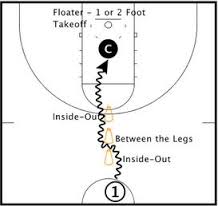
basketball-workout

I set a standard for each drill for 5 different levels of players. This is for a high school program, but you can obviously modify it for any level you coach. You could just use the level numbers or colors if there aren’t any names that fit for your level.

Level 1–Championship Level
Level 2–Varsity Rotation Player
Level 3–Varsity Team Member
Level 4–Junior Varsity
Level 5–Middle School

With 5 levels, we can have young and veteran players all doing the workout, with higher expectations for each of the basketball drills for better players. The young players can work at their own level and not be discouraged. You can also scale the intensity of the basketball drills you use in your workout to fit the age of the player you are working with.

The player and I work together to establish the level they will work at. They can move up to a higher level if they want to challenge themselves. I have also created college levels for graduates who are going to continue to play after leaving our program.

Here is an example of one of the drills that is on our list that can be used as a “game pace drill”. The player spins the ball out to simulate catching a pass and shooting a 15 foot shot. They rebound their own shot and spin the ball to another area for another 15 foot shot.

They have two minutes to complete the drill to ensure that they are working at a game pace.

Level 1–Championship Level Player must make 15 shots without missing 2 in a row at any point. If he misses 2 in a row the drill is over and the “game” goes down as a loss on today’s schedule of 20 drills. We call them 20 games.
Level 2–Varsity Rotation Player 12 makes without missing 2 in a row.
Level 3–Varsity Team Member 10
Level 4–Junior Varsity 8
Level 5–Middle School 6

You will need to create a similar scoring system for all of the drills that you will use in your competitive workout.

The player gets 1 chance at each drill. If he achieves the score for his level, he gets a win for that “game”. If he doesn’t achieve the score, he gets a loss. We do 20 drills each workout to complete a 20 game season. Then, after the 20th drill, the players get a chance at the postseason. In Indiana high school, you have to win 7 postseason games to win the state championship. All players compete at the Championship level in this phase of their workout. If you lose, just like the postseason tournament, your workout for the day is over.

The players can choose their own drills in the 7 postseason games. The way we incorporate free throws in this portion is by requiring players to “validate their win.” After they meet the standard to win a postseason game, they shoot one free throw. They make it, the win counts, they miss and the drill becomes a loss and the workout is over.

I have a list of drills for each category

1) Technique Shooting Drills
2) Dribbling and Driving Drills
3) Game Pace Shooting Drills (You can add any of your program’s intense basketball drills to this phase of the workout)
4) Toughness Shooting Drills

I also have created the scores for each drill that goes along with the five levels. You will want to create your own scores that are needed to win each level for each drill like the example I gave above.

I allow the players to choose the drill that they want to do for each game as long as it is from the category he is on.

1. Rim Flips (Form shooting at the basket to groove the shot)
I score this one by keeping track of consecutive makes or stepping back after a certain number of makes.
2. Consecutive Free Throws
(Championship and Varsity Regular make 3 in a row to win–one chance)
(Other 3 levels must make 2 in a row to win–one chance)
3. Technique Shooting Game
4. Free Throws (all Free Throw Games are the same as #2 above)
5. Dribbling and Driving Game
6. Free Throws (all Free Throw Games are the same as #2 above)
7. Different Dribbling and Driving Game
8. Free Throws (all Free Throw Games are the same as #2 above)
9. Game Pace Shooting Game
10. Free Throws (all Free Throw Games are the same as #2 above)
11. Different Game Pace Shooting Game
12. Free Throws (all Free Throw Games are the same as #2 above)
13. Third game pace shooting drill (may repeat one of the two previous game pace games only if you lost that game–cannot repeat one that you won)
14. Free Throws (all Free Throw Games are the same as #2 above)
15. Fourth game pace shooting drill (may repeat one of the three previous game pace games only if you lost that game–cannot repeat one that you won)
16. Free Throws (all Free Throw Games are the same as #2 above)
17. Toughness Shooting Game
18. Free Throws (all Free Throw Games are the same as #2 above)
19. Different Toughness Shooting Game (At this point in the workout, you want to give your players your most intense basketball drills that they can handle without becoming discouraged.
20. Free Throws (all Free Throw Games are the same as #2 above)

Postseason–player chooses the drill. Cannot choose a drill that they already won, but can choose one they lost. All players must compete at the championship level. One loss and the workout is over–just like the one and done postseason state tournament. If the player does win a drill, he must validate the win with a made free throw. If he misses the free throw, the drill is a loss and the workout is over.

Win 7 drills with 7 validations and you are a state champ for that day.

The workout is designed to work on these 6 ways to score (plus fatigued pressure free throws)

1) catch and shoot
2) catch, shot fake, one dribble pull up shot,
3) catch and shot fake, one dribble, a second dribble move to beat an imaginary help defender and shoot a runner in the lane
4) catch and shot fake, one dribble, a second dribble move to beat an imaginary help defender and finish with a finishing move at the basket
5) catch and shot fake, two dribbles and shoot a step back shot
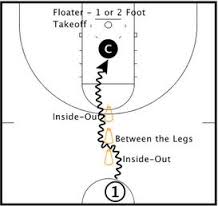
6) catch and shot fake, two dribbles, step back to shoot a hop back shot, keep the dribble alive, make a dribble move to beat the imaginary defender coming at you and finish with a floater.

The workout can be modified for post players.

Here are some ideas for drills for each of the categories, but you should use the drills that you use in your program that your players are familiar with. Here is a link to the archives if you would like to look for a drill that was on a previous post: Coaching Toolbox Archives

Technique Shooting Drills

Rim Flips emphasis on proper shooting technique

Shooting a basketball with one hand helps to work on shooting the ball straight and concentrating on the backspin rotation of the ball. This drill is to work on technique, foot position, and body alignment and not to simulate anything close to game speed. Rim flips are solely for refining and maintaining technique and form. SLOW. SLOW. SLOW!! Stand an arms length directly in front of the rim. Set the ball for the normal shot and then take the balance hand away. The entire focus of the drill is on correct shooting fundamentals. The initial stage of the drill does not involve jumping. Think of it as a short free throw. After making 10 in a row without hitting the rim, the shooter moves back two steps. After moving back two steps, place the guide hand on the ball, but use the exact same technique as before with the shooting hand. Once you can make 10 in a row, move back another two steps and work to make another 10 in a row. Eventually, you will jump toward the basket and land six inches closer just like you were taking a shot in a game. Work on the landing in all three phases of the rim flips drill. For more information on foot positioning and landing, go to our correct shooting fundamentals page.

5 shots 5 spots Two different spots 5-10 feet, Two different spots 10-15 feet, One spot 15-20. If there is a rebounder, the shooter shoots and then jogs to the next spot. If there is no rebounder, the shooter can jog to get his/her rebound and proceed to the next spot. You receive one point for each shot made. All shots are taken inside the three point arc. The objective of the drill is to work on technique without pressure.

45 Spot up Shots Inside the Arc. This game works best if you have a rebounder. The purpose of the game is to get in a rhythm of catching and shooting with perfect shooting form. The shooter stays inside the 3 point arc and moves around the inside of the arc until s/he has taken 45 shots.

Two to One Shooting Game Pick a spot on the floor. The shooter is playing against an imaginary opponent. The shooter gets 1 point for every make and the opponent receives 2 points for each miss. If the shooter reaches 10 first, it is one win in the twenty game workout. If the imaginary opponent reaches 10 points first, it is a loss. This is not at game pace. The purpose of the technique shooting game in the competitive workout is to shoot rhythm shots.

The 50 point game involves 29 shots. The shots should be taken in the order that the spots are diagramed at the left. For variety, the numbers can be mirrored on the floor so that the right side is where the first shots are taken from. If there is a rebounder, the shooter shoots and then jogs to the next spot. If there is no rebounder, the shooter can jog to get his/her rebound and proceed to the next spot.

Dribbling and Driving Games

One minute half court dribbling one basketball involves using both hands, seeing the whole floor, spacing the whole floor, using a variety of dribble moves, and moving at game speed while doing all of those things.

One minute half court dribbling two basketballs has the same purpose and execution as with one basketball, but has the added pressure of dribbling two basketballs.

100 reps of push/pull crossover for time.

50 reps of 2 ball crossovers for time.

10 straight line drives for time.

Links to Game Pace Shooting Drills on The Coaching Toolbox

200 Point Game and 10 in 1 Shooting

4 Quarter Shooting, Sweep Shooting, 2 Ball Shooting are some drill used by the Washington Women’s program.

5 Competitive Shooting Drills 90 second shooting drill, 10 shots/5 spots, 21 point, 10 point, and 5 point

Toughness Shooting Drills

2 Minute Drill is one of my favorite basketball drills. It combines game pace shooting, pressure free throws, and several types of shots.

The 3 point license A drill to give your players a standard they must meet to be able to shoot 3 point shots in a game.
Coaching Basketball Nick Saban Philosophy

By Brian Williams on March 18, 2014

University of Maine Assistant Men’s Basketball Coach Zak Boisvert has put together some notes on the coaching philosophy of Alabama Football Coach Nick Saban. I hope the notes can have a positive impact on your basketball program.

Coach Boisvert also has a monthly basketball coaches’ newsletter. You can subscribe for it at this link: Zak Boisvert Newsletter

I have previously posted some of the You Tube videos His You Tube channel is: Zak Boisvert You Tube Channel

If you are interested in subscribing.

He also is also very active on Twitter:
@ZakBoisvert

PROCESS

“We’re not going to talk about what we’re going to accomplish, we’re going to talk about how we’re going to do it.”

“We don’t talk about winning championships, we talk about being champions.”

-“I’m tired of hearing all this talk from people who don’t understand the process of hard work—like little kids in the back seat asking ‘Are we there yet?’ Get where you’re going 1 mile-marker at a time.”

-“The scoreboard has nothing to do with the process. Each possession you look across at the opponent and commit yourself to dominate that person. It’s about individuals dominating the individuals they’re playing against. If you can do this…if you can focus on the one possession and wipe out the distractions…then you will be satisfied with the result.”

-“He says ‘the grind’ a lot. The things you have to do so you can do what you want to do. Like play for the national championship. All the workouts. Spring ball. All the practices, summer workouts, and things like that.” –Alabama LB E. Anders

-“Focus on the play like it has a history and a life of its own.”

-“Success doesn’t come from pie-in-the-sky thinking. It’s the result of consciously doing something each day that will add to your overall excellence.”

-There’s no mention of titles. Instead, his message has been that the way to win a championship is to concentrate on what you’re doing today, and try to build on that tomorrow.

-“It’s not the end result. Don’t think about winning the SEC Championship. Don’t think about the national championship. Think about what you needed to do in this drill, on this play, in this moment.

That’s the process: Let’s think about what we can do today, the task at hand.”

-“If you don’t get result-oriented with the kids, you can focus on the things in the process that are important to them being successful.”

DARE TO BE GREAT:

-“Being the absolute best isn’t natural. You must bend your entire life around being great. Beat the urge to rest after you’ve achieved a taste of success.”

-“Once you get good, you need a total disposition about being better than good. Now the challenge is to be the best and that’s a never-ending process.”

CULTURE:

“We don’t have one individual on our team that can make our team great, but we can have one individual who could destroy the team chemistry by making bad decisions and destroy all the things we’re talking about.”

-“Team chemistry begins to surface in the summer. True leaders start to emerge. You start to see the core buy-in that everybody has in terms of how they go about what they do. For the first time, the responsibility becomes theirs instead of somebody else’s. You start to see what the team might be.”

-“He does an outstanding job of getting everybody on the same page and making sure that they understand ‘Look, you’re going to buy in or you’re going to become irrelevant.”

-“You’ve got to be responsible and accountable and be able to do your job. There’s a way you have to do it in terms of the effort, the toughness and the intangibles and dependability you have and discipline you have in carrying out your responsibility. And I, quite frankly, think when you have a critical mass of players on your team that think like that, they don’t really want other guys that don’t think that way to be out there with them.”

Five Day-to-Day Goals

1) Respect and trust your teammates
2) Have a positive impact on someone else
3) Dominate your opponent
4) Be responsible
5) Act like a champion

PARABLES:

“If I put a 2-by-4 on the ground and asked you to walk across it, how many of you guys could do that? You could all do it, because you’d focus on the board. But what if I took the same 2-by-4 and it put it 10 stories up, stretched between 2 buildings? Then it’s hard to focus on the board, because you’re focused on your fear of falling. Focus on your goals. Don’t be distracted by your fears. Concentrate on the 2-by-4 and we’ll get it done.”

“Discipline is not punishment. Discipline is changing someone’s behavior.”

Four Components of Leadership

Engage: You HAVE to make it about them because they don’t see it like we do. Get over it, youth have changed.

Inspire: Why does every coach think that everyone wants to be great? Human condition is to survive, to be average. IT IS SPECIAL TO WANT TO BE GREAT. You cannot expect your kids to want to be great. We’ve had success here at Alabama because we don’t assume people want to be great and we’ve put a system in place that makes it uncomfortable unless they’re choosing the path that will make them great. We don’t assume they will do it on their own. It’s up to us to inspire/put a system in place to make people want it.

Influence: Thoughts, Habits, Priorities. Influence these 3 (IN THAT ORDER!)

Impact: How do we impact them? How do they impact each other? Peer intervention + peer pressure.

“Nick has unique ability to make everyone in the building single-minded in purpose. There’s nobody in there that isn’t doing something to try to win.” –Bill Belichick

“Everything for us goes back to trust and respect. Trust and respect the principles of organization, trust and respect each other.”

“He puts a structure in place that covers all areas from ankle-wrappers to play-callers. Everyone is held accountable. It’s a system where people know there’s a standard, an expectation that you’re there to meet.” –Major Applewhite

“You have to challenge people to do things a certain way and it may be more than what they expect from themselves. You have to re-enforce positive performance when they do it, but you also have to confront them to do it correctly if they don’t do it that way. And there’s a balance in there.”

SELF-DISCIPLINE:

“Everything you do, everything you have, everything you become is ultimately the result of the choices you have made. You have the power to direct your life. How will you use it? What’s your choice?”

You have to have discipline to do things on your own. There’s not always going to be someone to make you do it. You have to have discipline to do it yourself.”

MOTIVATION

“I don’t care what you did yesterday. If you’re happy with that, you have bigger problems.”

MENTAL TOUGHNESS

“Mental toughness is a perseverance that you have when you can make yourself do something that you really don’t feel like doing. You don’t really feel like getting up, but you get up. You don’t feel like practicing today, but you practice. And, even in difficult circumstances and difficult surroundings, you can stay focused on what you need to stay focused on. So it really is a mental discipline to be able to
stick within whatever circumstance you are in and continue to persevere at a high level and not let other circumstance affect how you perform.”

“I will not allow my players to put their hand on their knees or show in their faces they are tired going into the fourth quarter. If they do, they are going to get their butts whipped. If they do that, they are showing the other team they can be beat.”

“The mental toughness training was geared toward showing players that their minds were as important to football success as their bodies.”

“Every day you come to practice, you get better or you get worse. You’re not going to stay the same and it’s all going to start with how you think. How you think will determine the mental intensity you play with. Without that mental intensity, we cannot improve.

“There are 3 intangibles that take no athletic ability that aids a player in being responsible for his own self-determination. Those 3 intangibles take the most time in coaching in my opinion. Those intangibles are effort, toughness, and assignment.”

“I think the things that it takes to be successful are the same regardless, whether it’s passion, commitment, hard work, investing your time in the right things, perseverance, pride in performance, how you think in a positive and negative way, the discipline you have personally—you have to make choices in your decisions.”

MISCELLANEOUS:

“He doesn’t obsess over national championships, he obsesses over trying to push people to be better. He thinks if he can do that, the wins will come.”

“You don’t dominate someone the first play, you do it the 70th play. You need to sustain.”

“Make all your decisions based on winning.” (#1 thing Saban learned from Chuck Knoll)

Locker room sign: “Don’t Come Back Until You’ve Improved”

“Be relentless in the pursuit of your goal and resilient in the face of bad luck and adversity.”

“The one thing our program is based upon is finishing. Finish games. Finish your reps. Finish your running. Finish practice strong. Finish the fourth quarter.” –Alabama OL Will Vlachos

“Don’t look at the scoreboard. Whether you’re ahead or behind shouldn’t affect how you participate.”

“Teaching is the ability to inspire learning.”

Basketball Plays Oklahoma State Man to Man Sets

By Brian Williams on March 17, 2014

These two quick hitters are posted on the Fast Model Play of the Day Site.

Click on the link to check out a lot of other great baskeball drills and baskeball plays!

They were contributed by Michael Bowden, Video Director for Maryland women’s basketball.

Both have a couple of ways to score, but the purpose of each play is to get a 3 point shot.


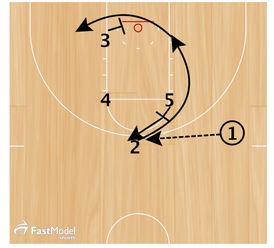
Set #1

basketball-plays-osu1

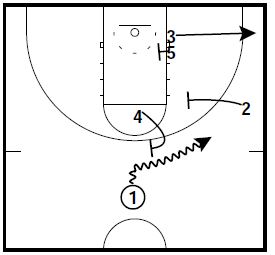
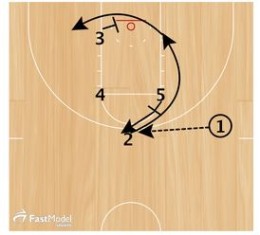
1 dribbles the basketball to wing.

5 and 3 set screens to get the 2 open

1 hits 5 after 5’s screen for 2.


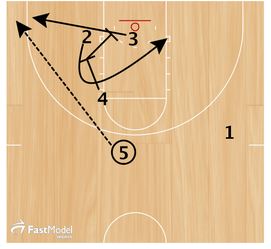
basketball-plays-osu2

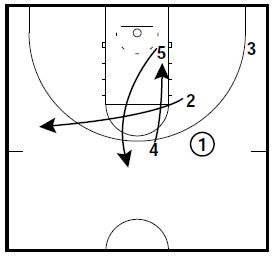
4 screens the 2 on the curl

4 then screens the 3 to pop to the corner

4 should be able to post and seal deep in paint

5 hits 3 in the corner for a shot or 3 can feed 4 in the post.


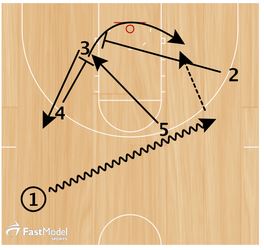
Set #2

basketball-plays-osu3

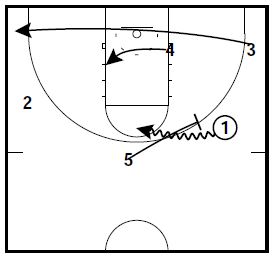
1 dribbles across the court

4 sets a pin down screen for the 3

2 sets a cross screen to bring the 4 to the ball side block

5 moves to the block.

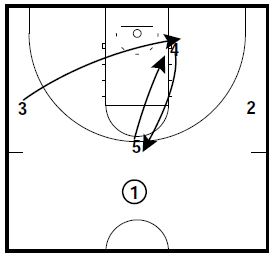
basketball-plays-osu4


5 and 3 then set a double down screen to bring the shooter to the top of the key.


Coaching Basketball Don Meyer on Using the Dribble

By Brian Williams on March 14, 2014

Dribbling Ideas / Live Ball Moves / Penetration Ideas

from Don Meyer

  • Dribble vs. Drive. We want our players to drive, but we don’t want them to dribble for no particular reason.
  • We always ask our ball-handlers: “If the ball had eyes, would it be able to see when you had it?”
  • On all dribbling drills (and as a general rule of thumb): Start slow, get a rhythm, go fast enough to make a mistake.
  • Versus pressure in the full court, we teach our players to attack the defense at a 45 degree angle–very hard to guard.
  • A good player needs no more than 1 or 2 dribbles to get from the wing to the rim. In all our breakdown drills, we don’t allow our players to use more than 2 dribbles to get to the rim, unless they are using a hesitation move, back dribble, etc. 
  • We want our players to drive in straight lines to the rim. We don’t want them veering out. Our goal is to make contact with the defense (make contact with the man guarding you and contact with the 2nd line of defense). We want to put our shoulder into the defensive man’s hip on all drives (put a body on first).
  • We want 60% of the weight on the permanent pivot foot on all moves (reduces traveling)
  • Play against your opponent’s momentum–Drive the front hand
  • We want to go from a medium center of gravity to a low center of gravity
  • “Be ball quick” and have eyes on the rim for vision 
  • Use the dribble to get out of trouble, not into trouble
  • Never pick up your dribble without a pass or a shot
  • The back dribble is the most important dribble in the game of basketball, but it is also probably the most rarely used, and it may be the most difficult dribble to master. The key points for the back dribble are:
    1) To Keep eyes on the rim
    2) 
    Have an “arm-bar” with the weak hand to shield the defense.
    3) 
    Point the back toe, dribble near or behind that toe, and get out of trouble as fast as possible.
    4) 
    The back dribble is a great time to get the defense attacking you–perfect opportunity to use a hesitation move to the rim (in the half court). 
  • The middle drive is the drive of preference in our offensive system. We believe that getting middle drives forces defensive help from defenders above the drive (great opportunity for crack-backs to 3 or dives to the rim) and from defenders (typically post men) below the drive (opportunity for bounce passes to our post men for easy lay-ups).
  • The only reasons to dribble are:
    1) 
    To advance the ball up the floor
    2) To improve passing angles (especially feeding the post)
    3) To get out of trouble
    4) To get to the rim
  • Great players typically only have 2 moves with the dribble; the Go-To move, and the Counter move.
    1) T
    he Go-To Move is the move everybody in the gym knows you’re going to make, and they still can’t guard you.
    2) The Counter Move is the move that you make when the defense is trying to take away your Go-To Move at all costs.
    3) Example: Go-To Move is the left-to-right crossover move, and the Counter Move is the In-n-Out (Fake Crossover) with the left hand. It works best if the Go-To & Counter Moves compliment each other. 
  • When driving baseline, players have to know what their options are if they can’t get all the way to the rim. In our Drive & Space scheme, on any baseline penetration, the weakside wing will “drift” to the corner, the strong-side guard will “crack-back” behind the penetration, we will have a low-post ready for a feed, and we will have one more shooter in the opposite guard / wing spot looking for the 3-point shot.
  • We allow our players to use either a “step-plant” or a “quick-stop” to go into the pull-up game. We typically teach and encourage player’s to use the 2-footed quick-stop, because it is easier to teach and it allows our player to keep his permanent pivot foot on passes in traffic, but we also will allow a step-plant if the player can prove to us that they are comfortable with that move. The step-plant does have benefits, most notably that it is “quicker” and it creates more separation between the offense and defense.
  • When a player penetrates and gets too deep into the lane to shoot a traditional pull-up, we teach the player to shoot a one-handed floater over the defender (we also have the shooter use the strong hand on the floater).

Basketball Plays 3-2 Zone Attack

By Brian Williams on March 13, 2014

Both of these plays came from Coach Mike Neighbors

Diagrams created with FastDraw
 

Punch Special

basketball-plays-punch-special1

5 and 4 exchange while 3 sprints to stack with 5 on the block


basketball-plays-punch-special2

4 sets screen on top o f the zone

2 screens top wing of the zone

5 screens bottom of the zone then sits on next defender

1 uses screen and looks for 3 or 5

basketball-plays-punch-special3


1 can pass t o the 3 or keep i t and find the 4 rolling or the 5 replacing the 4


basketball-plays-punch-special4


We go straight into our punch if we do not get anything off initial action


Punch Flat

basketball-plays-punch-flat

2 and 3 work no mans land so zone has hard time deciding who guards them

5 sets flat screen on the top of the 3 – 2 then pops t o 3 point line

1 uses the screen forcing the zone to collapse

1 reads options and finds open teammates

Coaching Basketball Glue Guy or Girl

By Brian Williams on March 12, 2014

This article was written by Alan Stein.

I would add a couple of things to what Alan has written. Great teams have lots of glue guys and girls–on those teams everyone is a glue player. I posted a couple of lists that are some thoughts in alignment with Alan’s Glue Player article.

The first is a list of what playing hard means to me. The second is a list of what togetherness looks like. Intensity and Togetherness Look Like

Glue Guy or Girl

by Alan Stein

Glue is an adhesive, and according to Webster’s Dictionary, the physics definition of adhesive is “a force that exists in the area of contact between unlike bodies and that acts to unite them.”

That’s a tad too scientific for me. Let’s just say that glue holds stuff together!

Who is the glue on your team? Who holds your team together? Who keeps your team focused? Who does all of the little things in practice and in games to make your team successful?

That person is a Glue Guy (or Glue Girl)!

How do you spot a Glue Guy? They are often seen:

• Taking charges
• Diving for loose balls
• Hitting crucial free throws
• Playing tough defense
• Setting solid screens
• Boxing out on every shot
• Cheering for their teammates

A Glue Guy doesn’t care about how many points they score or how many minutes they play. All they care about is the team winning and knowing they did everything within their role to contribute to the team’s success (regardless of how large or small that role is).

Every team needs a Glue Guy. Every team needs a player who will make all of the sacrifices necessary to hold the team together. Glue Guys are even more important during the playoffs.

If your Glue Guy is also your most talented player… I am willing to bet your team will maximize their potential.

If you want your team to make a serious run at a conference or league or state championship; I suggest you either say a sincere thank you to your team’s Glue Guy; or you become one yourself.

And for those of you who have already completed your season… Glue Guys are equally important in the off-season. After all, who else will hold your team together before the first practice of next season?

Play hard. Have fun. Enjoy the jouney.

Alan Stein

  • « Go to Previous Page
  • Page 1
  • Interim pages omitted …
  • Page 197
  • Page 198
  • Page 199
  • Page 200
  • Page 201
  • Interim pages omitted …
  • Page 288
  • Go to Next Page »

Primary Sidebar

  • Twitter
  • Facebook
  • Linkedin
coachestoolbox
personaldevelopmenttoolbox
basketballplayerstoolbox
basketballtrainer
athleticperformancetoolbox
coachingbasketball

© Copyright 2026 Coaching Toolbox

Privacy Policy