• Skip to primary navigation
  • Skip to main content
  • Skip to primary sidebar

  • Basketball Plays
    • Ball Screen Sets
    • Horns Sets
    • Man to Man Post Up
    • Man to Man Isolations
    • Backdoor Plays
    • Man to Man 3 Point Shot Plays
    • 2-3 Zone Attack
    • Baseline Inbound Plays
    • Sideline Inbound Plays
    • Combination Defense Attack
  • Drills
    • Defensive Drills
    • Offensive Drills
    • Competitive Drills
    • Passing Drills
    • Rebounding Drills
    • Shooting and Scoring Drills
    • Toughness Drills
    • Transition & Conversion Drills
    • One on One Drills
  • Blueprint
  • Practice
  • Mental Toughness
  • Skill Development
  • Offense
  • Defense
  • Store

Basketball Drills: Xavier Defensive Drills

Basketball Drills: Xavier Defensive Drills

By Brian Williams on July 30, 2014

This post contains some of my takeaways from an old Xavier Basketball Coaching Newsletter

You can see their archives at this link.

The first 3 are defensive drills and the last one is a set of practice expectations. While not all will fit your coaching situation or personality, I hope you can find a few items that can be adapted for your team.

Competitive Shell Drill

1. The drill begins with three offensive players competing against three defensive players at the three quarter court level. The offensive team moves the ball over the half court line as the defense executes proper shell positioning. Once the ball is crossed over half court the offense runs the shell action of the day.

2. They compete until a shot is taken. If a basket is scored, the offense and defense switch roles. In order for the basket to count the offensive team that is now on defense, must get a stop to accompany their basket. A basket followed by a stop counts as one point. The drill is played until the first team scores three points – three baskets accompanied by three stops.

3. This same drill can also be executed four on four.

1 on 1 Bust-out Drill

1. This is a one on one fullcourt drill. The defensive player is positioned at the foul line three quarter court level, the offensive player is at the top of the key directly behind the defender. The action begins with a coach yelling “shot.”

2. On the “shot” the defensive player breaks to the outlet position and becomes the offensive player. The original offensive player attempts to deny the outlet and establishes three quarter court pressure on the catch.

3. They play one on one across half court. Once across half court the offensive player passes to a coach on the wing and inside cuts the defense. Assuming the offensive player did not receive the pass on the inside cut, he then cuts through the lane and out opposite.

4. The ball is now skipped to the offensive player by the coach. They play one on one live from the wing. On the conclusion of the one on one action, offense and defense switch roles and return back down the court.

4 on 3 closeout Drill

1. The drill begins with four offensive players versus three defensive players. The offensive players cannot move without the ball. The drill is half court only.

2. The defense must get three consecutive stops to get out. Possession of the ball by the defense equals a stop. If the offense scores or is fouled before a “third consecutive stop” occurs, the consecutive stop count returns to zero.

3. The offense must shoot on three passes or less.

4. On every catch by an offensive player, one of the three defenders, the closest one, must actively closeout and defend the ball. A defender should not have to take two consecutive passes.

On Court Practice Rules

Below are the rules we shared with our team about our expectations of behavior in practice.

1. Always be on time. There is an 8 minute pre/post practice set up each day for your development. DTR means dressed, taped, ready for all practices including a morning on the court workout unless otherwise posted. Ankle braces and/or tape is mandatory unless a medical condition permits otherwise.

2. Being on time means being “ready to play” when the whistle blows to begin practice. Do not use our first drill to get ready because practice will always begin with a “bang”. We attack in everything that we do. This includes the start of each practice.

3. We will end each practice in a circle stretch.

4. When a coach talks, stop and listen. You can’t pay attention if you are moving. When a coach makes a teaching point to one player he is talking to all players. When on the sideline, watch a player at your corresponding position so that you won’t make the same mistake as him.

5. Don’t ever talk to another player while a coach is talking. We have no time to repeat what has already been said.

6. The pace of how we play has increased, so has the pace of how we practice. Going from one segment to the next has to happen quickly. Move from one thing to the next at a fast pace. Don’t walk anywhere.

7. No head bands or jewelry. Always have a 3rd color on – t-shirt.

8. Don’t shoot an extra shot or take an extra dribble after the whistle blows. No balls should be used while a player is out of practice unless given permission by a coach.

9. While standing on the X in practice, all players should be in front of me. We must see everyone’s eyes.

10. While shooting free-throws in practice, there is no talking.

11. Playing time is earned not given. We have a deep team and minutes in games will come from competing and performing on a daily basis. It is also important that you understand your role and our system. We need players that compliment each other and at the same time embrace what we do (The Xavier Way).

12. Coaches are not referees so play hard, compete and work to get better. Do not make a coach look bad because a “bad call” happened in a segment of practice.

13. Communication is an expectation in practice. We must communicate on a daily basis to be able to communicate under pressure in a game. In every segment of practice, communicate to your teammates. This is a point of emphasis in 06-07.

14. If moodiness is a part of who you are, get beyond it and understand that we depend on each other at all
Basketball Plays Spurs Rhody Backside

By Brian Williams on July 28, 2014

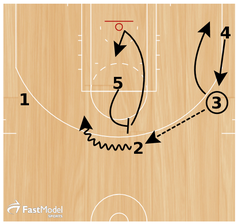
In their Game 4 win of the 2014 NBA Finals, the San Antonio Spurs ran this half-court set which included a multitude of actions.

As soon as 3 cleared 4, 2 was moving to set the back screen.

This timing allowed for 5 to pin-down for 2 and receive the ball on the move popping out.

5 set such a good pick and sealed in the lane that X4 had to help in the lane and allowed for an open throwback to Diaw.

This play was posted in Fast Model’s Basketball Plays and Drills Library by Kyle Gilreath


Spurs Rhody Backside

basketball-plays-spurs1

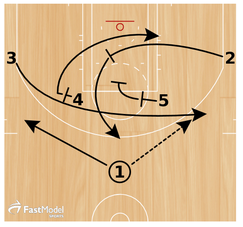
3 (Leonard) rhody cut off screens from 4 (Diaw) and 5 (Duncan).

1 (Parker) passed to 3.

At the same time, 2 (Ginobili) set a backscreen for 4 and 5 pinned down for 2.
 

basketball-plays-spurs2

3 passed to 2 and 5 set a quick middle pick & roll for 2.

3 and 4 exchanged.


The Spurs Playbook and the 2014-15 Golden State Warriors Playbook make up this weekend’s featured eBook bundle. You can find out more about them at this link:

Spurs and Warriors Playbooks

If you have any questions about the Playbooks, please feel free to email me or call/text me at (317) 721-1527.

Basketball Plays John Beilein Triple Wing Screen

By Brian Williams on July 25, 2014

This play was run by Michigan when John Beilein was the Coach.

If you are interested in adding to your Coaching Toolbox and getting access to content similar to this, take look at what I believe is our best offer.


CLICK HERE to select from a list of more than 70 eBooks.

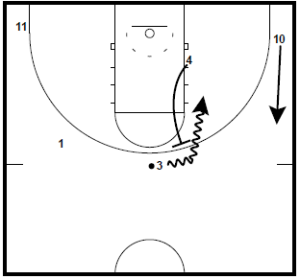
The numbers do not represent the traditional 1-5 positions. They are simply used for identification. If you want to run something similar to this, you will need to fit your personnel into roles that suit their skills.

Triple Wing Screen

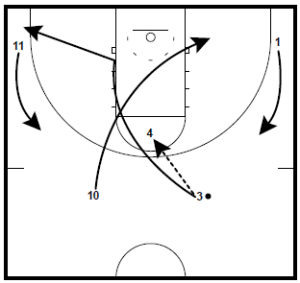
basketball-plays-beilein1

3 passes to 4 and cuts off the ball to the opposite corner

10 cuts behind 3 to the opposite corner

1 moves up to the wing as does 11 creating space


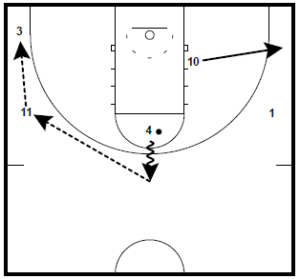
basketball-plays-beilein2


4 steps out and passes to 11 on the wing

11 passes to 3

10 steps out to the weak side corner


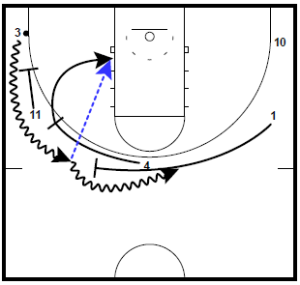
basketball-plays-beilein3PNG

3 receives two ball screens from 11 who pops to the corner looking for a throwback pass & shot or post entry pass to 4

4 sets the 2nd ball screen and rolls to the basket looking to seal his man for the pass

1 comes and sets a 3rd screen for 3 who looks to use the screen to attack the lane
 

basketball-plays-beilein4PNG


Michigan finished this play with 4 setting an face screen for 3 who tried to penetrate


If you are interested in adding to your Coaching Toolbox take look at what I believe is our best offer.

CLICK HERE to select from a list of more than 70 eBooks.

Basketball Drills 20 Makes Jab Step Shooting

By Brian Williams on July 24, 2014

This basketball shooting drill is a high repetitions drill that teaches the player to be able to make shots under pressure, as well as when they are tired.

Since the drill is based on makes and not just a set time or number of shots, it forces the player to make shots to get out of the drill.

It is primarily a shooting drill, but the passer must focus on making quality on-time passes, and the rebounder must not allow any missed shot to hit the floor.

Both of these are key skills that will translate over to a live game.

The video is one of the 1,000’s of basketball training videos for all levels of coaches, players, and parents that is offered by BasketballHQ.

You can see more of this type of content at this link: Basketball HQ

20 Makes Jab Step Go Opposite Shooting Drill

The video is one of the 1,000’s of basketball training videos for all levels of coaches, players, and parents that are offered by BasketballHQ.

You can see more of this type of content at this link: Basketball HQ

Basketball Wild Card Drills

By Brian Williams on July 23, 2014

This article was published in Winning Hoops Magazine in its November/December 2002 issue. Its author is Marty Cosgrove, Athletic Director and Head Girls Basketball Coach at that time.

In the off-season, many high school coaches are restricted on the number of players they can work with at one time. As a result, we are sometimes forced to go 5-on5 where the games get sloppy and bad habits rule. Here are eight ideas to spice up your 5-on-5 open gyms. Print off the Wild Cards and draw one at the beginning of open gym for the rules of the day.

You can also save these games for late in the season to add some variety to keep your practices fresh.


Download a template to make the cards to draw here.


SUDDEN VICTORY

The rationale behind this game is to get everybody involved with scoring. Your players will now be looking for teammates, making the extra pass and helping other players get open. It also facilitates communication both on offense and defense. Your players will need to yell things such as “Who still needs to score?” and “We have to stop Suzie, she hasn’t scored yet!”

5-on-5 full-court game. No score is kept. All players on the team must score. After all 5 players score, the next point wins. In essence, a sudden-victory situation.

CONTINUOUS

“Continuous” is an excellent conditioner and develops tremendous offensive and defensive transition skills.

5-on-5 full-court game, played up to 7 points. When a team scores, they stay on offense, by getting the ball out of the net and attacking the defense in the other direction.

3, 5, 7

This game puts pressure on all players and increases defensive responsibility by forcing teams to extend their defense to the 3-point arc.

5-on-5 full-court game played to 9 points. One point is awarded for all baskets, including 3-point shots. Teams may score from any area on the floor, however, on points 3, 5, and 7, the baskets must be 3-pointers. A team may score from inside the arc, but the score does not accumulate beyond 2, 4, and 6 until a 3-pointer is hit.

DISCONTINUED DRIBBLE

This game really helps develop screening, scoring off the screen and passing skills.

5-on-5 full court game, played to 9 points. Teams may dribble without restriction if they are in transition. However, if a team is in a half-court situation, no one may dribble inside the 3-point arc.

POSTMAN

This drill improves post player’s passing skills (an often overlooked skill) and forces teams to slow down, knowing they can’t score without a post entry.

5-on-5 full or half-court game, played up to 9 points. There are no restrictions on offensive play, except that before a team may score, the ball must be entered to a post player.

GOLDEN CHILD

Defensive integrity and intensity increases on an individual and a team basis, as the “golden child” simu-lates that opponent who must be stopped.

5-on-5 full-court game, playe up to 9 points. There are no restrictions. Each team has a player, who is selected as the golden child. All baskets are worth one point, however, the golden child’s baskets are worth 2 points.

LEFTY

“Lefty” is a simple game, but stresses the importance of utilizing both sides of the floor. Another added benefit is an increased comfort level of ball handlers working with their non-dominant hand.

5-on5 full or half-court game, played up to 9 points. All baskets are worth one point. All dribbles must be with non-dominate hand. In addition, the offense must initiate from the left side of the floor.

REWARD

Our team tends to reward points for offensive and defensive rebounds, but deflections, hustle points, (diving after loose balls, etc.) or a skill you want to emphasize, such as bank shots, could also be eligible for reward points.

5-on-5 full-court game, played to 13 points. All baskets are worth 1 point, as are any reward points for any skill a coach wants to emphasize.

Jim Boone 3 Stops Defensive Drill

By Brian Williams on July 22, 2014

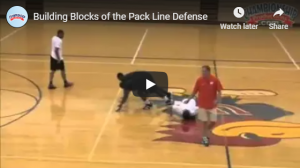
This defensive drill is used by Coach Jim Boone in his packline defense.

Coach Boone has won over 450 games at the Division I and II levels and is considered to be on of the top Pack Line Defense Coaches.

The drill requires players to get 3 defensive stops in a row against the other players in the group.

Even though you can’t be as physical in games as they are in the drill, I do like the point of teaching to get up into the dribbler and making him or her uncomfortable.

You could also play the drill so that a player must stay in until he or she gets 3 consecutive stops.


To learn more about the entire DVD that this sample came from, click here: Building Blocks of the Pack Line Defense.

Anyone who purchases anything from the store receives one of my basketball coaching eBooks as a bonus. Just email me and let me know which one you would like to receive!

Click the play arrow to see the drill.

  • « Go to Previous Page
  • Page 1
  • Interim pages omitted …
  • Page 183
  • Page 184
  • Page 185
  • Page 186
  • Page 187
  • Interim pages omitted …
  • Page 288
  • Go to Next Page »

Primary Sidebar

  • Twitter
  • Facebook
  • Linkedin
coachestoolbox
personaldevelopmenttoolbox
basketballplayerstoolbox
basketballtrainer
athleticperformancetoolbox
coachingbasketball

© Copyright 2026 Coaching Toolbox

Privacy Policy