• Skip to primary navigation
  • Skip to main content
  • Skip to primary sidebar

  • Basketball Plays
    • Ball Screen Sets
    • Horns Sets
    • Man to Man Post Up
    • Man to Man Isolations
    • Backdoor Plays
    • Man to Man 3 Point Shot Plays
    • 2-3 Zone Attack
    • Baseline Inbound Plays
    • Sideline Inbound Plays
    • Combination Defense Attack
  • Drills
    • Defensive Drills
    • Offensive Drills
    • Competitive Drills
    • Passing Drills
    • Rebounding Drills
    • Shooting and Scoring Drills
    • Toughness Drills
    • Transition & Conversion Drills
    • One on One Drills
  • Blueprint
  • Practice
  • Mental Toughness
  • Skill Development
  • Offense
  • Defense
  • Store

Wichita State Fatigue Shooting Drill

Wichita State Fatigue Shooting Drill

By Brian Williams on August 12, 2014

Today’s post contains two videos from Wichita State Head Basketball Coach Coach Gregg Marshall going through a series that they use to work on their wings players skills.

The video is about a minute long and shows a shooting drill that they use at the end of practice to develop the ability to shoot under fatigue.

You could use this as a team shooting drill in season, or tweak it when you are doing an individual workout with one or two players. Each player should shoot until he or she makes a shot at the spot while running to half court and back on a miss. They move on to the next spot when they make a shot from the current spot. Time them to ensure that they are running hard on their sprints.

They are You Tube videos, so you will need to have permission to view You Tube videos.

Make sure your sound is on as you watch. Click the play arrow to see the videos.

If you are interested in learning more about the entire DVD that this sample came from, click this link: Wichita State Skill Development Workout Guards. Anyone who purchases anything from the store receives one of my basketball coaching eBooks as a bonus. Just email me and let me know which one you would like to receive!
Basketball Plays Basic Out 54 Quick

By Brian Williams on August 11, 2014

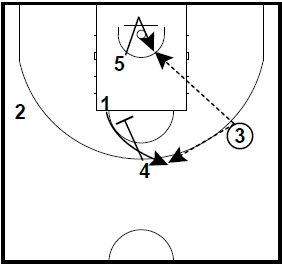
This is a quick ball screen isolation set for our 2/3 player when we feel they have a slow defender.

Coach Vonn Read has submitted several plays from his playbook series The Basketball Encyclopedia of Plays to the Coaching Toolbox.

Coach Read has served as an assistant coach in the WNBA with the Phoenix Mercury, Orlando Miracle, and San Antonio Silver Stars.  He has also been an assistant in the women’s programs at Syracuse, Houston, and Memphis.

He was an advanced scout for the Orlando Magic as well as The Charlotte Sting.


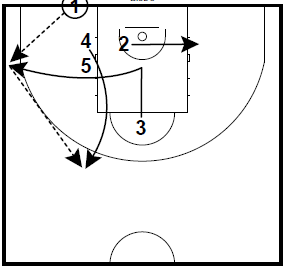
basketball-plays1

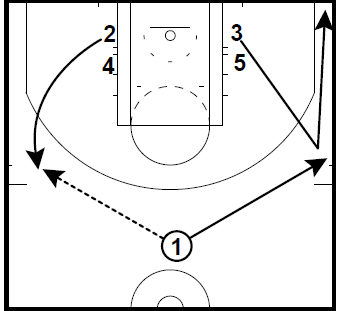
We start in a stack set and pop our guards out to the wing.

The 3 player then spots up in the corner and the 1 player cuts to the opposite wing.


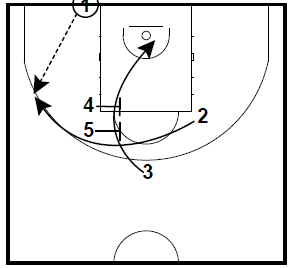
basketball-plays2

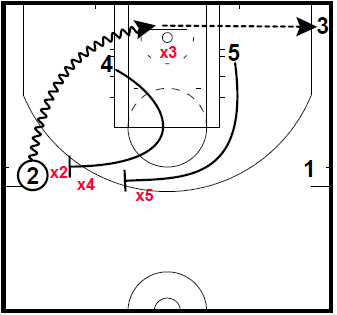
This is a fake double ball screen play used to take away the help when we refuse the ball screen and drive for the layup.

Both the 4 and 5 players will sprint to set the fake ball screens.

The 4 and 5 players sell the ball screen, which takes away help defenders at the basket.

The 2 player will reject the ball screen and drive for the easy layup, especially if X2 bites on the ball screen.

If X3 helps, we kick it to our shooter (3 player) in the corner.

Coach Read has also put together The Basketball Encyclopedia of plays. You can check them out here: The Basketball Encyclopedia of Plays or read more about the books:

Any coach looking for the latest and innovative plays from the Professional, College, or High School levels can stop looking. With a compilation of over 7,700 different plays, you will never need to purchase another basketball playbook again. These playbooks can be used as a great reference tool for years to come. This 2 Volume Book includes plays from 19 different play categories, and they are the most extensive playbooks on the market.

The Basketball Encyclopedia of Plays (Platinum Series) contains over 7,700 Plays (Both Volumes combined) from the NBA, WNBA, USBL, and College levels from someone who has worked as an Advanced Scout or Coach on each level!!! This book has been intensely compiled over the last 21 years, with plays taken from a lot of NBA Coaches (past and present), WNBA coaches, and College coaches (Men’s and Women’s) from around the country.

Any coach that is serious about improving their knowledge of the game from an X and O standpoint will benefit tremendously from these books. These Books can be used to discover New Quick hitters, add a New Package to your playbook, or develop an entire Offensive System. There are a lot of new ideas and concepts in these books to study, and the Basketball Encyclopedia of Plays can be a great resource for coaches on all levels!!! This book is definitely for those X and O junkies who are always looking to improve as a Coach.

“THE GAME IS ALWAYS CHANGING? ARE YOU?” Vonn Read

Here is the link: The Basketball Encyclopedia of Plays

Alan Stein on Reducing ACL Issues

By Brian Williams on August 8, 2014

What You Knee’d To Know

This article was written by Basketball Strength and Conditioning Coach Alan Stein and published on his Stronger Team Blog

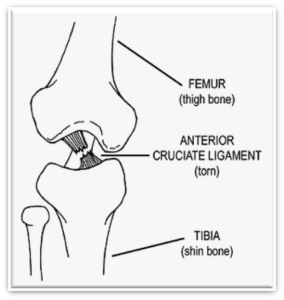
Although statistically female athletes are 5-8 times more likely to suffer and ACL injury, as we’ve seen from the likes of NBA superstars Derrick Rose, Ricky Rubio and Rajon Rondo, these injuries unfortunately can and will happen to even the most elite male athletes on the planet.ACL-284x300

To help raise awareness of ways to ‘bullet proof’ the knees and reduce the occurrence of ACL issues, I have declared this entire month #ACLAugust (follow me on Twitter and/or search this hash tag). I will post a 4-part video series this month on the Stronger Team YouTube channel that features exercises taught in ACL Injury Reduction 101.

Quick Facts:

  • Nearly 70% of all ACL injuries are non-contact and are the result of an improper landing or from a quick change of direction.
  • The ACL is located inside the knee and stabilizes the joint by preventing the shinbone (tibia) from sliding forward beneath the thighbone (femur). A hard twist or excessive pressure on the ACL can tear it
  • The cause of most ACL tears is a sudden, abrupt change in force to the knee. This can occur during a quick change of direction or when landing from a jump.
  • Female athletes are at a higher risk because of a wider pelvis and larger “Q” angle, greater incidence of knee valgus and foot pronation. NOTE: these are structural and genetic issues and can’t be addressed through training.
  • Additional factors that contribute to ACL injuries include a smaller hamstring to quadriceps strength ratio, poor recruitment of the hamstrings during landing, inappropriate jumping/landing mechanics and weak hip abductors.
  • Every basketball player on the planet over the age of 10 should participate in an ACL injury reduction program. Notice the word reduction. It isn’t possible to prevent ACL injuries (or any injury for that matter). But proper, consistent training can absolutely reduce the occurrence.

Here are 4 key pillars to a sound ACL injury reduction program:

  1. Improve ankle and hip mobility. The knee joint is designed to be stable. The ankle and hip joints were designed to be mobile. Allowing both the ankle and hip joints to go through a full range of motion during movement reduces stress on the knee. If the ankle (in particular), has a limited range of motion when landing from a jump, because it is either immobile or locked in a rigid ankle brace, the vast majority of the impact is redirected and absorbed by the knee. Barefoot exercises can be an excellent tool in strengthening the feet and improving the mobility in the ankles.
  2. Increase strength in the posterior side of the lower body (hamstrings & glutes). Running and jumping are fairly quad (thighs) dominant, so it is vital to target both the hamstrings and glutes (butt) when strength training. Both the hamstrings and glutes play a major role in protecting the ACL when landing from a jump and when planting and cutting. Some tips when strength training include using iso-lateral exercises when possible (one leg at a time), controlling the eccentric (negative, lowering) part of the exercise and always maintaining proper body alignment and form.
  3. Use proper footwork when decelerating, planting and cutting. Basketball is not a speed game. It is a starting & stopping game, a reaction game and a change of direction game. Incorporating acceleration and deceleration drills into the yearly training program is essential in preparing the body for the rigors of the game. A ‘T-Step’ or ‘Hockey Stop’ is an ideal way to safely and efficiently “put on the brakes” to plant and cut. Prior to planting and cutting, you want to quickly turn your hips and plant your outside foot perpendicular (90 degrees) to the direction you were going. For example, if running a sprint from the baseline to mid-court and back to the baseline, you would want to plant with your foot parallel to the mid-court line (thus perpendicular to the direction you will be running). This foot position will provide a strong braking mechanism for the knee as well as be the best position for a strong transition into the desired direction. It is important to keep your center of gravity low during each transition and in training, make sure you get an equal number of reps for each foot.
  4. Use sound landing mechanics. It is very rare a player injures their knee when jumping. It’s the landing that causes the problems! Players need to learn to land with their weight distributed along the power pads of their feet. They should not land on their toes or on their heels. They should allow the impact to be absorbed in their ankles, knees and hips (let it dissipate over 3 joints). An easy way to teach this is to practice landing barefoot on a soft surface. Use a verbal cue of a quiet landing or a soft landing. The key is conditioning a player to subconsciously land softly, quietly and on balance every time. Players should avoid a knocked knee’d position in both jumping and landing.

I am a huge advocate of going through a comprehensive, movement-based warm-up before all workouts, practices and games. I strongly encourage you to incorporate these 4 pillars in to each and every warm-up. That way you are working on ACL injury reduction techniques every day!

Alan Stein
http://www.About.me/AlanStein

Basketball Drills Defensive Combination Screening

By Brian Williams on August 4, 2014

This drill is from Drew Hanlen of Pure Sweat Basketball. It requires players to defend a variety of screening actions in a short amount of time.

The drill is also posted in Fast Model Sports Basketball Drills and Plays Library.

Drew is an NBA Strategic Skills Coach & Consultant that has helped over 25 NBA and NBA pre-draft players. Drew is the Head Skills Coach for Pure Sweat Basketball. He has run his internationally renowned Elite Skills Clinics in over 30 states and 4 countries over the past four years.

You can also use this as a multiple purpose drill by having one coach working with the offensive players on setting and using screens.

If there are other screens, that you need to be able to defend from the teams that you play, you can always modify and adapt the drill to fit the needs of your team.

Here is how Drew runs the drill:

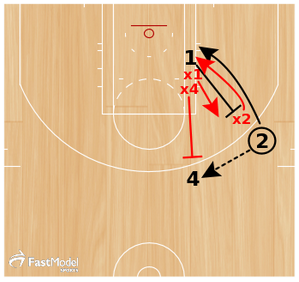
basketball-drills1

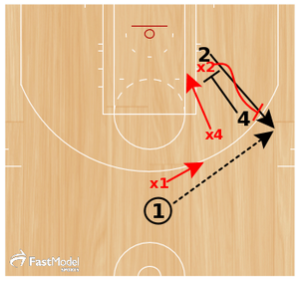
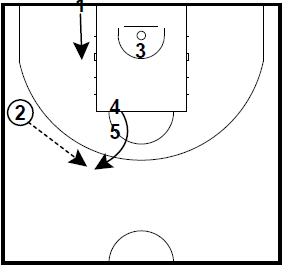
Ball handler (Player 1) will start with the ball at the top of the key and will be pressured by an on-ball defender (x1), while an offensive (Player 4) and defensive (x4) post player will start on the wing and an offensive (Player 2) and defensive (x2) guard will start on the strong-side block.

Offensive post player on the wing (Player 4) will set a pindown for the offensive guard (Player 2), who will use the pindown and pop to the wing and receive a pass from the ball handler (Player 1).

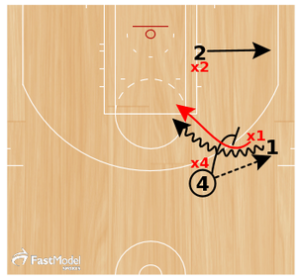
basketball-drills2

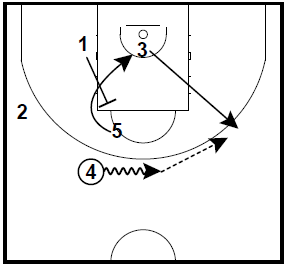
Offensive post player (Player 4) will then set a UCLA screen for the offensive player at the top of the key (Player 1).

Defender guarding the player using the UCLA screen (x1) will jump to the ball then get through the UCLA screen, while the screener’s defender (x4) will provide help if necessary.


basketball-drills3

After setting the UCLA screen, the screener (Player 4) will pop to the three-point line and receive a pass from the ball handler (Player 2). Offensive player on the block (Player 1) will immediately set a back screen for the offensive player on the wing that just made the pass (Player 2).

Defender guarding the player using the UCLA screen (x2) will jump to the ball then get through the back screen, while the screener’s defender (x1) will provide help if necessary.

basketball-drills4

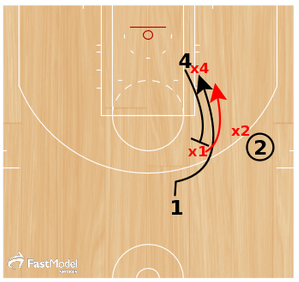
After setting the back screen, the screener (Player 1) will pop to the wing and receive a pass from the offensive post player (Player 4), who will then follow their pass and set an on-ball screen.

Drill becomes live 3v3. Defenders should guard the ball screen using their team’s defensive principles.


Basketball Plays Baseline Out of Bounds

By Brian Williams on August 1, 2014

Today’s post includes a couple of baseline inbounds plays.

The first one is to get your point guard isolated for a hand off in the middle of the floor.

The second has two options–it can finish with a post feed or with a look at a 3 point shot after a screen the screener.

Diagrams created with FastDraw


41 Handoff

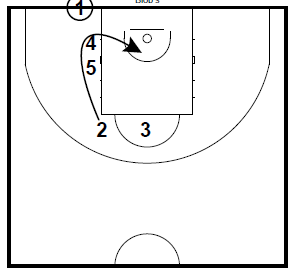
basketball-plays-blob1

2 curls around 4 and 5 to the basket.


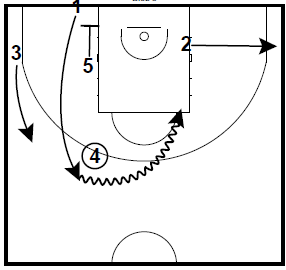
basketball-plays-blob2

2 pops out to the right low block.

3 cuts to the basket and then rub off 5 to the left wing.

4 pops out to the top left guard spot.

1 passes to 3. 3 passes to 4.


basketball-plays-blob3

5 sets a down screen for 1.

1 cuts to 4 for a hand off

1 attacks the right side of the lane.

3 slides up to the left wing.

2 pops out to the right corner.

45 Double Cross

basketball-plays-blob4

4 and 5 set a double cross screen.

3 cuts to the basket.

2 cuts to the left wing.

1 passes to 2.


basketball-plays-blob5

4 curls around 5 to the top left guard spot.

2 passes to 4.

1 steps into the left low block.


basketball-plays-blob6

1 sets a backscreen on 5.

5 cuts to the basket.

3 pops out to the right wing.

4 dribbles to the right side and passes to 3.


basketball-plays-blob67PNG

5 dives into the post and seals his defender.

4 sets a downscreen for 1.

1 cuts to the top of the key.

3 can pass to 5 on the post-up or 1 for the shot.


These plays are a part of Coach Scott Peterman’s Encyclopedia of motion, princeton, and ball screen offenses. There are over 2000 pages of notes on those offenses.

Champions Notebook

By Brian Williams on July 31, 2014

The following concepts were taken from Coach Ryan Renquist’s “The Notebook of Champions” that he uses as his Players’ Notebook at Walsh High School. I hope you find at least a few ideas to use in your program.

What Do I Want in a Player?

  • I want a player who is willing to make a commitment to being as good as he can be each time that he plays.
  • I want a player who is willing and ready to do what has to be done to make a positive contribution in the most difficult of games.
  • I want a player who competes in each game as though there is nothing he will ever do that will be more important.
  • I want a player who more than anything, wants our team to be the very best that it can be.
  • Is this too much for me to demand of you?
  • Is this too much for you to demand of yourself?

Next Play:
The Most Important Play is the NEXT Play! Whenever a player makes a mistake, he must immediately forget about it (except for the part that educates you).

Thank the Passer:
The scorer is the one the fans will recognize. We will recognize the passer. We will thank the passer by pointing at him.

Stand Up for a Teammate:
When a teammate comes out of the game, we will all stand up from the bench to congratulate him on his performance.

Don’t Look at the Scoreboard:
When a player knows what the score is, he changes the way he plays. We strive towards dominating each possession. We will let the final score take care of itself. Players need to pay attention to the time, but they don’t need to pay attention to the score.

Sprint To The Bench:
Players will sprint to the bench on every time out and end of the quarter situation. We will sprint to the locker room at the end of the first half and at the end of the game.

Fallen Teammate:
When a teammate hits the floor, we help him up.

Make Eye Contact:
When two people on this team are talking to each other, they will both look at each other in the eyes.

Hand the Basketball to the Referee:
We will make every effort to hand the basketball to the closest referee.

We ACT, We Don’t REACT:
Don’t concern yourself with things you can’t control like how good or bad a team is. We create the outcome of the game by doing what we do to the best of our ability.

Dominate your Opponent:
We want to create a nightmare for our opponents by dominating them for 32 minutes. When our opponents step off the floor, we want them to think, “I NEVER want to play the WALSH EAGLES again.”

The Fist:

  • Five fingers held together in a tight formation, a fist, is far more effective and powerful than five fingers held outstretched and alone.
  • In basketball, the five individuals on the court must act as one, as a fist, in order to achieve the success that they could not find acting as five independent players.
  • Each separate finger that makes up The Fist symbolizes a fundamental quality that renders a team great. We will emphasis five terms: We Play Hard, We Play Smart, We Play Together, We Play Aggressive, We Communicate. Each one of these traits alone are important. But all five together are tough to beat.
  • Instead of giving high fives or patting one another on the back, we will give fists.
  • When teammates show each other their fist, we remind one another of the five terms that will bring us together and allow us to be the strongest that we can be.
  • WE PLAY HARD: We give maximum effort at all times and in everything we do. We take charges, and are eager to dive for a loose ball.
  • WE PLAY SMART: We know our assignments and make wise decisions.
  • WE PLAY TOGETHER: Five people working together can achieve much more than five people working independently.
  • WE PLAY AGGRESSIVELY: The most aggressive team will get the majority of the calls.
  • WE COMMUNICATE: We make eye contact with each other whenever someone is talking. We talk at all times when we are on the floor.

Leadership

A true leader has the confidence to stand alone, the courage to make tough decisions, and the compassion to listen to the needs of others. He does not set out to be a leader, but becomes one by the quality of his actions and the integrity of his intent. In the end, leaders are much like EAGLES… they don’t flock, you find them one at a time.

“What you do; how you do it; and who you associate with on a daily basis will determine your image and your impact!” Kevin Eastman

“Surprisingly for some, research conducted by the Leadership Research Institute has shown that in times of crisis, people gravitate toward the person of highest character, not necessarily the person who is in charge or even the person they believe to be the most competent. Rather, people will tend to build a relationship with and follow the person they view as the most trustworthy, who cares the most, and who is willing to always do the right thing.” Tony Dungy

“Leadership is diving for a loose ball, getting the crowd involved, getting other players involved. It’s being able to take it as well as dish it out. That’s the only way you’re going to get respect from the players,” Larry Bird

“Instead of asking, how can I lead my company, my team, or my family to a higher level of success? We should be asking ourselves, how do others around me flourish as a result of my leadership?” Tony Dungy

Attitude

Attitude is a little thing that makes a BIG difference.

“Good talent with bad attitude equals bad talent,” Bill Walsh

“You don’t play against opponents, you play against the game of basketball,” Bob Knight

“The greatest discovery of my generation is that human beings can alter their lives by altering their attitudes of mind,” William James

“Most people are about as happy as they make up their minds to be,” Abraham Lincoln

“Nothing is worth more than this day,” Goethe

“Your life is either a celebration or a chore. The choice is yours,”

“If you’re a positive person, you’re an automatic motivator. You can get people to do things they don’t think they’re capable of.” Cotton Fitzsimmons

“If you want your life to be a magnificent story, then begin by realizing that you are the author and everyday you have the opportunity to write a new page.” Mark Houlahan

“Nothing can stop the man with the right mental attitude from achieving his goal; nothing on earth can help the man with the wrong attitude.” President Thomas Jefferson

“What you are as a person is far more important than what you are as a basketball player,” John Wooden

“Life is like a basketball, it just keeps bouncing up and down.”

“I treat every day like it is my last day with a basketball,” LeBron James

“Everything negative — pressure, challenges — are all an opportunity for me to rise,” Kobe Bryant

“Great players are willing to give up their own personal achievement for the achievement of the group. It enhances everybody,” Kareem Abdul-Jabbar

“Once you are labeled the best you want to stay up there, and you can’t do it by loafing around. If I don’t keep changing, I’m history,” Larry Bird

“I’ve got a theory that if you give 100 percent all of the time, somehow things will work out in the end,” Larry Bird

  • « Go to Previous Page
  • Page 1
  • Interim pages omitted …
  • Page 182
  • Page 183
  • Page 184
  • Page 185
  • Page 186
  • Interim pages omitted …
  • Page 288
  • Go to Next Page »

Primary Sidebar

  • Twitter
  • Facebook
  • Linkedin
coachestoolbox
personaldevelopmenttoolbox
basketballplayerstoolbox
basketballtrainer
athleticperformancetoolbox
coachingbasketball

© Copyright 2026 Coaching Toolbox

Privacy Policy