• Skip to primary navigation
  • Skip to main content
  • Skip to primary sidebar

  • Basketball Plays
    • Ball Screen Sets
    • Horns Sets
    • Man to Man Post Up
    • Man to Man Isolations
    • Backdoor Plays
    • Man to Man 3 Point Shot Plays
    • 2-3 Zone Attack
    • Baseline Inbound Plays
    • Sideline Inbound Plays
    • Combination Defense Attack
  • Drills
    • Defensive Drills
    • Offensive Drills
    • Competitive Drills
    • Passing Drills
    • Rebounding Drills
    • Shooting and Scoring Drills
    • Toughness Drills
    • Transition & Conversion Drills
    • One on One Drills
  • Blueprint
  • Practice
  • Mental Toughness
  • Skill Development
  • Offense
  • Defense
  • Store

Coaching Basketball Preparing Your Team Thoroughly

Coaching Basketball Preparing Your Team Thoroughly

By Brian Williams on November 12, 2014

Whether you have already started playing games or you still don’t have all of your players out from fall sports, I hope this post offers at least a few ideas to build on what you are already doing, or reminds you of something that you left off of your pre-season and early season to do lists.

If you have already completed your practices leading up to your first game, here are links to to 3 articles on Special Situations to cover once you have your base offensive and defensive systems installed:

Gordon Chiesa, retired NBA Coach, end of game checklist.

Special Situations Checklist (108 Suggestions for situations to be prepared for)

Special Situations Daily Practice Template (A way to save time and be thorough in practicing special situations)

Being thoroughly prepared for your first game

Budgeting your practice time.

To be sure that you cover everything prior to your first game, you have to begin with the end in mind as Stephen Covey taught. You need to develop a list of everything you MUST have done prior to the first game because you won’t have EVERYTHING done prior to the first game.

This list is not meant to cover everything, but is a place to start to stimulate your thinking for your team and coaching situation to budget your scarce and valuable practice time. Your needs will not be exactly the same as I have listed, but hopefully you can use this as a working structure.

If you don’t practice it, you can’t expect your players to execute it in a game.

Calculate as close to exactly as possible the number of minutes you will have on the floor prior to your first game.

I will use 12 practice days and 120 minutes per day as an example.

That would give you 1440 minutes on the floor prior to the first game.

Prior to first game (12 practice days) MUST DOs

  1. I believe in individual shooting/driving/scoring and skill development for 30 minutes a day that takes (30 minutes x 12 practices = 360 minutes of shooting/etc… prior to the first game)
  2. Primary Offense man to man offense, catch-up offense, 5 quick hitters (15 minutes per day =180 minutes )
  3. Zone offense 2-3 and 1-3-1 (5 minutes per day = 60 minutes. If you know you will be facing a team that plays zone as the primary defense in the fist game, you will need to budget more time.
  4. Conversion Defense (5 minutes per day = 60 minutes)
  5. Transition Offense (5 minutes per day = 60 minutes)
  6. Primary Half Court Defense, catch-up half court defense (15 minutes per day = 180 minutes)
    (Individual and Team Breakdown Defensive Skills and Drills such as Defending on ball screens, Closeouts, Help and Recover, Denials, Help the Helper, Blockouts, and everything else that is important in your defensive scheme)
  7. 5 on 5 scrimmaging. You have to have some time each day for players to fit your whole package into an up and down flow to be ready to play a game. (20 minutes per day = 240 minutes)
  8. Press Attack. The time you spend on this could vary depending on if you are opening against pressing teams, but I like to spend at least 5 minutes per day on press attack (5 minutes per day = 60 minutes)

That leaves 240 minutes for this example. That won’t be exactly the same for you, but use it as a place to start as you budget your time.

The remaining items on the list won’t take up as much time, but still need to be covered prior to your first game, so include the time for each in your practice time budget. I will leave it up to you as to how much time of your remaining floor minutes you want to devote to each one.

  1. Defending under the basket inbounds plays
  2. Catch up full court defense
  3. End of quarter/half plays
  4. Special plays to run at the end of a game where you need to score
  5. Half court trap offense
  6. 2 Under Out inbounds plays vs. man
  7. 2 Under Out inbounds plays vs. zone
  8. 1 side out game winner inbounds plays
  9. Pre-Game and Halftime warmups
  10. Time Out and Halftime Procedures

You still have stretching/warming, conditioning, toughness, attitude, communication, and all of the other areas that are important to you to work on during that remaining time.  That is why it is crucial to determine what HAS to be in by the first game and then budget your time and remember, as Coach Don Meyer always reminded us, “You can do anything that you want, but you can’t do everything that you want.”

The most important thing is to develop your own practice budget chart making sure that you have your list of what you need to do to have your team thoroughly prepared.

Early season administrative responsibilities to complete or delegate.

  1. Scouting Schedule Video exchange and in person
  2. Paperwork: Physicals, consent forms, Player resumes, Stats Spreadsheets, videos

I have always made basketball resumes for our returning players with stats and other honors. That way, I always have their accomplishments at hand to nominate them for awards, to give to the media, to use to nominate them for academic or service scholarships, to give to college recruiters, etc.. If you have a team website, you can include those resumes on your site. In addition, another way to promote your program is to email college recruiters the links to your site. It is very easy to post some videos of your players on the site using YouTube. School coaches and ADs can get free access to a resource with the email addresses and phone numbers of college coaches at this link: Coaches Directory

    1. Game Night presentation: Establish dates for Youth teams to play at halftime, autograph night, Verify Bus Departure Times
    2. Individual Meetings with prospects and sheets

Link to the Prospect Sheet I have used.

  1. Media/Picture Day
  2. Video person
  3. Parent Meeting and open practice Plan holiday and weekend practices to help families plan holiday activities
  4. Players notebook, basketball code of conduct

There are team management apps that allow you to have immediate access to player and parent contact information on your desktop workstation, tablet, or phone. Most parents and athletes are now comfortable with email and text as the primary method of communication for team info, which can dramatically speed up your job. However, there are other ways to make the job of managing the team easier as well. Team management tools, like TeamSnap, automate a lot of these processes for you. In addition to letting you create, update and store a team roster, tools like TeamSnap let you see players’ availability for games and practices, assign responsibilities such as post game food or snacks, and keep track of who has paid their equipment fees, and completed their paperwork.
Coaching Basketball Jimmy Dykes Philosophy

By Brian Williams on November 11, 2014

These thoughts are from an old Xavier Men’s Program Basketball Coaching newsletter. If you are interested in seeing their archive or signing up for the newsletter, click this link: Xavier Basketball Newsletter

Blueprint for a successful coaching philosophy–Jimmy Dykes

Coach Dykes is the former Women’s Coach at Arkansas. Prior to taking the job this past spring, he has been an analyst for ESPN and has served as an Assistant for several D1 Men’s Programs. He also spent a year as a Scout for the NBA Seattle Sonics (now the OKC Thunder).

Even though you probably won’t agree with everything, I think that there are at least a few thoughts included that can be applied to your coaching and to your team.

1) Everyday guys will beat sometime guys every day.
– High talent guys that are sometime guys will be a year of frustration.
– Key areas of recruiting: evaluation of talent and evaluation of character.
– Everyday guys go every day, every possession.
– When evaluating a player, watch how they respond in a bad game.

2) If you are not tough, you will not win.
– Do not flinch on a loose ball.
– Blow up screens.
– Do not let one mistake become two.
– “Toughness is doing what is right when it is really really hard to do what is right.”

3) If you cannot talk it, you cannot execute it.
– Players must be able to talk the action.

4) Practice for 5-10 minutes without talking.
– Will drive home the importance of talking real quick.

5) If you aren’t talking loud enough in practice to be heard in a silent gym, you will not be heard in the loudest arena.

6) Where are we scoring from? 3 key areas:
– The free throw line should be a number one priority in an offense .
– Are you scoring off of rim shots?
– Clean 3’s.
– The quality of shots of us vs. them will 90% of the time determine who wins the game.

7) How hard are your cuts?
– Be in good enough shape to still be able to hard cut in the last 5-6 minutes of the game, not just for a half.
– Cut with purpose and passion.
– Hard cuts wear people down.

8) 24/24 last final four teams have shot 32% or higher from the 3pt line
– Who is shooting your 3’s? Has a lot to do with what you shoot as a team.
– Selection of the 3: are you open? Are you balanced? Are you shooting a bad pass? Quit shooting bad passes and shot percent will rise as a team. Good 3pt shooting teams and good passing have direct correlation.

9) it is not the number of plays you have but the number of plays you can run with perfection.

10) You cannot be a great player if you avoid contact.

Simple things to always keep your eyes on:

1) Guard your yard.

2) Average teams can defend the first on-ball action, good defensive teams can defend the second
action, but only elite level teams can defend the third on-ball action.

3) ANY FORM OF SELFISHNESS MUST BE ELIMINATED, CUT OUT.

4) Leadership is backwards now-a-days. The freshmen or first year guys are the ones that have to do
things last, carry stuff off the bus, get the leftovers, etc. The greatest leaders are those that are
servants.
– How can you serve others? Get your leaders to think that.

5) What is emphasized the last 10 minutes in the locker room before a game better be emphasized
every day in practice before that.

6) When you watch your team play, they have either been taught to do that or you have allowed them to do that.

7) Good coaches can see the problem but great coaches can fix the problem.
– Great teams fix the problem right now.

8) We all need a reference point because we are either going to be ready or be rattled.
– Why is that happening?
– What do you go back to when things get chaotic?

9) Do not get bored with the basics. Shot goes up, are all 5 guys in motion?

Things not seen enough in drills

1) Not enough one on one.

2) Tremendous need in just knowing how to play the game. Need more 4-on-4 or 5-on-5 halv court no dribble. Do we know how to screen to get people open?

3) In golf, every swing you ever take should have a specific purpose. Every single time. Do we teach that when it comes to shooting? The great shooters gear their practice shots toward what they are actually going to do in a game.

4) You cannot allow outside distractions to effect practice and locker room. We cannot demand things of players that we cannot also do as a coach, As a coach, if you have junk weighing on you from outside the job, you cannot perform as a coach at the level that you need to perform. You don’t want that from your players so why want that from you?

5) Very important to raise the bar in areas of your life. Do not settle for less.

Basketball Plays Wichita State

By Brian Williams on November 10, 2014

These man to man quick hitters used by Wichita State men’s basketball coach Gregg Marshall are posted in the FastModel Sports Basketball Plays and Drills Library The site has thousands of drills and plays that have been submitted by basketball coaches from around the world.

You can also find out more about their Play Diagramming software by clicking this link: FastDraw

I hope you can find a cut or action to apply within your offensive system.

The 3 plays was submitted by Kyle Gilreath. Kyle is a former undergraduate manager and graduate assistant at the University of Florida. He is currently an assistant coach at Fort Myers High School in Florida.

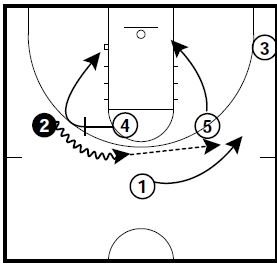
These plays are from Wichita State’s Quick series. Every dead ball or timeout, Coach Marshall gives his players a “1st Play” and “2nd Play” to run in the upcoming segments.

Quick 1

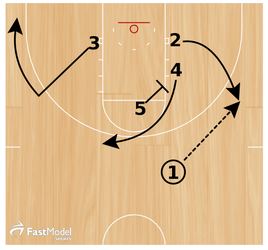
basketball-plays-wichita-state5

1 passed to 4 who passed to 3.

4 sprinted into a side pick & roll which he SLIPPED.

At the time 4 slipped 5 set the pick for 3 to use.

2 cut through and screened 4 into a post-up.
 

Quick 2

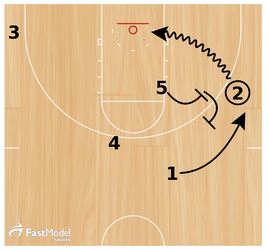
basketball-plays-wichita-state1

 
You can run this for a Quick 3 point shot.
4 cuts over top of screen from 5.

2 pops out and 1 passes to 2.


basketball-plays-wichita-state2


5 steps out to set a side pick & roll or 2.

2 turns down the pick and attacks the rim.

5 then screens 1 for a throw back option.


Quick 3

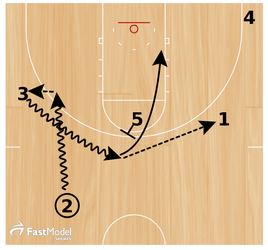
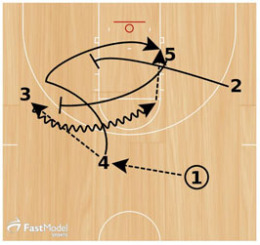
Wichita State frequented this play last year in the 2013 Men’s Final Four. The first option is to hit 3 cutting off the post for a lay-up. If he isn’t open, 5 steps out for a middle pick & roll and replace for 1.

basketball-plays-wichita-state3


3 received a dribble hand-off from 2.

3 dribbled up and passed to 1 and then sprinted off a cut from 5 to the rim.


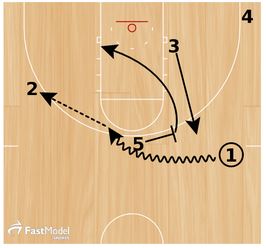
basketball-plays-wichita-state4


5 then set a middle pick & roll for 1.

1 came off and passed to 2 who looked to feed a rolling 5 in the post.

3 replaced 5 above the 3 point arc.

Basketball Drills Defending Perfect Movement

By Brian Williams on November 7, 2014

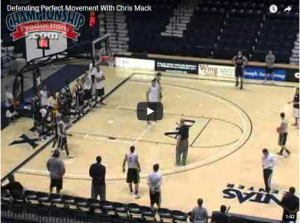
This post contains two videos from Xavier practice with former Coach Chris Mack. The first video is a 5 on 5 defensive drill requiring the defense to play perfectly for 24 seconds. The final video is a two player drill working on help position and closeouts.

If you are interested in seeing more information about the DVD that the samples are taken from, click here: All Access Xavier Basketball Practice

Press the play arrow in the middle of each video to see each YouTube video. Make sure that your sound is on as you watch them.

Basketball Drills: Defending Perfect Movement :24

This basketball drill requires players to be in perfect position, communicating with teammates, seeing the basketball, and staying in their defensive stance for 24 seconds. Any breakdowns and the players must start the drill again for a full, consecutive 24 seconds. You can add any fundamentals that you want to the requirements or require that players execute for a longer period of time to win the drill. Make sure that your sound is on and click the play arrow to see the video.

Basketball Drills: 2 on 2 Gap Closeouts

Drill to work on getting in the defensive gap to see both the basketball and the player you are guarding, establishing help side position, and closing out. Make sure that your sound is on and click the play arrow to see the video.

If you are interested in seeing more information about the DVD that the samples are taken from, click here: All Access Xavier Basketball Practice

Basketball Plays Spurs Power Roll

By Brian Williams on November 6, 2014

This set has a couple of different ways to run it.

My goal for these types of posts if for you to get some ideas for ways to run actions that allow your players to play to their strengths.

These options are from the San Antonio Spurs are drawn from Coach Scott Peterman’s Spurs Playbook compilation.

The Warriors Playbook and the San Antonio Spurs Playbook make up this week’s featured eBook bundle. You can find out more about them at this link:

Spurs and Warriors Playbooks

If you have any questions about the Playbooks, please feel free to email me or call/text me at (317) 721-1527.

Power Roll Option 1

Diagram created with FastDraw

basketball-plays-power-roll1

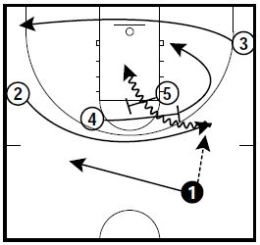
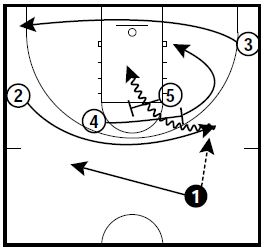
2 comes over the top to the right wing.

3 cuts to the left side corner.

5 sets a cross screen for 4 to make it difficult on 4s defender to get to the ball screen on time.
5 should space away to open up the pick and roll.

1 passes to 2 and slides to the left side wing.

4 sets a ball screen for 2 and rolls to the right low block.

2 comes off the ball screen to the middle of the lane.

Power Roll Option 2

basketball-plays-power-roll2

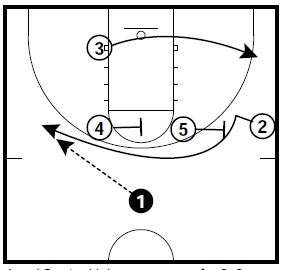
4 sets a down screen for 2.

5 sets a cross screen for 2.

2 comes over the top.

1 passes to 2 and slides over to the left wing.

3 cuts to the left side corner.

5 comes back and ball screens for 2.

2 comes hard off the ball screen to the middle.

Power Roll Option 3

basketball-plays-power-roll3

4 and 5 set a high cross screen for 2.

2 comes over the top to the left wing.

3 cuts to the right wing. 1 passes to 2.

2 might have a quick driving opportunity


Option 3 Continued

basketball-plays-power-roll4

4 sets a ball screen for 2 and rolls to the left low block.

1 slides over to the right wing.

2 comes hard off the ball screen to the top of the key.

5 slides down to the right low block.

2 can hit either big on the blocks or pass to 1.

These options are from the San Antonio Spurs are drawn from Coach Scott Peterman’s Spurs Playbook compilation.

The Warriors Playbook and the San Antonio Spurs Playbook make up this week’s featured eBook bundle. You can find out more about them at this link:

Spurs and Warriors Playbooks

If you have any questions about the Playbooks, please feel free to email me or call/text me at (317) 721-1527.

Coaching Basketball Kevin Eastman Defensive Thinking

By Brian Williams on November 5, 2014

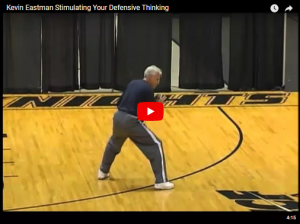
This four minute video clip came from a presentation entitled “Stimulate Your Defensive Thinking” with Veteran NBA Assistant Kevin Eastman.

He served as an Assistant Coach for the Celtics from 2004 to 2013. At that time he made the move to Los Angeles with Doc Rivers and was on the coaching staff and also served as the Vice President of Basketball Operations for the Clippers.

He is now retired from the NBA and is on the speaking and clinic circuit full time.

The purpose for the video is to provide some thoughts and ideas for you to apply to your thought processes about your defensive system. AT the bottom of this post, there are more links to other short videos with Coach Eastman on various topics.

If you are interestd in learning more about Coach Eastman’s 45 minute presentation on imporving your defensive thinking, click this link: Kevin Eastman Defensive Thinking.

You can also see another 5 minute video on Skill Development from Coach Eastman by clicking on this link below:

Make sure your sound is on and you click the play arrow to see the video.

  • « Go to Previous Page
  • Page 1
  • Interim pages omitted …
  • Page 172
  • Page 173
  • Page 174
  • Page 175
  • Page 176
  • Interim pages omitted …
  • Page 288
  • Go to Next Page »

Primary Sidebar

  • Twitter
  • Facebook
  • Linkedin
coachestoolbox
personaldevelopmenttoolbox
basketballplayerstoolbox
basketballtrainer
athleticperformancetoolbox
coachingbasketball

© Copyright 2026 Coaching Toolbox

Privacy Policy