• Skip to primary navigation
  • Skip to main content
  • Skip to primary sidebar

  • Basketball Plays
    • Ball Screen Sets
    • Horns Sets
    • Man to Man Post Up
    • Man to Man Isolations
    • Backdoor Plays
    • Man to Man 3 Point Shot Plays
    • 2-3 Zone Attack
    • Baseline Inbound Plays
    • Sideline Inbound Plays
    • Combination Defense Attack
  • Drills
    • Defensive Drills
    • Offensive Drills
    • Competitive Drills
    • Passing Drills
    • Rebounding Drills
    • Shooting and Scoring Drills
    • Toughness Drills
    • Transition & Conversion Drills
    • One on One Drills
  • Blueprint
  • Practice
  • Mental Toughness
  • Skill Development
  • Offense
  • Defense
  • Store

Basketball Plays: Short Seconds SLOB

Basketball Plays: Short Seconds SLOB

By Brian Williams on February 17, 2015

Here is an idea for a short seconds Sideline Out of Bounds play to run against man to man defense that has three options.

This post was contributed by Houston Women’s Assistant Head Coach Vonn Read.

Coach Vonn Read has submitted several plays from his playbook series The Basketball Encyclopedia of Plays to the Coaching Toolbox.

You can also see more of his plays in the Related Posts links at the bottom of this post.

Vonn served as an assistant coach in the WNBA with the Phoenix Mercury, Orlando Miracle, and San Antonio Silver Stars.

He was an advanced scout for the Orlando Magic as well as The Charlotte Sting.

Flare Hammer Combo Set

Diagrams created with FastDraw
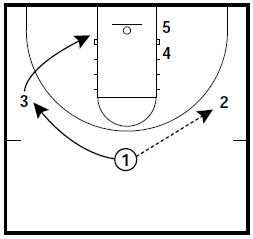
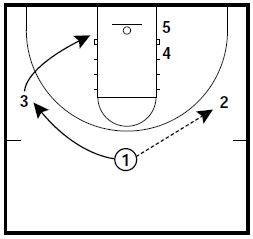
basketball-plays-flare-hammer-combo1

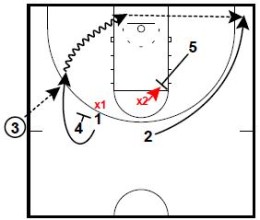
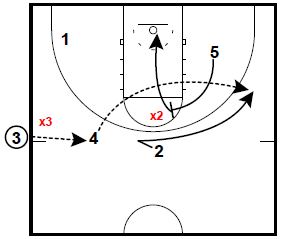
The 1 player will come off the screen set by the 4 player and curl to the basket for the pass.

On the catch, the 1 player will drive baseline, looking to kick it to the 2 player in the corner for the 3-point shot.

On the drive, X2 will get caught staring at the ball, while the 2 player flares to the corner off of a flare screen set by the 5 player.

If you only need 2 points, the 1 player can drive for the layup.
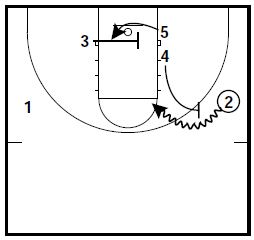
basketball-plays-flare-hammer-combo2

2nd Option

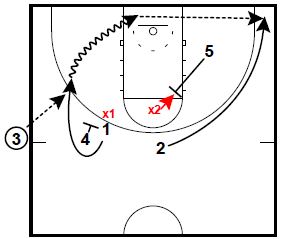
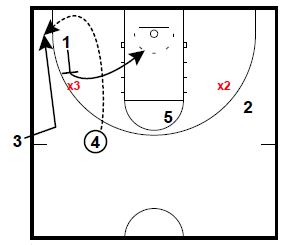
If the 1 player is not open, the 3 player will pass to the 4 player.

The 4 player has 2 Flare screen options, either to the 2 player or 3 player.

The 4 player can pass it to the 2 player coming off of the flare screen set by the 5 player.

If you only need 2 points, the 5 player can slip to the basket for a layup on the flare screen.
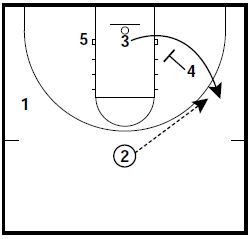
basketball-plays-flare-hammer-combo3

3rd Option

The 4 player can also pass it to the 3 player coming off of the flare screen set by the 1 player for the 3-point shot.

If you only need 2 points, the 1 player can slip to the basket for a layup on the flare screen.

Coach Read has also put together The Basketball Encyclopedia of plays. You can check them out here: The Basketball Encyclopedia of Plays or read more about the books:

Any coach looking for the latest and innovative plays from the Professional, College, or High School levels can stop looking. With a compilation of over 7,700 different plays, you will never need to purchase another basketball playbook again. These playbooks can be used as a great reference tool for years to come. This 2 Volume Book includes plays from 19 different play categories, and they are the most extensive playbooks on the market.

The Basketball Encyclopedia of Plays (Platinum Series) contains over 7,700 Plays (Both Volumes combined) from the NBA, WNBA, USBL, and College levels from someone who has worked as an Advanced Scout or Coach on each level!!! This book has been intensely compiled over the last 21 years, with plays taken from a lot of NBA Coaches (past and present), WNBA coaches, and College coaches (Men’s and Women’s) from around the country.

Any coach that is serious about improving their knowledge of the game from an X and O standpoint will benefit tremendously from these books. These Books can be used to discover New Quick hitters, add a New Package to your playbook, or develop an entire Offensive System. There are a lot of new ideas and concepts in these books to study, and the Basketball Encyclopedia of Plays can be a great resource for coaches on all levels!!! This book is definitely for those X and O junkies who are always looking to improve as a Coach.

“THE GAME IS ALWAYS CHANGING? ARE YOU?” Vonn Read

Here is the link: The Basketball Encyclopedia of Plays
POISE: Practice On Intense Situations Everyday

By Brian Williams on February 16, 2015

P-O-I-S-E

“Practice On Intense Situations Everyday”

by Coach John Kimble

CoachJohnKimble.com

Retired Crestview (FL) High School

Offensive Situations

This article was originally written for Winning Hoops

How many basketball games have you watched or been involved in where the outcome of a close game is determined by just a matter of a couple plays? Both teams may be very equal in the talent and skill level with possibly the only difference being the outcome of one or two key possessions during the game. It is conceivably possible that one of the teams could possibly even have less talent, in general been out-prepared, out-hustled, and out-played in almost every aspect and phase of the game. But because of just one or two particular possessions, that team that succeeds in those possessions can win the game.

Those possessions could very likely be the last second situations of each time period whether it is the end of quarters or halves. Those offensive possessions not only can produce points for your team but maintaining possession of the ball also prevents the opposition from scoring.

Preserving possession of the ball for the last shot of the time period and then scoring at the end of that specific time period could be as much as a 6 point swing in addition to the momentum and confidence builder that that one possession could produce. Having two or four end of time period possessions should then be looked upon as invaluable in the preparation time for that game.

Does one of these teams have a decided edge in preparation of unique scenarios that can easily happen during the game? But unless this team is prepared and can achieve an edge in these situations that can easily take place in a game, all of the hard work and effort put forth by both players and coaches (during the actual game and in practices) will have gone for naught.

If the various offensive situations that could possibly take place during the course of a game have not been carefully thought out, analyzed and then practiced many different times, a basketball team could only win this type of close game by relying solely on executing a play they have just had diagrammed to them for the first time in a frenzied timeout. If winning a game is so important, should a coach go with an offensive play that was drawn up during the excitement of a last second timeout—a play that the coaching staff and players are not necessarily familiar with or is a coaching staff going to elect to run a play that has been carefully thought out, discussed, taught, and practiced repeatedly during the season?

My opinion is that if a staff and basketball team that has spent countless hours on fundamentals and skills of the game and also numerous hours on plays, offenses, and defenses; shouldn’t “one-play scenarios” that may be the actual deciding factor in determining the winner/loser of the game be practiced at least for a few minutes frequently? Instead of a coach drawing up a play that his team might not have ever seen or practiced, why not have the plays already drawn up, seen and understood by his team and also specifically practiced. This would give that team an opportunity to be as prepared for these last second situations as they are for everything else that takes place in the game.

There are many different methods and philosophies that have been proven to be successful. There doesn’t have to be a “right or a wrong” method, as long as the method has been carefully thought out and agreed upon by the coaching staff. Once the philosophy has been developed, that philosophy must then be thoroughly taught and sold to the players. Instead of giving coaching staffs specific answers to all the many scenarios that exist, the purpose is to challenge each reader to be prepared for those situations by simply asking themselves if they have developed a sound idea and philosophy to the many different offensive situations that could easily come up in games.

OFFENSE—S.O.B./B.O.B. PHILOSOPHY

Before late-game decisions that could determine the outcome of the game are made, there are other ideas and philosophies that must to be developed. Does your offensive team have “baseline out-of-bounds plays” that will be successful against man-to-man defenses and/or against zone defenses? On offense, does your team have specific plays from the sideline that can be run against zone and/or man-to-man defenses?

TIMEOUT SELECTIONS

Does the coaching staff have a philosophy on whether they want players early in the game to call a timeout to protect the possession of the ball as they are about to fall out of bounds or about to get tied up after a loose ball on the floor? Or does the coaching staff want to save those timeouts for late game situations? If the coaching staff does not have a set philosophy and has not taught their players, those decisions will then be left up to the players. Does the coaching staff want to leave that decision up to the players?

OFFENSE—DELAY GAME AT THE END OF PERIOD

Offensively, does your team half a Delay Offense or more than one? What are the rules of the Delay Offense? Can anyone take the last second shot? What kind of shots are acceptable and what kind are unacceptable shots? When is the appropriate time to take the shot? Do you allow time for an offensive rebound? What defense are you going to fall back into? Will you press full court? If so, will it be passive or aggressive? Will it be man-to-man or zone press?

OFFENSE—SHOT SELECTION (“2’s” or “3’s?)

Another scenario/situation a team and coaching staff must recognize is the actual score and what type of shot do they need to take and what types of shots should not be taken. Don’t expect your players to read the your mind and know exactly what kind of shot you want. One line of thought is that if the score is tied or down by as much as 2, a high percentage shot or a shot that could draw a foul should be taken and not a “3” (in the lane). Others believe in taking the “3” immediately. Obviously if your team is down by 3, your team needs the best possible 3 point shooter to take as good of a 3 point shot as he can get and the play should be designed to allow that.

If your team is down by 4, the coaching staff must determine whether they want a 3 point shot or a 2 point shot to be taken followed by a press (and ultimately a foul). A definite philosophy should be agreed upon by the coaching staff in the preseason and then thoroughly taught to all players in the program, so that there is no doubt or hesitation in anyone’s mind as to what to do during the intense situation.

OFFENSE–TRANSITION AFTER OPPOSITION SCORES

One of the most important decisions a coaching staff should decide on and then convey to all players is what they should do in the last seconds of a game after the opposition scores to tie the game or put the opposition into the lead. The amount of the lead should also affect the coaching staff’s philosophy.

Do players have a grasp on how many seconds it actually takes to dribble full court for a driving layup or to the top of the key for either themselves or the opposition? Has the number of dribbles it takes to reach various points on the offensive end of the court (such as the basket, the top of the key, to the ten-second time line) been counted and timed? Does each player know who realistically are the three-point shooters that should take that last second shot? Has the team practiced those “buzzer beater” shots?

OFFENSE—TRANSITION WITH A LATE GAME DEFICIT

Does your staff have a philosophy (and a plan and a play) to react to the opposition’s score in the last minutes of the game that puts your team behind by 4 points with more? Or what do you want to do if you now trail by three points with more than or less than 10 seconds? What does your team do if you trail by two points with more than 10 seconds or less than 10 seconds, or trailing by one point, or when the score is tied (with more than 10 seconds or less than 10 seconds remaining? A coaching staff might not have practiced all of the various scenarios that could actually play out in a game, but he/she at least should have a mental plan on what he/she wants to do.

After the opposition scores late in the game, do you want your team to automatically call a timeout and set up a play? Many coaches adhere to that practice because they feel they then can organize their team for a planned (and hopefully practiced) play? This is a sound reason, but the timeout also gives the opposition an opportunity to organize and possibly substitute better defensive players into the game, set up a full court press, or change half-court defenses. Without a timeout, the opposition would be able to make none of these adjustments. Who will benefit more from the timeout, your offense or the opposition’s defense? Does the coaching staff have a sound philosophy for their decision?

A philosophy opposite of automatically calling a timeout after the opposition scores is for the offensive team to push the ball quickly down the court and already have a plan and a play (that has been practiced repeatedly) to execute. The defensive team obviously could not substitute better defenders in the game, could not probably set up full court pressure and probably not effectively set up a different half court defense. In fact, not calling a timeout sometimes could catch the opposition off balance and allow for better offensive matchups and give the offensive team a high percentage shot. The question that must be asked is “Is your offensive team prepared enough to execute a last second play in a pressure packed situation? Does your team fully understand what type of shot and who the coaching staff wants to take the last shot?”

OFFENSE–LAST SECOND SHOT SITUATIONS FROM FULL COURT

When your team calls a timeout and your offensive team must travel the length of the court, there are two important factors that can change the philosophy. One is that the offensive team may be or possibly not allowed to run the baseline.   Not being able to run the baseline takes away very important options that an offensive team can incorporate into their “last second shot” philosophy. The second scenario is determining whether the offensive team has any remaining timeouts left to use. If timeouts still exist, any offensive pass receiver that catches the ball in the frontcourt could possibly call an immediate timeout. This would allow the offensive team to reorganize and run a “Sideline Out-of-Bounds” play that starts much closer to the basket.

A coaching staff must know which scenario exists and not only know beforehand how he is going to handle these critical decisions, but convincingly sell his philosophy to every player and then have his players repetitively practice that play in game-realistic situations. The coaching staff must devise a play that could also handle the surprise defensive change by the opposition. Each play should have a primary and a secondary shooter in case the primary shooter is taken out of the play defensively.

OFFENSE–“QUICK” SIDELINE & BASELINE OUT-OF-BOUNDS SITUATIONS

Do you have a philosophy and a plan and a play for offensive “Sideline Out-of-Bounds” situations and also “Underneath Baseline Out-of-Bounds” situations when your team needs a “quick” shot (because of just a few seconds left on the clock), a “three-pointer,” or a “quick” three-pointer?

OFFENSE–LATE GAME DESPERATE FREE THROW SITUATIONS

Do you have a philosophy and a special play to fit the needs of your free-throw shooting team late in a game when your team is down by two or more points. Do you have any special “rebounding stunts” and intentionally miss specific free throws to get the offensive rebound? Do your rebounders know how to beat the defensive box-outs and does your free throw shooter know how to miss the free throw? Do you know how to slow the opposition down from inbounding the ball after your team has made the last free throw, so you can set up a full court press?

OFFENSE–DELAY GAME/FREEZE SITUATIONS

Do you have a plan of action when you want your offensive team to simply “milk” the clock and not be fully committed to “letting the air out?” Do you have an offensive philosophy dependent upon the time and score when to start your fully commitment to “stall?” Do you have an offense (or two) designed to achieve that purpose? Do you have a complementary defense that corresponds to the offense that you are implementing in that particular situation?

Do you have special inbounds plays to get the ball to your best free throw shooter when your team has the lead and are being pressed late in the game? Do you take advantage of the times when you are legally allowed to run the baseline when taking the ball out of bounds?

What is the coaching staff’s philosophy when it is very late in the game with the lead and you have to make a choice between inbounding the ball to one of two different players–your best free throw shooter or to your best ballhandler?

Do you and your team agree on who are your best free throw shooters are, who are your best ballhandlers, and who are your best 3 point shooters? The coaching staff and each and every player should agree with the coaching staff’s opinion on the best player in each of these categories. If not, there could be a breakdown in some crucial situation, which could prove costly to the team. How does the coaching staff determine who are the best free throw shooters, the best ballhandlers on the team? How does the coaching staff then convince the team who those specific players are?

CONCLUSION

Instituting a philosophy and specific offensive plan for the many situations requires a great amount of time, effort, imagination and creativity by the coaching staff. This plan will be much more fundamentally sound and effective when developed in the off-season instead of in the middle of the game. The margin of winning and losing can sometimes be just the difference of one decision by the coaching staff and/or of one correctly or incorrectly executed technique by a player. Winning just four games that could have been losses can drastically turn the outcome of an entire season around. A team that ends up with a 15-11 record seemingly has a totally different season when they could have had a 19-07 record.

If the coaching staff makes the correct coaching decision and a player executes that decision properly in a championship game could be the difference in winning championships instead of being runners-up.

Not only should a coaching staff create and build a wide range philosophy in the off-season, so that sound decisions can immediately be made during pressure-packed games, but a plan of action must be devised so that every player on the team can grasp the reasoning of those decisions. Those players must then be given frequent repetitions in order to improve their performance levels.

Implementing the last ten to fifteen minutes of practice of several sessions will be invaluable to the team. During the season’s practices, the appropriate techniques can then be fully explained, taught, and practiced with the players and the entire coaching staff. This makes everyone involved more prepared and confident in the defensive plan of action. Remember the cliché, “Luck is when preparation meets opportunity.” Be lucky in those close games with POISE.

About the Author

Coach Kimble was the Head Basketball Coaching position at Deland-Weldon (IL) High School for five years (91-43) that included 2 Regional Championships, 2 Regional Runner-Ups and 1 Sectional Tournament Runner-up. He then moved to Dunlap (IL) High School (90-45) with 2 Regional Runners-up, 1 Regional, 1 Sectional and 1 Super-Sectional Championship and a final 2nd Place Finish in the Illinois Class A State Tournament. He was an Assistant Basketball Coach at Central Florida Community College in Ocala, FL for 1 year before becoming Offensive Coordinator and then Associate Head Coach for 3 additional years He then was the Head Basketball Coach at Crestview (FL) High School for 10 years, averaging over 16 wins per season.

He has had articles published in the following publications such as: The Basketball Bulletin of the National Association of Basketball Coaches, the Scholastic Coach and Athletic Journal, Winning Hoops, Basketball Sense, and American Basketball Quarterly. He has also written and has had five books published along with over 25 different DVDs by Coaches Choice and Fever River Sports Production.

See him on Twitter @CoachJohnKimble and his Web Page “www.CoachJohnKimble.com”

Handling Defensive Pressure

By Brian Williams on February 13, 2015

Clinic Notes from:

PGC_GLAZIER_LOGO_K

These are some of the notes I took at last spring’s PGC/Glazier Basketball coaching Clinic in Chicago.

The presenter was Tyler Coston, a full-time course director and clinician with PGC Basketball and his topic was “Handling Defensive Pressure.”

Mindset for facing pressure

  • Dick Devenzio, Founder of PGC Basketball and author of several coaching books, taught players that “Pressure is an illusion in the mind of the offense.”
  • It’s not the pressure itself that leads to most of the turnovers, it is the fear of the pressure that causes bad decisions and leads to turnovers.
  • Most turnovers against pressure are stolen out of the air, not taking the ball from your hands.
  • Fear of being pressured (fear of anything for that matter) is a “Mind Killer.” You can’t think when you’re afraid.
    Fear makes you frantic and flustered, agitated and confused.
  • As coaches, we must help our players to develop a mindset to get over the fear and be cool, calm, and collected.
  • Actually an opponent puts themselves at a disadvantage when pressing because they spread themselves out and have more territory to defend.

Getting open against defensive pressure

  • Running a 4 way race.
  • Players should run east and west or north and south, taking long strides, running in a straight line, and making sharp changes in direction.
  • If the defense is on the side, run north and south. Players get in trouble when the run in curves.
  • Get open by the 3rd or 4th step.

Spacing against defensive pressure

  • You cannot have 2 players running away from the ball against pressure.
  • Any time the ball is trapped, you need 3 available receivers near the player with the basketball and 1 at the basket to force the defense to guard the basket.
  • You can usually fix your spacing just by moving one player.

Power Position Holding the basketball when being trapped while looking to pass out of the trap.

  • Hold the ball with both hands and against the shoulder to establish 3 points of contact.
  • Makes it much tougher for the defense to dislodge the basketball.
  • Elbows wide, but not swinging. They are not swords to swing, they are spears.
  • Wide Feet.
  • Changing heights moving up and down-flexing and extending knees.
  • Be ferocious when you are trapped.

Passing Out of a Trap

  • Fake first before you attack the trap.
  • Pass out of the trap with a “Piston Pass” an explosive driving pass from the shoulder. Pass as if you are trying to break a window with your fist. “Break the Glass on the Pass.”
  • The windows to use to pass by a defensive player are directly over their head, by their ears, and by their arm pits.
  • Ball handler must move the defenders hands and arms where you want them to be to make the pass with your eyes & body.

4 on 4 passing out of a trap drill

  • Objective of the drill is for players to develop confidence in their ability to pass out of a trap while teammates learn the value of 3 nearby and available receivers.
  • A space in the middle of the floor works best for the drill. The receives should to to the pass and meet it, so the group will constantly be moving and adjusting positions and spacing.
  • Offense must hold the basketball for 5 seconds before passing out of the trap. The two trapping defenders count to 5.
  • 2 defenders must always trap the basketball.
  • Offense gets a point per completed pass.
  • If the defense gets a deflection, offense and defense switch.
  • Play to 10 points.

2 offense vs. 3 defense Full Court Drill

  • Rule for the offensive players. If you have one defender guarding you, beat them. If you have two defenders guarding you, pass to the defense.
  • Offense plays to score or get fouled at the opposite end basket from where they start. Make teams of 3 and make the drill competitive.

Closing Thoughts

  • The moment a pass comes out of a trap, attack before the trappers can recover.
  • Your mentality against a press is to get a layup, not just getting the ball across half court.
  • You get layups by attacking immediately when the pass comes out of the trap.
  • Your team’s mentality must be ‘You press us, you pay!

Basketball Plays: Michigan State & OK State Zone Sets

By Brian Williams on February 12, 2015

These two zone attack sets are from Scott Peterman’s Ultimate Zone Offense eBook.

I hope they give you some ideas that you can add to your zone attack.

You can also get any two of our eBooks for $25 at this link: 2 eBooks for $25

If you have any questions about the ebooks, feel free to call/text me at (317) 721-1527or email me at [email protected]

Diagrams created with FastDraw

basketball-plays-osu-zone1

1 passes to 2 and cuts to the left wing.

3 cuts to the left low block.


basketball-plays-osu-zone2

3 screens across the zone.

5 curls across the screen.

4 sets a ball screen on 2.

2 attacks the middle of the zone.

2 hits 5 if it is open or hit 1.

basketball-plays-osu-zone3

4 sets a screen against the bottom outside zone defender.

3 cuts to the right wing.

2 can pass back to 3.


Michigan State Zone Attack Set

basketball-plays-michigan-state-zone

5 sets a ball screen on the top left zone defender.

1 dribbles to the left wing.

3 screens the top right zone defender.

4 screens the bottom right zone defender (who probably will have moved to the lane to help when 1 dribbles the ball to the left wing.)

2 pops out to the right wing.

1 throws a skip pass to 2.

These two zone attack sets are from Scott Peterman’s Ultimate Zone Offense eBook.

I hope they give you some ideas that you can add to your zone attack.

You can also get any two of our eBooks for $25 at this link: 2 eBooks for $25

If you have any questions about the ebooks, feel free to call/text me at (317) 721-1527 or email me at [email protected]

Basketball Drills Pressure Shooting

By Brian Williams on February 11, 2015

Today’s post is an idea for a competitive shooting drill with Brian Baudinet, former Assistant Coach with the NBA Development League’s Tulsa 66ers (Since relocated and renamed to the Oklahoma City Blue).

Coach Baudinet is currently the Head Boy’s Basketball Coach at Canterbury Prep School in CT.

You can use this drill as a part of your fall shooting workouts or save it for the individual skill development portion ofyour winter practices.

I like finding varieties of ways of keeping score and putting some pressure on the shooter. You could also add a timed segment to the drill to put another type of pressure on your shooter.

You can change the types of shots that you shoot to fit your system.

Another tweak you can make is to change the scoring to fit the level of your players. For example, making 15 without missing through could be “Gold”, making 13 and missing 3 could be “Silver,” 11 and 3 “bronze,” etc… You could use D1, D2, D3, Champion, Varsity, JV, or whatever levels are appropriate for your team.

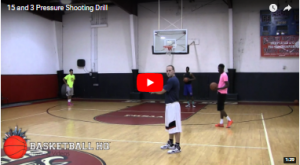
This video is one of the great resources available from basketballhq. They have several more videos as well as resource articles.

Please make sure your sound is on to see the video.

Click the play arrow so see the drill.

Basketball Drills 15 and 3 Pressure Shooting

Coaching Basketball: Playing with Purpose on Purpose Part 1

By Brian Williams on February 10, 2015

This article was written and submitted by retired High School Coach Dave Millhollin.

I have included more information about his coaching career at the end of the article.

Caoch Millhollin has contributed several insightful articles to the site. You can find links to more of them at the bottom of this post under the “Related Posts” tab.

If you would like to contact Coach Millhollin, email me and I will put you in touch with him.

Playing with Purpose on purpose (Part 1)

The following is a simple process describing how “meaning and purpose” can be infused into your team.  It involves efficient communication, goals clarification and player/coach involvement.  It promotes unity and “buy in”.  Teams that play with meaning and purpose naturally develop their own unique “identities”.  The team and program’s Philosophy and the Actions of the Team become one in the same.

Begin this process after the season is over in the spring or summer.  Have a meeting with your returning and incoming players.

What we want to accomplish

Discuss and decide upon the major things that your team wants to accomplish the next season.  I’m talking about tangible things like: finishing in the top 3 of league, going undefeated at home, winning two playoff games, conference or overall record, winning district, etc.

As the coach and director of the team, you must make sure the goals your team decides upon are challenging but realistic; this is critical.

THIS PROCESS WILL BACKFIRE IF YOU SET UNREALISTIC OR UNREACHABLE GOALS.

Who we have to beat

Now that you have your list, the next step is to identify the specific teams you must defeat in order to achieve your goals.  One team is fine, but no more than three specific teams.  The idea here is that the way you must play in order to beat these identified teams will be sufficient to defeat pretty much anyone else on your schedule.

How we have to play

Once you have your list of goals and have identified the teams you have to beat, the next step is to make a list of how you need to play in order to beat those teams and achieve what your team wants to accomplish.  This involves making another list.  Some things on this list will probably be things your team is already pretty good at, but most of the things on the list will be things your team will need to work hard at in order to get good enough at them to enable them to achieve their goals.

For the sake of illustration, let’s say you and your guys have decided the team they have to beat is the called the “Lancers” and let’s say your players identified the following things they must do in order to beat the “Lancers” and to accomplish their goals:

  • DEFENSIVE CONTAINMENT and CONVERSION
  • DRIVE DEFENSE
  • QUICK KICK OUT CLOSE OUTS
  • MAKE OPPONENTS TAKE LOW % SHOTS
  • KEEP OPPONENTS OFF THE FREE THROW LINE
  • DEFENSIVE REBOUNDING (GIVE UP NO 2ND SHOTS)
  • HANDLE PRESSURE AND PRESSES (COMMIT NO LIVE BALL TURN OVERS)
  • OFFENSIVE CONVERSION; TAKE GOOD SHOTS AND SHOOT A HIGH % (PROBABLY +50%)
  • FREE THROW CONVERSION (+70%)
  • GET GOOD AT EXECUTING IN GAME ADJUSTMENTS
  • EMOTIONAL CONTROL
  • GREAT PHYSICAL CONDITION

There are 12 things on the above list.  You may want to condense your list to 4 or 5 essentials, or if it has 12 things like the one above, you could keep them all and call it something like the “dirty dozen”.

Players and coaches make a commitment to the “goals list” and to the “what teams we have to beat” and “how we have to play” lists.  These lists need to be something every player and team coach knows and can explain inside and out.  These lists provide the PURPOSE for virtually everything your team does and everything your coaches do.

Therefore, PURPOSE drives all your meetings, practice activities, pre-game goals, post-game evaluations, offensive and defensive schemes, player roles and playing time, and everything else your team does.  Everything that is not consistent with your PURPOSE must be ELIMINATED………So, coaches (and players) must constantly be identifying things they are doing or thinking that are not consistent with their PURPOSE (so those things can be eliminated).

For teams that are allowed to play “off season” games (summer league, team camp, etc.) the “PURPOSE process” should start as soon as possible in the spring or summer.  For teams that are not allowed to begin until the fall, it should start then.

Practice Games

All your off season, pre-season and exhibition games and scrimmages should be approached with your PURPOSE in mind, no matter what kind of teams you face, you should play in such a manner that would enable you to beat the “Lancers” and reflect your “how we have to play” list.

If your team plays well enough to beat the “Lancers” they will probably be able to have a chance to be successful against just about everyone else on their schedule; if they continue to play that way.  In taking such an approach, your team will develop a consistent style of play, a style that does not change much from game to game and one based firmly on your PURPOSE. 

Coaches

As you “coach with PURPOSE”, you will develop a consistent coaching style predicated on helping your team play with PURPOSE in mind.   Your players will learn to TRUST and depend on you and better understand what your expectations are.  Your players will be better able to meet the challenges you present them as you progress toward accomplishing your goals. Coaches must instill in their players the CONFIDENCE that they will “coach to win” during every game; players need to know that their coaches are just as committed to their PURPOSE as they are as players (more to come on “coach to win” in Part 3)

Player roles and playing time

Player roles are driven by PURPOSE; each player receives a role based on his ability to help his team accomplish its goals.  Individual praise must be consistent and based not on the role a player receives, but on how well the player performs his role, at every team function; practices, meetings, games, etc.  Every coach and player must respect, appreciate and acknowledge how IMPORTANT every other player’s role is and publically acknowledge each other for well performed roles, and hold one another accountable for inadequate role performance.

Playing Time and “Cause over Self”

If you approach the game with PURPOSE; playing time becomes very consistent for each player does not fluctuate much in either close or blow out games.  Each player becomes preoccupied with “Our Purpose and my role” rather than “my minutes” or “my touches”.  This is the epitome of “Cause over Self”.

Communication, Reminders and “Players” on the bench

Players must understand the importance of communication and reminders.  This must be reinforced during all practice drills and on the bench during games.  Players communicate specific directions, encouragement, reminders, praise and constructive criticism.  Side conversations on the bench or in line prior to taking practice “reps” or during team meetings should be strictly forbidden.  Every player on the sideline or on the bench must be cognitively and verbally “in the game” at all times during games and “in the drill” at all times during practices.


© Dave Millhollin

About the author of this article, Coach Dave Millhollin In fourteen years at Ponderosa High School, Coach Dave’s teams won 260 games (.665). From 2000 through 2009 Ponderosa won 207 games over a ten year stretch which included four SVC Conference Championships and two CIF Section final four appearances. Over his 27 year Boys Varsity Coaching career, Coach Dave posted 391 wins, produced 20 college basketball players and was named SVC Coach of the Year four times. At Ponderosa, Coach Dave’s teams were #1 in California in team defense five times and in 2008 Ponderosa was the top defensive team in the Nation among shot clock states. Over Coach Millhollin’s last five seasons (2005-6 through 2009-2010; 136 games) Ponderosa averaged a composite 50% total field goal percentage, 58% two point field goal percentage and 32% three point field goal percentage. Since retiring from High School coaching in 2010, Coach Dave has been actively involved in coaching Jr High level School and AAU teams as well as and running instructional basketball clinics from the primary grades through the College level.

  • « Go to Previous Page
  • Page 1
  • Interim pages omitted …
  • Page 163
  • Page 164
  • Page 165
  • Page 166
  • Page 167
  • Interim pages omitted …
  • Page 288
  • Go to Next Page »

Primary Sidebar

  • Twitter
  • Facebook
  • Linkedin
coachestoolbox
personaldevelopmenttoolbox
basketballplayerstoolbox
basketballtrainer
athleticperformancetoolbox
coachingbasketball

© Copyright 2026 Coaching Toolbox

Privacy Policy