• Skip to primary navigation
  • Skip to main content
  • Skip to primary sidebar

  • Basketball Plays
    • Ball Screen Sets
    • Horns Sets
    • Man to Man Post Up
    • Man to Man Isolations
    • Backdoor Plays
    • Man to Man 3 Point Shot Plays
    • 2-3 Zone Attack
    • Baseline Inbound Plays
    • Sideline Inbound Plays
    • Combination Defense Attack
  • Drills
    • Defensive Drills
    • Offensive Drills
    • Competitive Drills
    • Passing Drills
    • Rebounding Drills
    • Shooting and Scoring Drills
    • Toughness Drills
    • Transition & Conversion Drills
    • One on One Drills
  • Blueprint
  • Practice
  • Mental Toughness
  • Skill Development
  • Offense
  • Defense
  • Store

Basketball Plays Calipari 3-2 Zone Attack

Basketball Plays Calipari 3-2 Zone Attack

By Brian Williams on April 2, 2015

These two zone quick hitters are from Scott Peterman’s Ultimate Zone Offense eBook.

It is bundled with his Ultimate Matchup Zone Defense eBooks as the featured bundle for this week.

Click this link to find out more about the bundle. Zone Offense Playbook & Matchup Zone Defense Playbook


Calipari 3-2 Zone Attack #1

Diagrams created with FastDraw
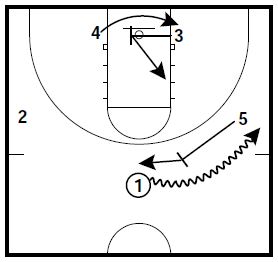
basketball-plays-3-2-attack1

5 sets a ball screen for 1.

1 dribbles to the right wing.

5 pops to the top of the key.

3 sets a cross screen for 4 and steps back to the middle of the lane.

4 comes across the lane.
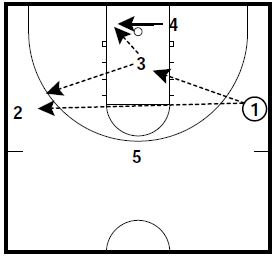
basketball-plays-3-2-attack2

1 can pass to 3 on the step back.

Or, 1 can skip pass to 2.

If 3 gets the ball, he can pass to 4 or out to 2 if the defense collapses.


Calipari 3-2 Zone Attack #2
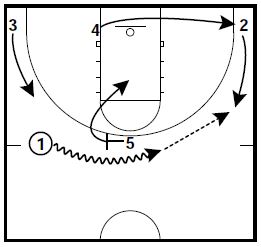
basketball-plays-3-2-attack3

5 sets a ball screen on the top zone defender and then rolls to the middle.

1 comes hard over the ball screen.

2 slides up the right wing.

3 slides up to the left wing.

4 cuts to the right corner.

1 passes to 2.

basketball-plays-3-2-attack4

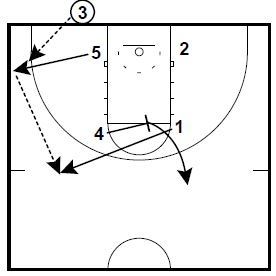
2 passes to 4.

5 cuts to the right low block.

3 cuts to the left low block

4 passes to 5 on the cut to the basket.

These two zone quick hitters are from Scott Peterman’s Ultimate Zone Offense eBook.

It is bundled with his Ultimate Matchup Zone Defense eBooks as the featured bundle for this week.

Click this link to find out more about the bundle. Zone Offense Playbook & Matchup Zone Defense Playbook
Basketball Plays Box Double Low

By Brian Williams on March 31, 2015

This play is designed as a baseline inbounds play to run against a 2-3 zone defense.

Coach Vonn Read has submitted several plays from his playbook series The Basketball Encyclopedia of Plays to the Coaching Toolbox.

You can also see more of his plays in the Related Posts links at the bottom of this post.

Vonn is currently an Assistant Coach for the University of Houston Women’s basketball team and served as an assistant coach in the WNBA with the Phoenix Mercury, Orlando Miracle, and San Antonio Silver Stars.

He was an advanced scout for the Orlando Magic as well as The Charlotte Sting.

Box Double Low – Slip Seam Option vs Zone

Diagrams created with FastDraw

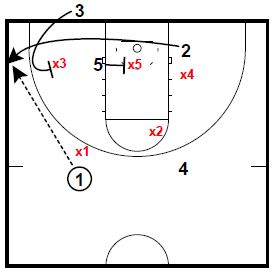
basketball-plays-box-double-low1

This is a great play for a shooter against a Zone Defense.

The 5 player will pop out to the corner for the pass.

The 4 player will screen for the 1 player, who pops out to receive the pass from the 5 player.


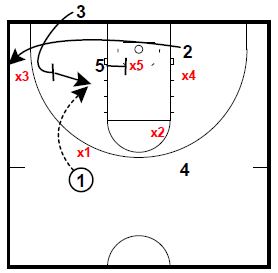
basketball-plays-box-double-low2


The 5 player will cut to the block after making the pass to the 1 player.


basketball-plays-box-double-low3


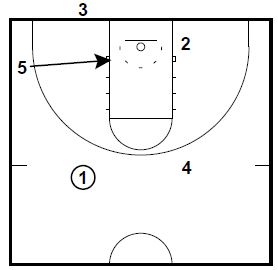
The 3 player will step in and screen X3, with the 5 player screening X5.

The 2 player will cut off the double screen, looking for the 3-point shot in the corner.


basketball-plays-box-double-low4

If X3 steps out and takes away the pass to the 2 player, the 3 player will slip right into the seam for the easy jump shot.

This is an overload action against the Zone, which puts 4 offensive players vs. 3 defenders on the strong side of the floor.


Coach Read has also put together The Basketball Encyclopedia of plays. You can check them out here: The Basketball Encyclopedia of Plays or read more about the books:

Any coach looking for the latest and innovative plays from the Professional, College, or High School levels can stop looking. With a compilation of over 7,700 different plays, you will never need to purchase another basketball playbook again. These playbooks can be used as a great reference tool for years to come. This 2 Volume Book includes plays from 19 different play categories, and they are the most extensive playbooks on the market.

The Basketball Encyclopedia of Plays (Platinum Series) contains over 7,700 Plays (Both Volumes combined) from the NBA, WNBA, USBL, and College levels from someone who has worked as an Advanced Scout or Coach on each level!!! This book has been intensely compiled over the last 21 years, with plays taken from a lot of NBA Coaches (past and present), WNBA coaches, and College coaches (Men’s and Women’s) from around the country.

Any coach that is serious about improving their knowledge of the game from an X and O standpoint will benefit tremendously from these books. These Books can be used to discover New Quick hitters, add a New Package to your playbook, or develop an entire Offensive System. There are a lot of new ideas and concepts in these books to study, and the Basketball Encyclopedia of Plays can be a great resource for coaches on all levels!!! This book is definitely for those X and O junkies who are always looking to improve as a Coach.

“THE GAME IS ALWAYS CHANGING? ARE YOU?” Vonn Read

Here is the link: The Basketball Encyclopedia of Plays

Coaching Basketball: Game Administration

By Brian Williams on March 27, 2015

This article on game administration is the third article from the series,

“Practice On Intense Situations Everyday”

by Coach John Kimble
CoachJohnKimble.com

Retired high school and college coach

I posted the first two articles on offensive situations and defensive situations in February.

Administrative Situations

Originally published in School Coach and Athletic Journal

There are many different methods and philosophies that could be developed that are successful. The key is that there just has to be a set plan and philosophy in place, so that a team knows what to do in those pressure-packed situations. Having been prepared, there should be a confidence, a calmness and a poise for that team to be successful. There doesn’t have to be a “right or a wrong” method, as long as the method has been thought out, agreed upon (by the coaching staff), then thoroughly taught and sold to the players. Instead of giving a coaching staff specific answers to all the many scenarios that exist, I would like to challenge each reader to be prepared for those situations by simply asking them if they have a sound idea and philosophy to the many different situations that could easily come up before, after and during basketball games.

This article discusses some of the many different scenarios from the basketball administrative perspective, while the following articles deal with the specific offensive and defensive situations that can and will take place in games

ASSISTANT COACHES

Assistant coaches must be given responsibilities and assignments and utilized to have an efficient and productive coaching staff that also feels as if they are contributing to the team. Is there a plan of delegation for all assistant coaches during practices, during timeouts and half-times, during pre-games, games and post-games? Where do the coaches sit during games? Are they seated together or do they sit interspersed among the players at predetermined locations? Where? Why or why not?

PRACTICE PLANNING AND PRACTICE ADMINISTRATION

In addition to being a good example and showing the players the coaching staff’s commitment to organization, hard work and effort; detailed practice plans make the teaching and coaching of players more time-efficient and productive. Players want to know what is expected of them and why they are asked to do the things that a coaching staff wants them to do. They need to be led by example and to have faith and trust in the coaching staff. With a practice plan that is carefully laid out (and followed) that encompasses all of the details that are necessary to give a team the poise that it needs to be successful, it also shows a team that a coaching staff’s word is good. Every aspect of the game, including all fundamentals and techniques must not be assumed by the coaching staff that each player is proficient in. Certain fundamentals must not be omitted because they are boring to the coaching staff to teach and boring to the players to learn, improve on or practice. A coaching staff must preach and show by example the “5 P’s—Proper Planning Prevents Poor Performance!”

PRE-GAME ADMINISTRATION

Have those pre-game responsibilities been delegated to assistant coaches and managers? Do the players know what time they are to arrive? Does the coaching staff give the team any free time for players to prepare in their own individual manner? Are there any parameters set for those ways? Are the managers given a certain time to arrive to the locker room?   When they do arrive, are they given specific assignments to pass out uniforms, warm-ups and the preparation for Gatorade or water? What person is delegated to keep track of the time before the first half? Is there a designated time that the staff wants to make sure the players have to warm up for the first half? Is there a pre-game shoot-around? Is there a particular pre-game warm-up routine that is time and energy efficient that is to be used? Who is in charge of filling out the scorebook and naming the game’s starters?

“LAST SHOT” PHILOSOPHY

Preserving possession of the ball for the last shot of the time period and then scoring at the end of that specific time period could be as much as a 6 point swing in addition to the momentum and confidence builder that that one possession could produce. Having two or four end of time period possessions should then be looked upon as invaluable in the preparation time for that game. Does one of these teams have a decided edge in preparation of unique scenarios that can easily happen during the game? But unless this team is prepared and can achieve an edge in these situations that can easily take place in a game, all of the hard work and effort put forth by both players and coaches (during the actual game and in practices) will have gone for naught.

MULTIPLE DEFENSE AND OFFENSE PHILOSOPHY

A successful coaching staff must be able to not only accurately evaluate the physical skills and talents of their team but also the mental skill level of his/her team. Having more than one offense or more than one defense can be very instrumental in the overall success of a basketball team. But having too many can mentally hamper a team and decrease the overall effectiveness of all offenses or defenses. The multiplicity of offenses and defenses must be carefully evaluated as each team has different mental capacities.

OFFENSE—S.O.B./B.O.B. PHILOSOPHY

Before end-of-the-quarter (or half) or late-game decisions that could determine the outcome of the game are made, there are other ideas and philosophies that must to be developed. Does your offensive team have “baseline out-of-bounds plays” that will be successful against man-to-man defenses and/or against zone defenses? On offense, does your team have specific plays from the sideline that can be run against zone and/or man-to-man defenses?

SUBSTITUTIONS

During the game, there can be quite a few different substitutions. Does the coaching staff have a philosophy and a set plan on what all players do on the bench when a player comes out of the game? Do all players know what is expected of them when they come out of a game? Do the assistants know their responsibilities and assignments when a player comes out of the game? Is it allowed for the player taken out to sit anywhere on the bench or are they instructed to sit in a specific location on the bench to receive individualized instructions and corrections from a designated coach? Who is that designated coach?

FOUL-TROUBLE SUBSTITUTIONS

Does the coaching staff have a first half and second half philosophy on taking out a key player because of foul trouble? How many fouls does a player have to get in the first (or second) half before he/she is taken out? At what point in time is that player put back in the game? Is there a specific assistant coach that is assigned to keeping track of the ‘foul situation’ and then informing the head coach?

OFFENSIVE/DEFENSIVE SUBSTITUTIONS

Does the coaching staff have a predetermined plan of subbing offense for defense or vice versa at the end of the game? Do the players understand and are they sold on whom the defensive stand-out is and who the offensive stand-out is? Do they know the proper procedures for when and how they can report in at the dead ball situations? If a coaching staff and team strongly believes in this end-of-the-game procedure, why not use it at the end of the first half or at the end of the quarters? Does the coaching staff have a philosophy on how to sub players in and out during the free throw shooting by the opposition? Does the staff have a plan on how to interrupt that time in order to try to ‘freeze an opposing free throw shooter? Do the players understand the philosophy and the plan? Have they practiced that plan in order to maximize its effectiveness?

TIMEOUT ADMINISTRATION

Has the coaching staff practiced late game timeouts with just the coaching staff? Who has the freedom to talk in the huddle? Who is in charge of obtaining statistics for the timeout? Who is in charge of the diagram boards? Do the manager(s) have water or Gatorade and towels ready? What coach is in charge of making sure that substitutes get in for the resumption of play after the timeout? What coach is in charge of keeping track of the time remaining in the timeout? Does the coaching staff have a set procedure for the active players and for substitutes on where to assemble? Have all players been educated on the importance of the timeouts and do they all know what is expected of them during the timeouts? Has the staff practiced timeouts with the team, including assistants and managers? Are the short timeouts managed any differently than full timeouts? Do the players still go to the bench or do they remain on the court and huddle up?

TIMEOUT SELECTIONS

Does the coaching staff have a philosophy on whether they want players early in the game to call a timeout to protect the possession of the ball as they are about to fall out of bounds or about to get tied up after a loose ball on the floor? Or does the coaching staff want to save those timeouts for late game situations? If the coaching staff does not have a set philosophy and has not taught their players, those decisions will then be left up to the players. Does the coaching staff want to leave that decision up to the players?

STEALING A TIMEOUT

Does the coaching staff have a plan and procedure in place to use the designated time to replace a fouled out player (whether it is their player or an opponent) to gather their team together for an extra timeout? Have the players practiced that procedure? Do the players understand how to execute the planned out procedure?

HALF-TIME ADMINISTRATION

Have responsibilities been delegated to assistant coaches and managers? Who is in charge of the foul situation, the score book and other important statistics? What person is delegated to keep track of the time before the second half? Is there a designated time that the staff wants to make sure the players have to warm up for the second half? What kind of warm-up routine does the staff want the team to use for the second half? Is it the same as the first half warm-up routine? Why or why not? Who is in charge of naming the second half starters?

LAST SHOT ADMINISTRATION

If a team and staff spends so much time and effort preparing for and actually playing a game for the game to come down to one last play, shouldn’t a coach go with a well-thought out play that was designed before the pressure packed situation—a play that all of the players have seen and actually practiced beforehand?

POST-GAME ADMINISTRATION

Assistant coaches and managers need to have a pre-determined plan of action to make the end of game activities a learning and positive atmosphere. This will be the last impression that everyone involved in the program takes away from the game. This time can be a crucial time and everyone must carry out their scripted jobs and assignments to make it time efficient and productive. There will be many different activities and responsibilities that must be taken care of, such as with the press and the possible dispersal of players. Who is allowed in the locker-room after games? Has that been determined? Will there be a post-game instructional session by the Head Coach? Has that time been thought out so that it is after a slight cooling off period where emotions as well as thoughts and statistics have been organized? The media might be involved after the game? What assignments are delegated to people there? Uniforms and the various types of basketball and first aid equipment must be gathered up, inventoried and stored.   Scorebooks, statistics and video equipment must be collected.   All of these “behind the scenes” activities must not only be done but done in a timely and efficient manner. Without a well-planned routine, this will not happen. Final announcements about the next meeting must be given to the team before they are dismissed. Players want and must know the routine before and after games so they can perform them the way the coaching staff wants them to.

CONCLUSION

Creating a philosophy and specific plan for all of these scenarios takes a great deal of time and effort by a coaching staff, but its development can be much more productive and effective when it is done in the off-season and not in the “heat of battle,” during an actual game. During the season, the appropriate techniques can then be explained, taught, sold, and practiced with the players. This makes everyone more confident and prepared. Being prepared will give a team the necessary confidence, calmness and poise to be successful. Remember the saying “Hard work beats talent when talent doesn’t work hard.” Hard work in planning and organizing by a coaching staff can be an invaluable asset for a basketball program.

As a coach, focusing on the important aspects of leadership, improvement, and teaching the game can be overshadowed at times by urgent matters such as getting time-sensitive information out to your team. There are team management apps that allow you to have immediate access to player and parent contact information on your desktop workstation, tablet, or phone. However, there are other ways to make the job of managing the team easier as well. Team management tools, like TeamSnap, automate a lot of these processes for you. In addition to letting you create, update and store a team roster, tools like TeamSnap let you see players’ availability for games and practices, assign responsibilities such as post game food or snacks, and keep track of who has paid their equipment fees, and completed their paperwork.

About the Author

Coach Kimble was the Head Basketball Coaching position at Deland-Weldon (IL) High School for five years (91-43) that included 2 Regional Championships, 2 Regional Runner-Ups and 1 Sectional Tournament Runner-up. He then moved to Dunlap (IL) High School (90-45) with 2 Regional Runners-up, 1 Regional, 1 Sectional and 1 Super-Sectional Championship and a final 2nd Place Finish in the Illinois Class A State Tournament. He was an Assistant Basketball Coach at Central Florida Community College in Ocala, FL for 1 year before becoming Offensive Coordinator and then Associate Head Coach for 3 additional years He then was the Head Basketball Coach at Crestview (FL) High School for 10 years, averaging over 16 wins per season.

He has had articles published in the following publications such as: The Basketball Bulletin of the National Association of Basketball Coaches, the Scholastic Coach and Athletic Journal, Winning Hoops, Basketball Sense, and American Basketball Quarterly. He has also written and has had five books published along with over 25 different DVDs by Coaches Choice and Fever River Sports Production.

See him on Twitter @CoachJohnKimble and his Web Page “www.CoachJohnKimble.com”

Coaching Basketball Player Development

By Brian Williams on March 26, 2015

Some thoughts on player development from various coaches.

This week’s eBook bundle contains 3 eBooks:

2011 NCAA Tournament Coaches – Basketball Skill Development
2012 USA Olympic Team Basketball Drills
130 Ways to Improve Your Program’s Attention to Detail

You can find out more information about the bundle at this link:

Skill Development Bundle


  Billy Donovan

  • Basketball is an unselfish game that is too often played by selfish people
  • Donovan and his staff constantly ask themselves where are our guys mentally?
  • Examine body language as they come into practice or workouts
  • Building chemistry isn’t all on the coach, your best players have the best chance to
    improve chemistry
  • Leaders on the floor/ Leaders in the locker room- often can are two different sets of players
  • Bill Belichick met with Florida’s basketball team shortly before the SEC tournament. Showed them a video of the Breeders’ Cup Horse Race. He paused the tape halfway through the race with the
    outcome still up in the air. He asked the team “Who will win? The horse with the most
    experienced jockey? The horse who has won the most money? The horse with the best odds
    prior to the race?” The team was puzzled, “No, it’s the horse that runs the best race from
    here on out.” You can’t focus on prior accomplishments/failures, you must only focus on
    the present and doing your best the next play.

Rick Pitino

  • Sits down with all his seniors after the season is over and asks them to tell him what they
    enjoyed and what they hated. Constantly seeks feedback.
  • Skill development philosophy: We’re not leaving until you master that move
  • 3 or 4 man workouts lasting from 45 minutes or 1 hour
  • Offensive player should go body-to-body with defender in all drills not just to beat the individual
    defender
  • Players shoot 22% when challenged. (He really emphasizes this fact to the point that during
    one-on-one competition, Louisville players are told to pass it back to a coach rather than
    take a challenged shot)
  • 42 Point Game: Group of 3 players stand at 3 point line, managers rebound. Players shoot a corner 3 running to opposite corner after their shot to take a 3 from opposite corner. Players will then run back to original corner for a one dribble pull-up before heading to opposite corner to do the same. Players will then return to original corner for a catch-rip- 1 dribble layup.Players will do this from seven spots (corners, wings, elbows extended, top of key)with the three-pointer counting as 3, pull-up counting as 2, and the layup as 1. Maximumpoint total:42, losers run.
  • Footwork drill: players line up on baseline under basket, toss the ball to a coach at the three-point line in the corner. Player sprints out to catch the ball on a jump stop facing the coach. Turns his body ripping the ball through (2 important notes: first thing the defender should see is the offensive player’s elbow coming through before the body. Player should exaggerate how low he is on pivot) Run from seven spots on the floor) pivoting both ways-14 actions.
  • Post footwork: Drill begins same as above, but guards now go to block. Before coach passes it into the post, he will hold and make the player move laterally to fight for position against manager. First rep: player turns to the middle, one dribble, point the shoulder into jump hook. Second rep: baseline jumper (DON’T FADE!!!)
  • Box Drill: 1 player on each block, one with a ball. The player with the ball (X1) tosses the ball out to a coach standing outside the 3 point line before x-cutting to elbow. As he’s doing this, the player on opposite block (X2) cuts to the opposite elbow. X1 passes to X2 (who is bothered by manager playing dummy defense to force a difficult pass), X1 takes one step away before cutting across the lane to catch a pass back from X2, X1 absorbs contact (coach holding pad underneath hoop) with his inside shoulder and finishing with his outside hand.Switch players and sides.
  • 1-on-1 Keep out: 1 player on each block. Player with the ball (Offense) throws the ball outto coach and sprints out to receive hand off. As the defensive player steps up, his goal is tokeep the offensive player out of the paint. If offensive player can get into the paint= pointfor the offense. If the defensive player is able to drive him out= defensive wins.
  • The mark of a great on-the-ball defender: ability to keep his shoulders squared on offensiveplayer. Once you open up your shoulders, you’re beat
  • Box Tap Drill: One player on each block. The player with the ball (offense) throws the ballout to the coach and sprints to elbow, defensive player trails. Offensive player catches withhis back to the basket at the elbow and waits for the defensive player to touch his back (hiscue to play) Winner stays on offense.
  • 3 man shooting: 1 player at the top of the key and each wing (3 total). Player at the top of the key receives first pass from coach underneath the hoop for a catch and shoot three. On the next pass, player dribbles twice to the right into the paint and kicks to right wing whospaces out on point’s penetration (Player shoots and then runs through to opposite wing). Player on the left wing replaces at the top of the key and receives his first pass for a catch and shoot and his 2nd for a drive and kick to the right wing (now held by the person whobegan at the top of the key)
  • Coach Pitino Doesn’t allow full court 5-on-5  out of season: “All it does is allow your team to repeat bad habits.”
  • Put competition in every drill—players play harder when there’s a winner/loser. Put something on the line.
  • Don’t personalize criticism- “We” not “You”
  • Working hard is an acquired skill
  • The more you build self-esteem when it’s deserved the more likely guys will work to overachieve.
  • 1on1: Coach on each wing with ball, one player at top of key (offense) and one player just below FT line (defense). Player can step to either side (elbow extended) to receive pass from coach. Defensive player closes out, offensive player is allowed 2 dribbles. On a miss, defensive player passes ball out to coach only to receive it right back (mid-range area on wing). Players stay on until a score. On a make, offensive player heads out to the top of the key and the drill starts again. ON A FOUL: offensive player ducks in immediately to post up next player in line (players must be ready to jump on and try to get in front). A couple of points: no staredowns (players must work quickly) and do not allow your players to take contested shots (rather than take a contested shot, they can pass the ball out to one of the
    coaches and play again).

Bob Hurley, Sr.

  • Keep a separation from your players (“I’m Coach or Mr. Hurley, I am not your buddy”) I never want a player to come back and say I was too nice to them and I should have pushed them harder.
  • Have your former players come back and tell you’re guys 2 things: that everything they’re going through is worthwhile and how great college is.
  • WIN STAT! Deflections + steals + contested shots + blocks + charges + defensive rebounds + loose balls + throw-aheads + offensive rebounds + 50% FG + 70% FT. Player who collects the most in each game gets to sit out all conditioning in the next practice.
  • Make sure that in the first 15 minutes of practice you say something to every player.
  • After a bad loss, teach rather than blame
  • Pickup rules: Games to 8, 2’s and 3’s. Team that wins must “validate” the win with a free throw. If player misses, teams play again. If his team wins again, another free throw. On a miss, his team loses and is off.
  • Drills: 2 teams go against each other for 4/8 minutes. Team that wins must validate the win with a free throw. If he makes it, losing team does the conditioning, but if he misses, his team is now the loser and must run.
  • 3 times a week they practice hustle plays. Drill: Player slides to block to take charge of incoming offensive player. Defensive player jumps up and must dive on the floor to retrieve ball thrown on floor by coach. Player throws it back to coach, gets up and sprints in to get ball back from coach for a layup.

This week’s eBook bundle contains 3 eBooks:

2011 NCAA Tournament Coaches – Basketball Skill Development
2012 USA Olympic Team Basketball Drills
130 Ways to Improve Your Program’s Attention to Detail

You can find out more information about the bundle at this link:

Skill Development Bundle

Basketball Drills Wichita State Shooting

By Brian Williams on March 25, 2015

Two shooting drills from Wichita State and Gregg Marshall. These drills could be a part of either an in season practice or an improvement season skill development workout.

I also have links to other Wichita State skill development drills at the bottom of the page in the list of Related Posts

They are You Tube videos, so you will need to have permission to view You Tube videos.

Make sure your sound is on as you watch. Click the play arrow to see the videos.

If you are interested in learning more about the entire DVD that this sample came from, click this link: Wichita State Skill Development Workout Guards. Anyone who purchases anything from the store receives one of my basketball coaching eBooks as a bonus. Just email me and let me know which one you would like to receive!

Curl, Fade, Transition Shooting Drill

Each player shoots nine shots in this drill–3 sets of 3 shots. A 12 foot curl shot, then back peddle for a fade shot, then touch the half court line and come back to simulate a transition 3 point shot. You can certainly change the drill to incorporate the types of shots you get in your offense. A way to insure that your players go full speed is to add a time that they must complete the shots in once you determine what shots you will be using in your version of the drill.

4-3-2-1 Shooting Drill

Player shoots four shots at one end, sprints to the opposite end to shoot three more, back to the first end for two more shots, then change ends one more time for a three dribble max pull up shot.

If you are interested in learning more about the entire DVD that this sample came from, click this link: Wichita State Skill Development Workout Guards. Anyone who purchases anything from the store receives one of my basketball coaching eBooks as a bonus. Just email me and let me know which one you would like to receive!

Coaching Basketball 10 Point Improvement Plan

By Brian Williams on March 24, 2015

Ten Point Basketball Coach’s Growth Plan

One of the maxims that has influenced my thinking as a head basketball coach is that “Champions have no off-season.” It led to my naming the spring and summer as our program’s “Improvement Season.” I expect our players to work at improving themselves using the program that we have developed for them. I believe that I must lead by example. I also believe that if I am not improving as a coach, then I am holding our players and program back.

I develop a specific, written improvement program for myself and for our assistant coaches at the end of each season. Here are some ideas for you to use to develop a coaching improvement plan for your staff.

1. Develop a specific written summer workout plan for each of your players. A coach is only as good as his or her players allow. List the drills they need to do and how they can measure those drills in made shots or shooting percentages, repetitions for ball handling drills, and times they need to meet in their workouts. Having a unique plan for each player will force you to think about how that player will be able to contribute in the coming season.

2. Choose a specific theme that is critical to the on court success of your team or a specific coach to study for the spring and summer. If your theme is improving your ball screen offense, make a list of every resource, books, DVDs, websites, coaches who are effective with that offense. Then schedule a specific time to read and watch those resources or meet with those coaches.

3 Hold your own mini-clinic by arranging a meeting with former players who are now coaching, coaches you have worked with, or any coach you feel you could learn from and who would also benefit from being included. Arrange a day, or two, or three where you can get together and share ideas with each other. Have a specific agenda for your clinic and assign each attendee a topic to present on.

4. List 10 ways that you can help your players to become better leaders. As John Maxwell says, leaders who grow followers add to their influence, leaders who grow leaders multiply their influence. If you are a head coach, also make a list of 10 ways that you can utilize your assistants more productively than you did last year. More important than just making the lists, make a commitment to take action on the ideas.

5. Find a successful coach who would be willing to spend a couple of hours talking to you in person. It might be a state champion coach, a college coach, a coach whose teams play like you want yours to play, or a coach that you heard at a clinic that you would like to have a chance to learn more from. If you are an assistant coach, it could be any head coach that you look up to and would like to learn from.

6. Take 30-60 minutes once a week to sit where you won’t be interrupted and think about improving your program. Things you want to improve on, goals you want to achieve, what steps you will take to achieve those goals, anything that will make your program better. Make sure that you record every idea, goal, and action step that comes to mind on paper or with a voice recorder. You might not use all of the ideas once you flush them out, but it is important to capture them because they might lead to other thoughts that you can use.

7. Spend as much time as you can putting your drills, offensive and defensive schemes, philosophies and everything else about your program in writing. Make sure to include the specific teaching points, purpose, and objectives for each. Having your system in writing allows you to share it with assistants and provides better clarity for you. I agree with the statement that unless your philosophy is in writing, then you really don’t have a philosophy.

8. Develop an off-season reading list of not only the best basketball books, but also have a reading plan that will help you become a better leader. Block out 30 minutes a day to do your reading.

9. Schedule time for watching some of your game films from last year. Look at what teams who successfully defended you did and what types of offensive movements you had trouble guarding. List the steps that you will take to improve in those areas and design the drills that you will use to make those improvements. Sometimes you can learn more when you are looking at the films without the emotion, stress, and fatigue that you watched them with during the season.

10. Set your statistical goals for the upcoming season and make a plan to achieve them. Make sure to have goals for both practices and games and for individual games as well as the entire season. Your improvement season skill workouts should reflect those goals and will be your first chance to measure your team’s progress toward those goals.

There are many, many other ways to improve as a coach. The program that you develop for yourself will be determined by the needs of your program and where you are in your professional development. I hope that my 10 points can serve as an inspiration and a guide as you put some sustained thinking toward developing your own coaching improvement plan.

  • « Go to Previous Page
  • Page 1
  • Interim pages omitted …
  • Page 159
  • Page 160
  • Page 161
  • Page 162
  • Page 163
  • Interim pages omitted …
  • Page 288
  • Go to Next Page »

Primary Sidebar

  • Twitter
  • Facebook
  • Linkedin
coachestoolbox
personaldevelopmenttoolbox
basketballplayerstoolbox
basketballtrainer
athleticperformancetoolbox
coachingbasketball

© Copyright 2026 Coaching Toolbox

Privacy Policy