• Skip to primary navigation
  • Skip to main content
  • Skip to primary sidebar

  • Basketball Plays
    • Ball Screen Sets
    • Horns Sets
    • Man to Man Post Up
    • Man to Man Isolations
    • Backdoor Plays
    • Man to Man 3 Point Shot Plays
    • 2-3 Zone Attack
    • Baseline Inbound Plays
    • Sideline Inbound Plays
    • Combination Defense Attack
  • Drills
    • Defensive Drills
    • Offensive Drills
    • Competitive Drills
    • Passing Drills
    • Rebounding Drills
    • Shooting and Scoring Drills
    • Toughness Drills
    • Transition & Conversion Drills
    • One on One Drills
  • Blueprint
  • Practice
  • Mental Toughness
  • Skill Development
  • Offense
  • Defense
  • Store

Developing Your Drills Philosophy

Developing Your Drills Philosophy

By Brian Williams on May 27, 2015

Some thoughts to consider as you work to update your drills book over the summer in preparing for next year.

Submitted by Coach John Kimble
CoachJohnKimble.com

Retired high school and college coach

Follow him on Twitter @CoachJohnKimble

This article was originally written for Winning Hoops

 PHILOSOPHY on DRILLS

by Coach John Kimble

Introduction

Every athletic team has practice to prepare for their games. What takes place in practice can and will make the difference in whether that team will succeed in the game or fail. It is very likely that a large portion of each of these daily practices will be the fundamental drills that I would like to discuss with you. Drills and the way the drills are taught and how they are incorporated in the daily practices will determine whether a coach is a good coach or not and whether the team has a chance to succeed in actual competition or not.

The following is a short composite of a philosophy of drills that has grown from 25 years of not only coaching basketball at the high school and junior college level, but also many years of coaching baseball as well as football. The philosophy has grown from observing college and NBA practices. This is in addition to watching and learning from NBA, college and other high school coaches.

  • Make your practices as “game-realistic” as possible. Have fundamental drills and breakdown drills incorporated in all phases of the game you are coaching. TEACH at your practices.
  • Get excited as a coach. Be enthusiastic. You must love to come to practice for the players to love to come. Players must be able to see you love to teach the game. Be thorough in your teaching. Assume that your players know nothing. Be a “stickler” for the smallest of details (in a positive manner). Do not ask for, but demand full efforts from yourself, your coaching staff, and your players.
  • A good coach is a GREAT teacher and motivator.

  • Have a detailed practice plan and follow it. “PLAN YOUR WORK–WORK YOUR PLAN!” Still, there are times when you must be flexible with your practice plan.
  • Incorporate the “whole-part-whole” method in your teaching of the game.
  • Do NOT  ask for–DEMAND your players’ attention. They must give you their “eyes and ears” at all times.
  • Make your practices more demanding and tougher (both physically and mentally) than the games will demand.
  • Establish your drills so that your players must concentrate as they perform them. This will prepare them so that they will be able to concentrate more in their games.
  • Do NOT allow any players to stand around in practice, doing nothing.
  • Assume that your players know nothing and that they have no basic fundamental skills. Start with the basics both intellectually and skill-wise. Stress fundamentals and proper technique. Stress mental and physical effort ALL of the time by EVERY player.
  • Stress teamwork both on offense and on defense. Stress communication with teammates and the coaching staff.
  • Give positive credit to players with more enthusiasm than others, especially when they have shown extra effort–physically or mentally.
  • When a player does something positive a couple of times, send that player for a water break. Have the other players shoot “one and one” free throws. If that player misses the front end of   the “1 & 1,” have them run a full court sprint. If that player makes the front end of the “1 & 1,” but misses the second free throw, have that player run a half-court sprint. If that player makes both ends of a “1 & 1,” send them to water also.
  • Often, reward the player or players that do something correct or well, instead of punishing the player or players that do not perform as successfully.
  • Make sure that there is plenty of running and movement immediately before you send your players to shoot free throws. Make sure you have your players shoot 2 free throws at a time, as the players would do in a game.
  • A drill is not a GREAT drill, unless the coach TEACHES the drill in a GREAT manner with GREAT enthusiasm and energy.
  • Make sure that you constructively correct a player when he/she does something wrong and try not to criticize that player. Make sure that all criticisms are constructive and not personal.
  • Set standards for your players in your shooting drills. Set time limits for your players to hurry (but under control) and get off as many shots as possible. Set accuracy limits for your players to attempt to make a specific number of shots in each different shooting drill.

  • Utilize many of your shooting drills after some type of strenuous drills, so that your players can get accustomed to shooting when they are winded and fatigued.
  • Make sure you can combine some drills with other drills, so that there are frequent opportunities to work on “offense-to-defense” transition, as well as “defense-to-offense” transition.
  • Have managers record statistics from your practice, such as many of   the various shooting drills that you utilize. Post those statistics, so that players can see that their results are important to you and the team.
  • Spend time thinking of ways to make as many of your drills as possible into competitions. To provide variety, there can be individual competition, small group competition, and team competition. Have a winner and a loser in the majority of the competitive drills, with the losers having some form of a light penalty.   The light penalty could be in the form of small sprints, pushups, or sit-ups.
  • When you are about to criticize a player, first ask him or her: “What did you just do correctly?” Then ask him, “What did you do incorrectly?”
  • Do not allow yourself to omit the physical conditioning of your players, because you ran out of time and some part of the practice had to be sacrificed. This can become an easy bad habit to fall into.
  • “Practice does not make perfect,” but “Perfect practice does make perfect!” Perfect practice comes from well-planned practice plans by the coaching staff. The practice plan is the coach’s lesson plan.
  • Implement a great deal of structure into your practice plans and practice routines, so that your players can have an idea of what to expect. Keep the practice lengths at about an equal length of time for each practice, with shorter practices and lighter physical activity the night before games and often the night after games.
  • Occasionally, during the long hard grueling part of the season about 2/3 or so through the schedule, call off a scheduled practice. Or have practice, and do something completely different. Play wiffle ball or watch a movie or have pizza for the team. It can be a tremendously positive “breath of fresh air.”
  • Remember to teach the following phrase by preaching it as well as by example, “Failing to prepare is preparing to fail.”
  • Do not finish practice on a negative note-not a poorly performed drill, or a missed shot, or a turnover. Do not finish your practice with conditioning work. Conditioning is extremely important, but it does not have to conclude a practice. The last drill or activity should be a positive, rewarding, and fun type of activity to give them the motivation for the next day’s practice. Make players eager for tomorrow’s practice.

Summary

These are a few thoughts and ideas that I have learned from other coaches or have discovered over the many years that I have participated either in the many types of practice as either a player or as a coach in the various sports I have coached at the different levels that I have coached. Utilize them into your philosophy and constantly work on improving your practice sessions.

About the Author

Coach Kimble was the Head Basketball Coaching position at Deland-Weldon (IL) High School for five years (91-43) that included 2 Regional Championships, 2 Regional Runner-Ups and 1 Sectional Tournament Runner-up. He then moved to Dunlap (IL) High School (90-45) with 2 Regional Runners-up, 1 Regional, 1 Sectional and 1 Super-Sectional Championship and a final 2nd Place Finish in the Illinois Class A State Tournament. He was an Assistant Basketball Coach at Central Florida Community College in Ocala, FL for 1 year before becoming Offensive Coordinator and then Associate Head Coach for 3 additional years He then was the Head Basketball Coach at Crestview (FL) High School for 10 years, averaging over 16 wins per season.

He has had articles published in the following publications such as: The Basketball Bulletin of the National Association of Basketball Coaches, the Scholastic Coach and Athletic Journal, Winning Hoops, Basketball Sense, and American Basketball Quarterly. He has also written and has had five books published along with over 25 different DVDs by Coaches Choice and Fever River Sports Production.

See him on Twitter @CoachJohnKimble and his Web Page “www.CoachJohnKimble.com”
Coaching Basketball Take Control of Your Mind

By Brian Williams on May 26, 2015

This article was written by Lindsey Wilson. Lindsey is the Co-Founder of Positive Performance Mental Training Zone. Lindsey played basketball at Iowa State and then played professionally overseas. She has been teaching, writing and speaking about mental training for the last 6 years.

Take Control of Your Mind

by Lindsey Wilson

There are those who are brave, and then there are those who are BRAVR™.

The BRAVR™ Goal

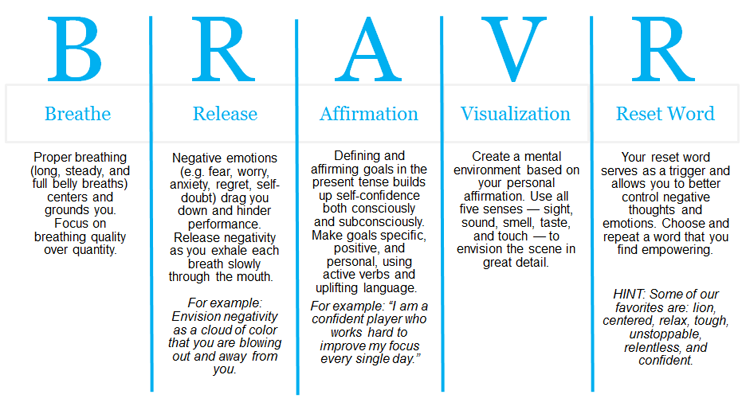
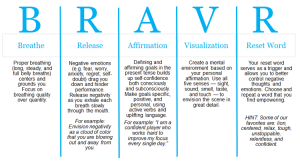
We developed this focusing technique to give coaches and athletes a more defined path toward achieving their goals. Through BRAVR™, athletes and coaches alike can manifest their dreams into reality through a process that “resets” the brain and prepares the mind and body for optimum performance.

BRAVR-Method3

The Coach’s Role

Encourage players to use all five components of the BRAVR™ Method.

  • Remind them to breathe properly and deeply.
  • Help them to identify negativities that are holding them back, and to blow them out when they exhale.
  • Remind them to say their positive affirmation every day, out loud! If they have trouble coming up with an affirmation, come up with one together.
  • Assure they visualize themselves succeeding using all their senses. Go through each sense individually to bring the whole picture together. Can they see the opponents’ uniform colors? Smell the sweat? Hear the sound of sneakers squeaking on the court?
  • Come up with a reset word that both describes and inspires them. Learn your players’ reset words and use them to encourage them during practice and during games when you see they are mentally struggling.

Use the BRAVR™ Method on yourself.

Even though coaches are the most neglected members of the team, they require just as much mental training and preparation as any player. Get yourself performing at your best – get in focus with positive thinking and proper breathing – and you’ll be better able to pass that confidence along to your athletes.

Do BRAVR™ as a team.

It doesn’t take a lot of time and is so easy it can be done alongside most pre-existing routines, like pre-practice stretching, water breaks, and cool downs.

Immediate Improvement

Many of our clients report that the first 20-minutes of practice drastically improves after implementing this five-minute pre-practice routine. Giving your team an opportunity to get their minds centered, focus on practice, visualize what they want to achieve, and let go of any unproductive thoughts and emotions is the most productive use of 300 seconds that we know of.

BRAVR™ Quick Start:

After telling your team why you’re doing this pre-practice routine (there may be considerable eye-rolling, but just ignore that; your team will notice a difference almost immediately!), start the BRAVR Method by reading off these instructions to your team:

  • Breathe. Close your eyes and take five deep, long belly breaths. Count six seconds in, and six seconds out.
  • Release. Let go of all unproductive thoughts, emotions, and all those things that don’t serve a purpose at the moment: self-doubt, worry, fear, or even feelings of silliness. Focus strictly on breathing.
  • Affirm. States your personal sports-related affirmation quietly to yourself.
  • Visualize. Visualize that affirmation as if it is happening right now. (Again, it’s important to use all five senses in imagining your affirmation becoming reality.)
  • Reset word. Say your one- or two-word reset word quietly to yourself at the top of every breath and at the end of your visualization. This will also serve as your tool to get back into a relaxed and focused state (For example: during a break in a competition, take a deep breath, say your Reset word, and get your mind back to where you want it.)
  • Final Breath. Take one final long, deep belly breath, six seconds in, six seconds out. Open your eyes and start playing!

You can download the Positive Performance BRAVR Quick Start Guide at this link: BRAVR Quick Start Guide

Print it out. Use it at your next practice. Take it with you on the road. Put it in your gym bag. Post it in the locker room. Put this technique to work for you wherever you and your athletes might need to take a few minutes to reset and get BRAVR.

Mental Toughness and Ball Toughness Drills

By Brian Williams on May 25, 2015

These drills are included in Coach Lee DeForest’s Princeton Offense system, which includes practice planning (with ideas for both offense and defense) to teach the system.

I hope you find something that you can either use in your summer workouts, or that you can save and use next season.

You can find out more about his Princeton Offense System at this link: Princeton Offense System.


Diagrams created with FastDraw


Mental Toughness Drills

We want to teach aggression and have no fear of making hustle plays

2 Man Loose Ball – 10 in one minute – the players will use one ball and one player is the passer. The other player is down in a stance and will dive on the loose ball then pass the ball from the ground calling out the receiver’s name.

2 Man Take Charge – can go for 1-2 mins – switch the man taking the charge at 30 secs. One player has a ball about lane line apart and dribbles at his partner who takes the charge by landing on his butt and yelling. He gets up immediately and takes another charge.

2 Man Bump Cutter – go for one minute and switch at 30 secs. Players are lane line apart and no ball is used. Player sprints across the lane and gets bumped by the defender who is in a stance – make contact. Constant cutting and making contact then switch at 30 secs.

2 Man Back to Passer – Lane wide and it goes for one minute. One player has a ball and the other player has his back to the ball while chopping his feet. The passer calls out his partner’s name and the player jump pivots in the air to catch the pass. The passer throws the pass before he says the player’s name.

Ball Crawls – players line up near a bleacher or wall. They will kick off the wall and dive on a ball their partner is holding. The partner will count until they get to ten and the player diving yells for the ball.

Ball Toughness Drills

1 on 1 Drills

Stationary – Hit coach in lane when he calls your name. Put players in pairs with each group having a basketball around the 3 point line. Rips/Sweeps either above the head or below the knee. Work on winning the battles and being ball strong. Time limit. PPF.

12 Second Drill – Hold for 4 seconds with rip/sweeps then dribble with right hand or left hand only for 4 seconds and finally pick the ball up and rip/sweep for 4 seconds. Teach how long 12 seconds is with the basketball. Pick up, dribble, then pickup again is called by coach.

Dribble Weave – crossover (move alignment of defenders), hesitation dribble (lane line all defenders), between the legs (move alignment with two in the lane and one near volleyball line), vs. trap (use 4 guys
with two at FT line and two near HC). All different dribbles with coaches set up as cones who will be fouling the hands of the dribbler as they make moves. Head up. Then in trap, the offense works on two moves – hesitation or pull back crossover – attack outside leg. This drill is like Human Cones from Hurley. Can use 3 people and go to half
court or use more and go full court with finish vs. football pad.

Group Drills

3 on 3 Ball Toughness – Square up – with/without a ball. Complete passes for points. No point without a rip or sweep on the catch. No dribble or dribble variations. 10 complete passes then switch. 3 possessions each team. Split them into two groups on either sideline. Black on right and white on left to sub in after each change. Turnover or 10 complete passes. Variation – No score first then give 10 points on a layup. Run the difference in the score. A down/back for each point. One shot to score.

3 on 4 – either to a score or complete 10 passes catch/rip. Dribble or no dribble. Start drill in the middle and a closeout trap while the other two offensive players move to get open. Completed passes are one
point get to ten and switch or on turnover the number of passes is the score. Loser runs the difference.

4 on 2 – offense is on each elbow and block. Defense is inside the lane trying to deflect or steal the ball. Complete 10 passes, no bounce passes, catch and rip/land on two.

These drills are included in Coach Lee DeForest’s Princeton Offense system, which includes practice planning (with ideas for both offense and defense) to teach the system. You can find out more about his Princeton Offense System at this link: Princeton Offense System.

Scramble Defensive Drill

By Brian Williams on May 22, 2015

This video is with Minnesota Men’s Coach Richard Pitino.

The drill is meant for pressuring teams that play for steals, but regardless of what style of defense you play, and whether or not you run a drill with 5 defending 4, I think he has some good teaching points and ideas for you to give some thought to.

Like Coach Don Meyer always said, “It’s not what you teach it’s what you emphasize.: The same thing can be said for drills. It’s not what drills you run, it’s what you emphasize in the drill (and how you emphasize it) that helps your players to improve. We all can do a better job of finding ways to make sure that we are making it clear to players what the purpose of and what the skills are that we are seeking to improve with each drill.

Some of my takeaways from this short video,

1) Run the drill as a shell before making it live.
2) Charting deflections in the drill to emphasize ball pressure.
3) Chart the times the defense forces the ball handler to turn their shoulders in your pressure defense drills as another point of emphasis.
4) Rather than requiring a certain number of stops to get out of a defensive drill, at times see how many stops they can get in a specific amount of time. Of course, there are times when you will want to require a specific number of stops, even if it does take 20 minutes to get it done.

This is a YouTube videos, so you will need to have permission to view YouTube videos.

Make sure your sound is on as you watch. Click the play arrow to see the videos.

Scramble Defense Drill

If you are interested in learning more about the entire DVD that this sample came from, click this link: Establishing a Full Court Pressure Defense. Anyone who purchases anything from the store receives one of my basketball coaching eBooks as a bonus. Just email me and let me know which one you would like to receive!

Basketball Plays: 2 NCAA Zone Attack Sets

By Brian Williams on May 21, 2015

These two zone quick hitters are from Scott Peterman’s Ultimate NCAA Zone Offense playbook.

You can find out more about that playbook at this link: Ultimate NCAA Zone Offense playbook


Georgia Stack

basketball-plays-stack1

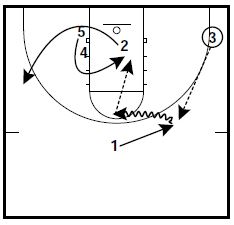
2 cuts to the right wing.

3 slides to the right corner.

1 passes to 2.

2 passes to 3 and cuts to the basket.

basketball-plays-stack2

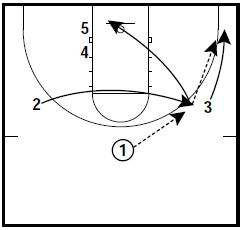
1 flashes over to the top right guard spot.

3 passes to 1.

2 pops out to the left wing.

5 curls off 4 to the middle.

1 dribbles to the middle and passes to 5 on the curl.

Oklahoma State

basketball-plays-osu1

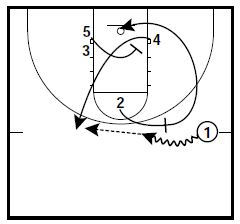
2 sets a ball screen for 1.

1 attacks the middle of the zone.

5 sets a screen on the middle of the zone.

4 pops up to the top left guard spot.

2 rolls to the basket after the ball screen.

1 passes to 4.

basketball-plays-osu3

2 curls off of 3 to the basket.

3 slides to the middle of the zone.

4 passes to 3.

These two zone quick hitters are from Scott Peterman’s Ultimate Zone Offense eBook.


Coaching Basketball: What’s Your Paint Game?

By Brian Williams on May 20, 2015

This post was written by Texas A & M Women’s Assistant Bob Starkey and posted on his blog Hoop Thoughts. He shares his thoughts on all topics related to coaching and updates the blog frequently. It is definitely worth your while to check it out.

What’s Your Paint Game

Bob Starkey, Texas A & M

For the large majority of us, we are well into the beginning of the off-season. A major part of the off-season for the best of coaches is a thorough review of their system of play. As I view the NBA plays-offs, my question to us is this: WHAT’S YOUR PAINT GAME?

I’m a strong believer that championships are won in the paint. This speaks to both offensive and defensive philosophies.

In 2011, the Miami Heat lost in six games to the Dallas Mavericks. The Mavs dominated the paint and the Heat settled for jump shots far too many times. In that off-season, LeBron James called up Hakeem Olaguwon and asked him if he would work with him that summer on his paint game. You have to give great credit to LJ for first recognizing what he need to work on to improve his game and then for not hesitating to ask for help — those are the two marks of a great player.

Too many coaches think that a “Paint Game” means isolating a big post on the block and working the ball inside. And if you have a big that certainly is a good thing to do. But just because you don’t have a big doesn’t mean you don’t have a paint game. Here are some ways to get the ball to the paint:

1. Low Post Play: develop your post players — regardless of size — to post, seal, move without the ball and to finish.

2. Transition Offense: beat the defense to the paint before they get there.

3. Dribble Penetration: being able to put the ball on the floor and drive it to the paint has become increasingly popular with so many teams utilizing the Dribble Drive Offense.

4. Flash Game: flash players into the paint for a touch…this can be post players or perimeter players.

5. Post Up Guards: you may not have a big but if your posts can step away and shoot you can post up your guards inside.

6. Offensive Rebounding: working and emphasizing offensive rebounding above and beyond what other teams might do is another way to create a paint game.

We are not suggesting that you abandon your offensive system but having a paint game allows you a chance to score and draw fouls on the opposition when the mid-range or 3-point shooting has gone cold. Some people point to the fact that Duke and Mike Kryzewski has become great proponents of the 3-point shot. Watch how many of them come off of a paint touch — either dribble penetration or post feed to a fan pass. The “Paint Touch 3” is a great way of setting up a good three point shooter while still pressuring the defense to play interior defense.

Part of having a solid paint game on offense is understanding defenses and how they are played today. We all know the Chuck Daly mantra of “Spacing if offense and offense is spacing.” Well, the same can be true of defense. While offense is looking to spread the defense, defenses are now looking to shrink the floor — getting and sitting in gaps.

Even the best low post players have a difficult time of getting a good look off of the same side entry pass in offensive play. Two keys that will be beneficial include:

1. Reversing the basketball. While at LSU, with Sylvia Fowles dominating the inside, we would tell her to start opposite the ball in our motion offense and reverse the ball to her side forcing the defense to go from help to ball and ball to help.

2. Occupy the helpside. Movement away from where you want to enter the paint with the ball is critical. Making defenders guard two things at once will help you to get the ball to the paint more efficiently. Another one of our basic concepts is for players to “cut to create help.” If we are cutting hard and correctly, we have a chance to draw a helpside defender which creates more space for drives or post feeds.

  • « Go to Previous Page
  • Page 1
  • Interim pages omitted …
  • Page 153
  • Page 154
  • Page 155
  • Page 156
  • Page 157
  • Interim pages omitted …
  • Page 288
  • Go to Next Page »

Primary Sidebar

  • Twitter
  • Facebook
  • Linkedin
coachestoolbox
personaldevelopmenttoolbox
basketballplayerstoolbox
basketballtrainer
athleticperformancetoolbox
coachingbasketball

© Copyright 2026 Coaching Toolbox

Privacy Policy