• Skip to primary navigation
  • Skip to main content
  • Skip to primary sidebar

  • Basketball Plays
    • Ball Screen Sets
    • Horns Sets
    • Man to Man Post Up
    • Man to Man Isolations
    • Backdoor Plays
    • Man to Man 3 Point Shot Plays
    • 2-3 Zone Attack
    • Baseline Inbound Plays
    • Sideline Inbound Plays
    • Combination Defense Attack
  • Drills
    • Defensive Drills
    • Offensive Drills
    • Competitive Drills
    • Passing Drills
    • Rebounding Drills
    • Shooting and Scoring Drills
    • Toughness Drills
    • Transition & Conversion Drills
    • One on One Drills
  • Blueprint
  • Practice
  • Mental Toughness
  • Skill Development
  • Offense
  • Defense
  • Store

Basketball Drills: Hornacek Shooting

Basketball Drills: Hornacek Shooting

By Brian Williams on November 24, 2015

This shooting drill is from Matt Monroe’s former Hoops Roundtable site.

Modify this drill to fit what types of shots you get from your offense and that fit the shots that your players take in games including adding in 3 point shots to the drill.

You could add an element of a time limit or change the scoring so that the rebounder and the shooter are scored together as a team and competing against other two player teams or against a scoring standard.

Diagrams created with FastDraw

The following is from Jim Harrington, former Head Boys Basketball Coach, Elgin High School:

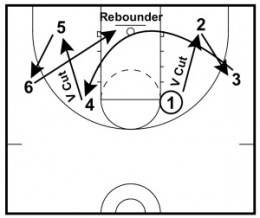
Hornacek Shooting Drill

1.) Shooter starts at right elbow and attempts a shot

2.) After 1st shot, they V-cut to the corner for a second shot

3.) After the second shot, they sprint past the three point line and comes back in for a lay-up
hornacek-shooting-drill

4.) Repeat the same procedure on the left side

5.) Play to 50 points and increase it as the season progresses
• Shots 1-2-4-5 (jump shots) are worth 5 points
• Shots 3 and 6 (lay-ups) are worth 2 points

6.) it is a continuous shooting and moving drill that is good for conditioning
Thankful for Teachers, Coaches, and Leaders in Our Lives

By Brian Williams on November 24, 2015

Thankful for Teachers, Coaches, and Leaders in Our Lives

by Scott Rosberg

The posts I am writing this month when we celebrate Thanksgiving revolve around the concept of things we have to be thankful for. Last week I wrote a more personal post about things and people for which I am thankful. Today I want to ask you to consider a group of people in your life who I believe you should be thankful for. I want you to consider the teachers, coaches, and leaders who you have studied or followed and the mentors who have guided you. Are you thankful for the contributions that they made in your life?  Have you told them?

We tell our students, athletes, and their parents how teachers and coaches play such an important role in kids’ lives. They provide knowledge, guidance, counseling, and nurturing for so many young people every day. They are selfless. Their whole professional life is about serving others. Teachers and coaches are there for you when you need them. So we tell our kids to thank their teachers and coaches for all that they do.

Today I want you to consider, as a coach/leader yourself, who has done the same kinds of things for you in your professional life. Who has taught you strategies, tactics, and the fine points of how to coach/lead? Who has helped guide you at times when you were struggling? Who has helped you with your coaching/leadership style? Who has been an ear for you when you needed to bounce ideas off someone, had questions about a certain situation, or had a tough problem that you were dealing with? Who sparked something in you that you didn’t even know you had in you? Who has helped you become the best you are capable of becoming?

For most of you, there are many people who have had that kind of impact on you. Of course, there will be some people’s faces that will quickly jump into your mind. These are the people who have had the greatest impact on your career, the job you do, and how you do what you do. These are the “life-changers” that so many of us point to as being the most influential people in our lives. Certainly, our parents will fall into this category. But who are the other people in your life who have had the greatest impact on you becoming the coach/leader you are today?

As you contemplate who has had a huge impact on you, you will probably realize that there are others who have also contributed to who you have become as a coach/leader. These may be people who played a smaller role in your growth as a coach/leader, but who, nonetheless, have been influential in some way in you becoming the person you are today. They may have offered a tip, may have been an example of a certain way to deal with a situation, or may have been someone from back when you were younger who you realize has always been a part of how you live your life. While their role may not seem as large and influential as the people who immediately stand out as impactful to you, the accumulation of all of their contributions has ended up having a huge impact on who you have become.

I am going to issue two challenges to you to try to accomplish by the end of this upcoming holiday season. First, make sure you thank the people who have been so impactful in your life. Of course, this starts with those people who immediately came to mind when you were asked to think of the people who have had the greatest influence for you. But this challenge also includes reaching out to the other people who have had what may seem like minor influences on you, but when you add them all together, you realize their impact has been huge. Do not put this challenge off. The people who have had an impact on your life will be so grateful that you have recognized them and thanked them for all that they have done for you.

The second challenge could be even more important than the first. I want to challenge you to become one of the people that other people will point to as having great influence and impact on their lives. Become a catalyst for growth, development, and inspiration to help others become all that they are capable of becoming. Do all that you can to pay forward the concepts that so many others have done for you. Be the inspiration to become one’s best the same way someone else was an inspiration for you. And do this for a variety of people in a variety of circumstances. Be the coach who inspires kids to stretch themselves beyond what they thought they were capable of. Be the coach who works hard to create a positive experience for everyone in the program.  Be the leader who helps other coaches, teachers, and supervisors feel the confidence to try something new or handle some situation that they may have struggled with before. Be the friend who is there for someone who is facing a struggle that they are not sure how to get through.

True leadership is about serving. When you help others get what they want, overcome obstacles, and develop the ability to become all they are capable of becoming, you help yourself and your teams do the same. Gandhi put it so well – “Be the change you want to see in the world.” You have a great opportunity to change so many lives for the better because of your leadership role in people’s lives. Lead and inspire with honor, dignity, and compassion, and others will follow your example. By doing so, you will soon be the answer that someone gives when they are asked the question, “Who are you thankful for?” Go to the Coach with Character Facebook Page and let us know who you are thankful for in your professional life.

About the Author of this Article

Scott Rosberg has been a coach (basketball, soccer, & football) at the high school level for 30 years, an English teacher for 18 years, and an athletic director for 12 years. He has published seven booklets on coaching and youth/school athletics, two books of inspirational messages and quotes for graduates, and a newsletter for athletic directors and coaches. He also speaks to schools, teams, and businesses on a variety of team-building, leadership, and coaching topics. Scott has a blog and a variety of other materials about coaching and athletic topics on his website – www.coachwithcharacter.com. He can be reached by email at [email protected].

Scott is also a member of the Proactive Coaching speaking team. Proactive Coaching is dedicated to helping organizations create character and education-based team cultures, while providing a blueprint for team leadership. They help develop confident, tough-minded, fearless competitors and train coaches and leaders for excellence and significance. Proactive Coaching can be found on the web at www.proactivecoaching.info. Also, you can join the 200,000+ people who have “Liked” Proactive Coaching’s Facebook page at www.facebook.com/proactivecoach. Scott can also be reached through Proactive Coaching at [email protected].

Basketball Drills: The “Super Transition” Drill

By Brian Williams on November 23, 2015

Submitted  by Coach John Kimble
CoachJohnKimble.com

Retired high school and college coach

Follow him on Twitter @CoachJohnKimble

This article was originally written for Winning Hoops

Diagrams created with FastDraw

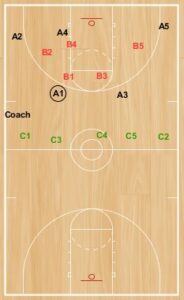
The primary purpose of this drill is to work on your team’s “Transition Game,” whether it is from offense to defense, or from defense to offense, or both. In essence, “Squad A” must compete against two different squads, with each of those squads having distinct position advantages over them. We are using the “overload theory” to make the drill extremely difficult for the chosen squad.

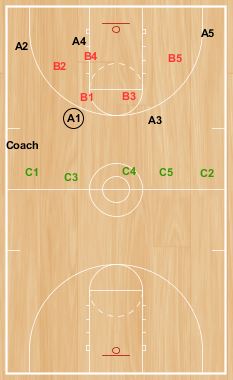
The drill can be initiated with a five-on-five controlled scrimmage with a selected team receiving the coaching staff’s primary focus. In this discussion, we will call that team “Squad A.”   We have Squad A running through their offensive entries and/or offensive continuity against a defensive group that we will call “Squad B.” “Squad A” could work on improving their transition from offense to defense after losing possession of the basketball, via committing turnovers, or after missing or making shots. “Squad C” has absolutely no defensive responsibilities and is stationed in a random manner out near the ten-second line and near the near hash mark.   Their primary responsibility is to be able to generate a fastbreak in a much quicker manner than in an ordinary setting. This puts extra pressure on “Squad A” by overloading the degree of difficulty in achieving their task of defensive transition (after offense).

Defensive Transition after a turnover.—–The first scenario would be implemented in the following manner. The offensive team (“Squad A”) could align in the appropriate offensive set and run an entry or even get into an offensive continuity pattern. On the coaching staff’s whistle, the offense could drop the ball (as in a turnover) and the defensive team (“Squad B”) then recovers the loose ball and immediately outlets the ball to an assistant coach, who is located near one of the two offensive hash marks.

Defensive Transition after a missed (or made) shot.—–Another scenario would be for the original offensive team to look patiently for a good shot and take that shot, and look to legitimately offensive rebound the missed shot. To maximize the chance for defensive rebounds, you might dictate to Squad A’s offensive rebounders to make the effort to rebound, but not allow them to actually grab the rebound. Therefore, all missed shots would result in defensive rebounds by Squad B’s defensive rebounders. After securing the defensive rebound, Squad B’s rebounders could pitch the outlet pass out to “Squad C” so that they may run their offensive fastbreak, with a head start. If Squad A actually makes the shot, the assistant coach on the side of the court, could use a new basketball and quickly outlet the ball to start an immediate fastbreak, going in the opposite direction.

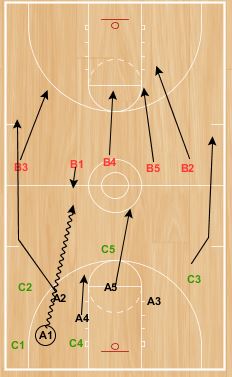
diagram1
Diagram 1

To make it much more difficult on “Squad A’s” task of getting back on defense, the supplemental group of players in “Squad C” could position themselves and be spread out in a manner that they would have a significant position advantage on “Squad A,” in getting down-court.   Obviously, “Squad C” would have a head start as they sprint out and look for the outlet pass from the assistant coach. The assistant coach pitches the ball out to one of the fast breakers on “Squad C” and that group looks to run their primary fastbreak (and on into their secondary fastbreak).   See Diagram 1.

The members of “Squad A” must sprint back “in their defensive fastbreak lanes” as fast as they can to stop the primary fastbreak (and ultimately the opponent’s secondary fastbreak) of “Squad C.” This new offensive fastbreak group of “Squad C” could be instructed to do any one of the following:   a) force a shot out of the primary break or the secondary break, b) force a pass that could most likely become a turnover, or c) remain patient and under control and look to carefully score in a legitimate manner. “Squad A” would be working on attempting to prevent easy shots out of the opponents’ primary or secondary fastbreak. Ultimately when “Squad A” finally recovers possession of the ball, they quickly reverse their direction and sprint back on offense toward their original basket. “Squad A” will not have any supplemental group to aid them in transition, so they will run the entire length of the floor and perform both fast breaks and possibly on into their continuity offense against a defense who has had the head start advantage of being able to defensively set up ahead of time.

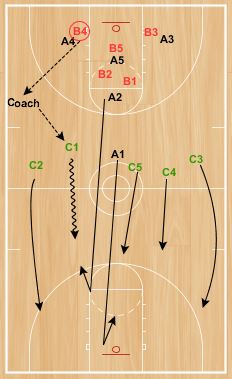
diagram2
Diagram 2

“Squad B” (the original defensive group) has gained their advantage by moving toward the ten second timeline, while “Squad C” has attacked “Squad A.” “Squad C” will easily and always get back ahead of “Squad A.” “Squad A” now is forced to execute both their primary and secondary break, possibly into their continuity offense. See Diagram 2.

As “Squad A” then offensively attacks Squad B, the supplemental group, “Squad C” positions itself ready to run another offensive fastbreak. The cycle is ready to be repeated. Both the B and the C Squads start with position advantages and also enjoy a breather, while the opposite squad is competing against “Squad A.” But, “Squad A” never has a position advantage on anyone and also never has a breather. “Squad A” competes against both squads. This is the “overload method” we are wanting to place on the primary squad–“Squad A.”

There are many benefits in this drill for each of the three groups. “Squad A” will receive work and practice in the following: a) running a half court offense, b) reacting and getting back on defense after turnovers or made/ missed shots to prevent easy lay-ups by their defensive opponents, c) reacting quickly to run their own primary and secondary fastbreaks on offense (from a half court defensive setting), and d) a great deal of full court conditioning as they work on the different aspects of their “Transition Game.“

Squad B will be able to work on their half court defense as well as the back part of their defense versus an opponent’s fastbreaks (in a controlled setting). “Squad C” could be a less talented team (JV or a Freshmen) that could work on the latter half of their offensive fastbreaks–a little of their Primary Break as well as their Secondary Break.

“Squad A” and “Squad B” could easily exchange their original positions so that “Squad B” could receive the most attention and work on their own Transition Game-both offensively as well as defensively.

This drill requires the full court and a minimum of at least 15 participants, with each squad having the ability to easily and quickly substitute others into the drill. There could actually be three different coaches coaching each of the three squads, with all three coaches having different “points of emphasis” to constantly observe and critique.

COACHING POINTS OF EMPHASIS

The primary emphasis of the drill will be devoted to “Squad A;” therefore that group would have the largest number of “points of emphasis.” There can be many “points of emphasis” implemented with the imagination of a coaching staff, but some of the most important would be the following: a) Making sure the “Tailback,” the “Halfback,” and the three “Fullbacks” get in the proper positions after our offense has shot the ball. (Our “Tailback” is what we call our Safety, our “Halfback” is our designated “half-rebounder and half-safety” and our three “Fullbacks” are our three assigned offensive rebounders), b) Making sure that all five players sprint back in their defensive fastbreak lanes (while looking over their inside shoulder) and set up defensively in the lane, before building the defense from the inside-out, and c) Making sure that either the “Tailback” or the “Halfback” becomes the “Ball Man,” while the other becomes the “Basket Man,” and d) Making sure that the “Ball Man” and the “Basket Man use the proper procedures and techniques to defend the basket and buy their three defensive teammates some time in getting back. (See the “Ball and Basket” Transition Drill in Diagram 3), and e) Making sure that all five players then get out quickly and run the proper lanes while executing their Primary Fastbreak, their Secondary Fastbreak, and their half-court offenses.

diagram3
Diagram 3

Squad B would have the following “points of emphasis” continually being used to evaluate, correct, and critique them: a) The proper techniques and concepts used in their half court defensive philosophies, while b) “Squad C” would have as their main “points of emphasis” all the concepts, philosophies, and techniques used in their offensive fastbreak system–both primary, secondary, and half court offense. See Diagram 3.

SUMMARY

There are many products produced from this drill, in addition to the many by-products that can be utilized. The major products are that a select group of players can be closely scrutinized and taught efficiently in a relative small amount of time. This group can prepare in a very real game-like situation. The only part of the drill that does not resemble game-like situations is the part of the drill that provides an overload facet-thus making the drill more difficult than would exist in an actual game. A concentrated effort can be made by coaches in working with individuals in that selected group. Transition from offense to defense as well as from defense to offense can be worked on. Half court offense and defense can be evaluated as well. The physical conditioning of the players of that selected group will be improved on. Players can easily be inserted into the particular group to be put ‘under the microscope’. The Super Transition Drill can be an extraordinary drill in that it can be extremely time-efficient, thus allowing time in your practices for working on other facets of the game. The overload method of working one particular team against ‘tougher than game’ conditions makes the drill an invaluable drill. Besides offenses and defenses being worked on, the all-important part of the Transition game, becomes the focal point of the drill. During this drill, many offensive concepts and philosophies can be taught, reviewed, drilled, observed, evaluated, critiqued and corrected with the players. Likewise, many defensive facets of the game can be practiced with a different group of players at the same time. During the utilization of this drill, a great number of players will be able to watch, listen and learn, participate and practice in the performance of the drill. The drill will not be boring. No player should have to or be allowed to stand around while the drill is being run. It is also an excellent method of unobtrusively conditioning your players as they are learning and improving many different aspects of their game. It allows a large number of coaches to coach and an even greater number of players to learn, all the while being in the same setting.

About the Author

Coach Kimble was the Head Basketball Coaching position at Deland-Weldon (IL) High School for five years (91-43) that included 2 Regional Championships, 2 Regional Runner-Ups and 1 Sectional Tournament Runner-up. He then moved to Dunlap (IL) High School (90-45) with 2 Regional Runners-up, 1 Regional, 1 Sectional and 1 Super-Sectional Championship and a final 2nd Place Finish in the Illinois Class A State Tournament. He was an Assistant Basketball Coach at Central Florida Community College in Ocala, FL for 1 year before becoming Offensive Coordinator and then Associate Head Coach for 3 additional years He then was the Head Basketball Coach at Crestview (FL) High School for 10 years, averaging over 16 wins per season.

He has had articles published in the following publications such as: The Basketball Bulletin of the National Association of Basketball Coaches, the Scholastic Coach and Athletic Journal, Winning Hoops, Basketball Sense, and American Basketball Quarterly. He has also written and has had five books published along with over 25 different DVDs by Coaches Choice and Fever River Sports Production.

See him on Twitter @CoachJohnKimble and his Web Page “www.CoachJohnKimble.com”

Coaching Basketball: Eliminate Losing

By Brian Williams on November 17, 2015

This list on eliminating things that increase your chances of losing was contributed by Coach Derek Sheridan – retired from Delta (Ohio) High School

  1. THROW THE BALL TO YOUR TEAM
  1. TAKE HIGH PERCENTAGE SHOTS:

-KNOW & ACCEPT what you can do well (Accept clearly defined Role)

-KNOW & ACCEPT what you cannot do well (Play to your strengths)

-KNOW & ACCEPT what WE do well & perfect those skills daily

-VALUE effective FG% v. total points scored

  1. BUY-IN: Best finishers get the most shots (Perimeter & Post)
  1. OFFENSIVE REBOUND, MORE THAN THE OPPOSITION
  1. SHOOT MORE FREE THROWS THAN THE OPPOSITION SHOOTS
  1. CONTEST SHOTS (EARLY CLOSEOUTS)
  1. DON’T ALLOW LAY-UPS
  1. BLOCK OUT & GET THE FIRST REBOUND
  1. DON’T ALLOW THE OFFENSIVE TEAM TO SCORE OFF OF PUT-BACKS
  1. CATCH & SQUARE UP TO THE BASKET – DON’T DRIBBLE LOSE BALLS
  1. DON’T LET THE DEFENSE TAKE THE BALL FROM YOU = STRONG WITH BALL
  1. USE SHOT-FAKES & PASS-FAKES WITHOUT TRAVELING
  1. TAKE ADVANTAGE OF WEAK DEFENDERS
  1. FOLLOW THE GAME PLAN & TAKE WHAT THEY DO WELL AWAY FROM THEM
  1. VETERAN PLAYER’S EXHIBIT CONSISTENT LEADERSHIP SKILLS & YOUNGER PLAYERS ACCEPT THEIR LEADERSHIP

– Veteran Player Leadership:

  • Do/Say the right thing when coaches aren’t present, EVEN when you’re upset with the coaching staff
  • Give positive reinforcement
  • Tone of negative reinforcement is unemotional & used as a teaching tool
  • Cannot take it personally when younger player(s) squawk back under their breath
  • Must be a good school citizen
  • Acknowledge ALL players in the hallways & ask younger players if they need help with anything
  • Sorry is just a word; real sorrow = change in behavior

The information is a compilation of knowledge that I’ve acquired from:

Bob Knight (HOF)
Brooks Miller, Trine U.
Dick Bennett, Washington State – Retired (HOF)
Mike McBride, Holy Cross College
Jim Robinson, Maumee HS – Retired (HOF)
Dean Foster – Retired IN, HS Coach
Jim Irwin – Retired IN, HS Coach
Eric Thompson – Manchester HS, IN
Paul Patterson, Taylor U. – Retired (HOF)
Steve Platt, Huntington College – Retired (HOF)
Tom Johnson, Wheeler HS, IN
Jack Gabor, Wheeler HS, IN (HOF)
Rick VanMatre – McClain HS – Retired (HOF)
Duane Keisling – Eastern Howard HS, IN – Retired
Mike Sheridan – Taylor HS, IN – Retired
Donnie Campbell – Blue Valley HS, KS
Jack Edison, Plymouth HS, IN – Retired
Brian Vorst – Rossford HS, OH
Dave Boyce – Perrysburg HS, OH
Johnny Enochs, Washington HS, OH
Joe Wisecup, McClain HS, OH – Retired
Wayne Brooks, Fort Wayne Community Schools, IN

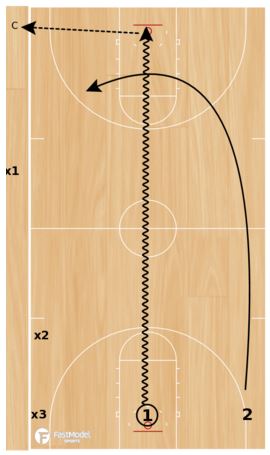
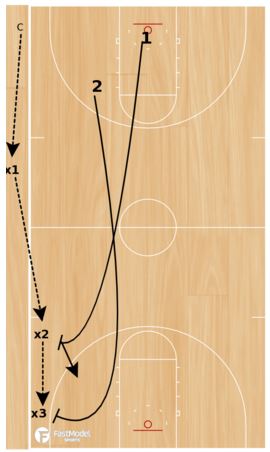
Chris Holtmann Hawk Transition Drill

By Brian Williams on November 15, 2015

These diagrams represent principles presented by former Butler and current Ohio State Coach Chris Holtmann at the 2015 Basketball Caoches Association of Michigan coaches Clinic.

The drill is a featured post in the FastModel Sports Basketball Plays and Drills Library.

You can also find out more about FastModel Play Diagramming software by clicking this link: FastDraw

My goal for all posts is not that you necessarily use the drill exactly as presented, but that it gives you some ideas on ways to make what you are doing more efficient and effective.

I hope you can make the drill even better by implementing your rules and teaching points.


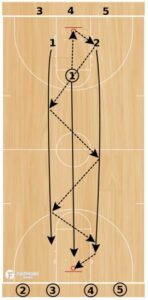
hawk1

2 v 1:

The drill begins with a Free Throw.

The ball is rebounded and then transition takes place 2 v 1.

Points are awarded on the value of the shot scored. Additional points can be given for other things such as offensive rebounds, etc.


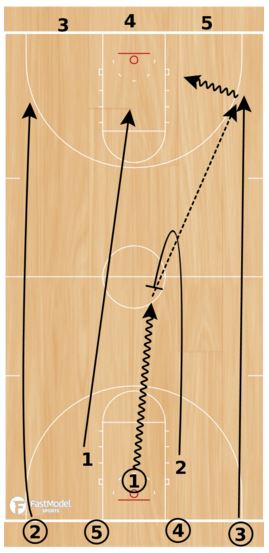
hawk2

3 v 2:

The drill continues when the defense obtains the ball through either a rebound or a basket.

Two players on the baseline add to the defense to make it 3 v 2 on the return trip of the floor.

Players should defend according to your conversion defense rules.


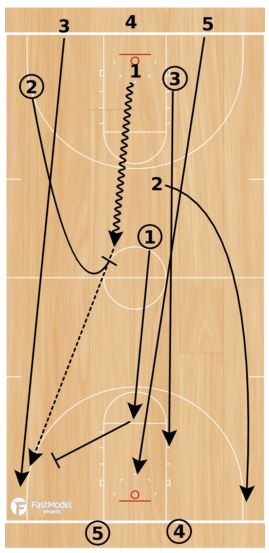
hawk3

4 v 3:

Play continues when the defense obtain possession and two players add to make the transition 4 v 3.

This pattern continues to 5 v 4 and then finishes on the 5th trip of the floor 5 v 5.

The drill then resets and the opposing team starts with the free throw.

Scores are recorded for a final winner when the drill ends.


Fullcourt Closeouts

By Brian Williams on November 15, 2015

These diagrams represent principles presented by John Beilein at the Basketball Caoches Association of Michigan coaches Clinic.

The drill is a featured post in the FastModel Sports Basketball Plays and Drills Library.

You can also find out more about FastModel Play Diagramming software by clicking this link: FastDraw

My goal for all posts is not that you necessarily use the drill exactly as presented, but that it gives you some ideas on ways to make what you are doing more efficient and effective.

I hope you can make the drill even better by implementing your rules and teaching points.


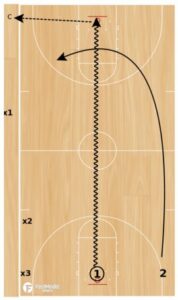
closeouts1

Sprint dribble to a layup with a pass to coach.

Outside man sprints to free throw line extended and then crosses the court to recover.


closeouts2

Pass to coach is the beginning of defensive conversion.

Outside players pass the ball up the floor to the corner.

1 closes out on the ball and then jumps to the basket and the ball when the ball is passed to the corner.

2 closes out to the corner.


  • « Go to Previous Page
  • Page 1
  • Interim pages omitted …
  • Page 137
  • Page 138
  • Page 139
  • Page 140
  • Page 141
  • Interim pages omitted …
  • Page 288
  • Go to Next Page »

Primary Sidebar

  • Twitter
  • Facebook
  • Linkedin
coachestoolbox
personaldevelopmenttoolbox
basketballplayerstoolbox
basketballtrainer
athleticperformancetoolbox
coachingbasketball

© Copyright 2026 Coaching Toolbox

Privacy Policy