• Skip to primary navigation
  • Skip to main content
  • Skip to primary sidebar

  • Basketball Plays
    • Ball Screen Sets
    • Horns Sets
    • Man to Man Post Up
    • Man to Man Isolations
    • Backdoor Plays
    • Man to Man 3 Point Shot Plays
    • 2-3 Zone Attack
    • Baseline Inbound Plays
    • Sideline Inbound Plays
    • Combination Defense Attack
  • Drills
    • Defensive Drills
    • Offensive Drills
    • Competitive Drills
    • Passing Drills
    • Rebounding Drills
    • Shooting and Scoring Drills
    • Toughness Drills
    • Transition & Conversion Drills
    • One on One Drills
  • Blueprint
  • Practice
  • Mental Toughness
  • Skill Development
  • Offense
  • Defense
  • Store

Drills from University of Tennessee

Drills from University of Tennessee

By Brian Williams on February 11, 2016

Clinic Notes from:

These are some of the notes presented by Dean Lockwood at a PGC/Glazier Basketball coaching.

He is currently the Associate Head Coach for the Michigan State women’s program.

Dean was an assistant in the Tennessee Women’s Program for 15 years.

He was also an assistant in their men’s program for 5 years.

In between those stints at Tennessee, he has been the men’s head coach at Saginaw Valley State, and Northwood University.

Persistence Drill

The objective of this drill is to develop a mindset of toughness.

Drill is executed with 3 teams of 5 or 3 teams of 4.

Shot clock is utilized; clock can be set at 1:00, :45 or :30. (The longer the shot clock, the tougher the drill is to complete.)

Drill begins with an offensive team attacking the defensive team in the half court. The shot clock starts. Offense can employ anything they want to get a shot. If defense gets a stop, the shot clock stops immediately. Offensive team goes out, and the team waiting (A’s) comes in on offense. If offense scores or gets fouled, shot clock resets and a new offensive team comes in while the defense stays on the floor.

The goal of the defense is to get stops & get the shot clock to expire. (Defense must get PERFECT defensive possessions. Shot clock stops once defense secures ball.)

The goal of the offense is to continue to score, get fouled or get offensive rebounds to keep the shot clock resetting & keep the defensive team on defense.

THERE IS A NEW OFFENSIVE TEAM ON EVERY CHANGE OF POSSESSION.

THE DEFENSE STAYS ON DEFENSE UNTIL THE SHOT CLOCK READS 0:00. THIS IS THE ONLY WAY THE DEFENSIVE TEAM CAN EARN THEIR WAY OUT OF THE DRILL.

If defense takes a charge, :05 can be deducted.

If a possession starts with under :10 on the shot clock, coach can designate to play the entire possession out or to play the shot clock.

You can also use the drill to practice short clock situations.

Numbers Rebounding Drill
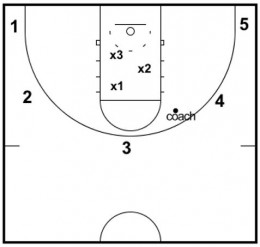
numbers

Diagrams created with FastDraw

Coach starts with ball anywhere on court.

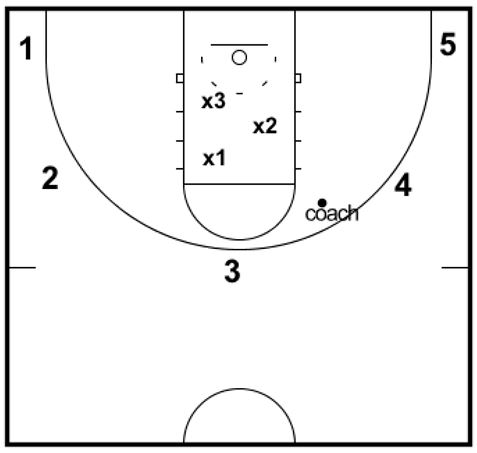
Xl, X2 and X3 are defenders; all 3 defenders start in paint.

Players 1—5 are offensive players, each assigned a specific number. Players 1—5 are positioned outside of arc but can change positons (But NOT their numbers’) and can also move.

Just prior to shooting ball, coach calls 3 offensive player numbers; coach then shoots and misses. The more realistic the coach can make the miss–a shot off the rim that simulates a miss in a game, the more effective the drill is.

The 3 players called by the coach immediately crash boards. Defenders must communicate, box out the 3 offensive rebounders, and secure rebound. They must recognize who the best offensive rebounder who is coming and get that player blocked out.

Once ball is shot by coach, it becomes live play until 3 defenders secure the rebound. The offense looks to score if they get the rebound.

Scoring system:

2 points for an offensive rebound, plus 2 or 3 points for a made shot off the offensive rebound.
The defense gets 1 point for each defensive rebound and a 1 point bonus for 3 defensive rebounds in a row.

You can also include allowing the defensive to take the ball in transition to the other end as a reward for rebounding

Chaos Rebounding Drill
chaos

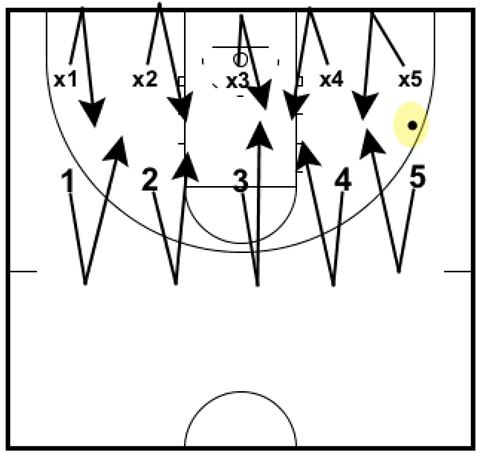
Defensive team lines up across the floor at the level of the block.

Offensive team lines up across the FT line.

Coach blows whistle and the defensive team sprints to touch the baseline while the offensive team sprints to touch the hash mark lines extended. (See diagram)

Coach shoots ball & misses —— drill is live.

If offense gets rebound, they attack & try to score.

If defense gets rebound, they convert to other end.

(2 ways drill can be executed at this point:
5 on 0 conversion or 5 on 5 conversion)

Point system:
2 points for offensive rebound
1 point for defensive rebound
1 point for a score or a foul
Ben Jacobson Competitive Defensive Drills

By Brian Williams on February 10, 2016

These defensive drills and defensive philosophy with Ben Jacobson are from this week’s featured eBook bundle. The eBooks are Coach Scott Peterman’s Basketball HoopScoop Coaching Clinic Notes Series.

We have 62 Digital Coaching books between the HoopScoop and Coaching Toolbox playbooks that are available in bundles of 4 for $35. You can choose the Coaching eBooks that you are interested in at this link: 4 for $35 eBook sale.

Diagrams created with FastDraw

Northern Iowa Defensive Philosophy
1. Create an identity for you program- ¼ court defense
2. Charges and Loose balls- you must finish possessions–These are two things that your guys can rally around
3. Communication must be part of everything
4. 4 Key Areas of Defensive Play
a. Guard the basketball- with a certain level of pressure and limited rotation…build a wall
b. Don’t take yourself out of position to guard…shot fake…jab…closouts…jump the passing lane
c. Be part of our team defense- you are not guarding a guy
d. Finish every play- charges, loose balls, defensive rebounds…talk about every day in practice, you cannot give in at the end of defensive possession. You need consequences, competitive drills

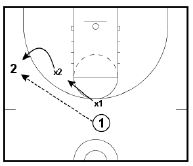
Drill: One-On-One Live From the Wing

uni1

1. If you want to get better guarding the ball…you must play live one on one
2. Head up on the ball…square
3. You cannot get beat baseline…if he goes middle you must level the dribble off going toward the top of key
4. Ball pressure is scouting based…pressure to your ability…if you can dominate the ball, dominate the ball
5. When the ball is in the middle, you level off the dribble both directions
6. Trace the ball with one hand…as it moves your hand will change…start with a ball call
7. Hand the ball to the offense…end the possession
8. Offense has three dribbles
9. When the dribble is picked up…chest up with your knees bent…both feet on the floor…finish plays in this position…shooters are bothered more this way
10. When starting on the wing the ball must be leveled off above the elbow

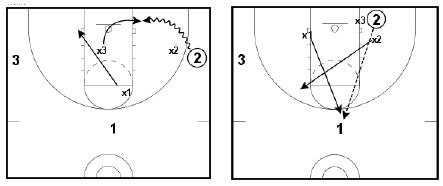
Drill: Two on Two Angle of Approach-

uni2

1. When the ball is at the top…level it off above the elbow
2. On the wing…don’t get beat baseline
3. Use the elbow as the pack line
4. When off the ball you are in a closed stance…gives you a better opportunity for a short close out when the ball goes to your man
5. As your man moves down the floor you must stay up in the gap…if you get flat in the gap it kills this defense…even with your man…when the ball is dribbled right on top of you, you can never get to the corner
6. Angle of approach- get underneath opponent to approach head on when closing out to your man when he received the
ball…puts you in a position to cut off baseline
7. Take the same angle on the wing and at the top
8. Communicate in the drill…Talk to each other…Talk to each other by name
9. Close out…weight back, chop your steps, throw both hands high
10. Do not bounce when you guard the ball…you cant bounce
11. When you throw up both hands…take his vision away

Drill: Three on Three Angle of Approach
1. New position is the midline defender
2. Ball side foot must be on the mid line…much better position to be in to be part of team defense
3. Same emphasis on angle of approach and close outs

Drill: Paint Touch Drill
1. 3 on 3. offense is trying to touch the paint as many times as they can…or beat them baseline…coach counts
2. When you get loose ball recovery every sprints to help him up…rally around it
3. Make competitive…Defense has an up and back for each paint touch or baseline drive
4. Any time an offensive player is on the move and they leave their feet it has to be charge

Drill: Rotation (3 on 3)
1. Why do you work on rotation if it violates the rules? They are not supposed to get beat but they do
2. Teaches your players how to play…teaches them to play as a team…get stops as a team
3. When the ball goes baseline…mid line defender gets outside of lane line…top man covers down outside the land…butt to the baseline…below the offensive player
4. When the bal comes out…Cover down guys takes first pass…ball defender rotates with his momentum to the mid line
5. Get two good rotations…any more than that and you are just running around
6. Long close out sprint half way first

uni3

Drill: Four on Four Scramble

1. Promotes communication
2. Great Daily Drill
3. Offense starts with ball…when coach says go…they scramble to a defensive position…defense then becomes the offense…the new defense must cross the midline and sprint to defensive spots
4. Don’t run to a man…sprint to your position
5. As soon as the defense picks the ball up they are trying to drive and score
6. Get to ball…get is covered
7. Give the offense 18 seconds to score…that is good defensive possession
8. To give the defense more time…require offense to complete one pass (start with this, then go to the dribble)

These defensive drills and defensive philosophy with Ben Jacobsen are from this week’s featured eBook bundle. The eBooks are Coach Scott Peterman’s 2011 and 2012 Coaching Clinic Notes.

If you are interested in adding to your Coaching Toolbox take look at what I believe is our best offer.

CLICK HERE to select from a list of more than 70 eBooks.


Turning the Ship Around

By Brian Williams on February 9, 2016

Turning the Ship Around
Cory Dobbs, Ed.D.

A maxim of team building is that the biggest wins start small.  This too is true of the biggest losses.  Recently, I was called in by a successful coach to help him save his season from becoming a complete disaster.  At the time of the call the team was five and fifteen.  And four of the five wins came from beating perennial losers. Essentially this team won only one competitive match.

No matter how hard you try it takes the greater part of a season to pull together a group of young student-athletes. Cohesion is never a given.  Unfortunately for the distressed coach who called me for help, the pulling together had yet to take place.  Rather, bit-by-bit the players built relationships that pushed them apart, a gap emerged from player to player.  Conflict avoidance and superficial harmony were the unwritten rules of relationship building.  The result was a downward relational spiral in which morale deteriorated gradually at first, then a tsunami of ill-will permeated interpersonal interactions.

Finally, the team woke up and realized that there was no sense of unity or authentic camaraderie on the team, which translated into a team of selfish and uncommitted players.  Luckily for the coach, most of the players admitted fault (as did the coach) and willingly accepted working side-by-side with the coach to create an engaging and inspiring environment.

Over the years I’ve come face-to-face with the reality that something big always comes from something small.  Small causes are so often the start of something big—both on the positive and negative side of the ledger.  Yet too often we only attend to something after it has already become a hefty problem requiring a massive undertaking.

For the coach and the player to recover the season they realized change was necessary for survival.  The time had come for all team members, coaches included, to shed the illusion that they were building right relationships that would take them where they wanted to go.

COURSE CORRECTION

To inspire the team to quickly adopt changes—those the players proposed and others put forward by the coaching staff—they decided to look to Hollywood.  Yes, tinsel town!

Screen writers tell us that there is really only seven or so master plots from which all stories are developed.  These story structures are called archetypes.  An archetype offers the audience a relatable back-story with a familiar pattern that taps into the mental models of the viewer.  The classic archetypes include: rags to riches, overcoming adversity, the quest, comedy, tragedy, voyage and return, and rebirth.

The idea was for the team’s members to create a story that they wanted to “write.”  All participants agreed that to transform the team required a story that would fit the team today and acknowledge its current realities.  The goal was for the team to agree to adopt, enact, and live the story daily.  The team agreed to undertake the challenge of change by employing the archetype of Disastrous Voyage and Fortunate Return.  This was fitting because this archetype is about progression from naivete to wisdom, from disparity to triumph.  In typical Hollywood movies the protagonist stumbles across obstacles and challenges with the mistaken notion that they know where they are going.  In this real-life voyage the players sadly were heading in the wrong direction to creating a competitive team with a sense of well-being for its participants.

Beginning with the team’s current realities it seemed fitting to “title” the change story Turning the Ship Around.  The student-athletes discussed together their story with candor and enthusiasm—how they got to where they were and how they wanted to go about changing their course.  By agreeing to the archetype they went about living a shape-shifting story of resurgence and resurrection based on building durable and enduring relationships.

Fortunately, the path to turning the season (the ship if you will) around began with small victories.  Not victories on the playing field, rather small wins in building right relationships.  Day-by-day living the narrative of Turning the Ship Around the team did come to experience a successful change of course.  After one more loss the dedicated team lived to tell the tale of a seven-game win streak to finish out the season. By righting the course the team is now ready to set sail for an exceptional season next year.

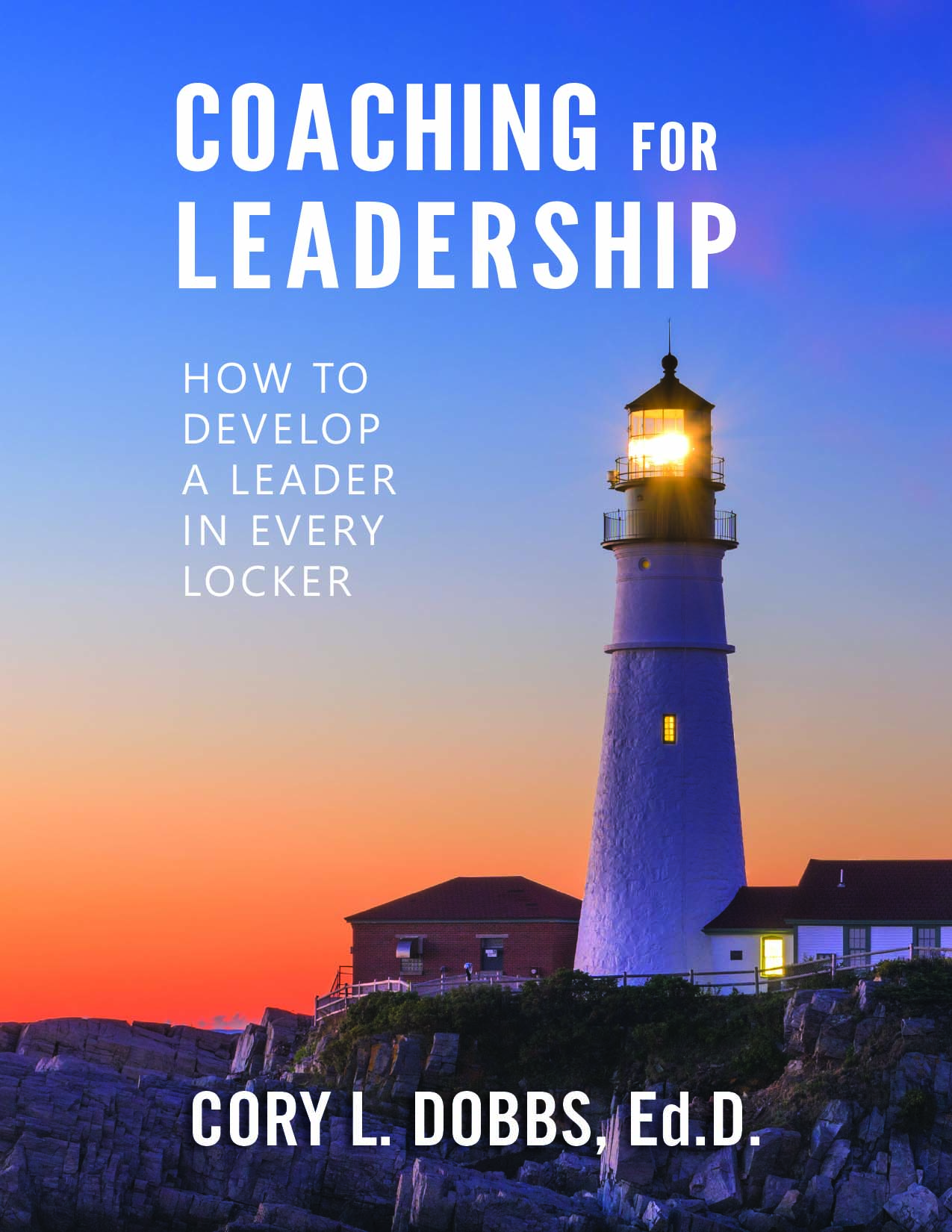
“Tell me and I’ll forget. Show me and I may remember. Involve me and I will care.” -Your Student-Athlete The world of coaching is changing. In Coaching for Leadership you’ll discover the foundations for designing, building, and sustaining a leadership focused culture for building a high-performance team. To find out more about and order Sport Leadership Books authored by Dr. Dobbs including Coaching for Leadership, click this link: The Academy for Sport Leadership Books

About The Academy for Sport Leadership

The Academy for Sport Leadership is a leading educational leadership training firm that uses sound educational principles, research, and learning theories to create leadership resources.  The academy has developed a coherent leadership development framework and programs covering the cognitive, psycho-motor, emotional and social dimensions of learning, thus addressing the dimensions necessary for healthy development and growth of student-athletes.

The Academy for Sport Leadership’s underlying convictions are as follows: 1) the most important lessons of leadership are learned in real-life situations, 2) team leaders develop best through active practice, structured reflection, and feedback, 3) learning to lead is an on-going process in which guidance from a mentor coach helps facilitate learning and growth, and 4) leadership lessons learned in sport should transcend the game and assist student-athletes in developing the capacity to lead in today’s changing environment.

The Easy and the Hard

By Brian Williams on February 9, 2016

Editor’s Note from Brian: I have had this in my files for around 20 years and feel that it is definitely worth sharing.  I think it is good advice for all of us, regardless of our age!

Written by Beverly Heirich.

We all have the same questions: Why is life so tough? Well, there’s an answer to that:

When my husband and I were raising our five children, we taught them everything we knew. Now we know that was not much

If we could do it over, here are some critical facts about human nature that I would start teaching them before they were old enough to brush their teeth without help.

Bad is easy. Good is hard.
Losing is easy. Winning is hard.
Talking is easy. Listening is hard.
Watching TV is easy. Reading is hard.
Giving advice is easy. Taking advice is hard.
Flab is easy. Muscle is hard.
Stop is easy. Go is hard.
Dirty is easy. Clean is hard.
Take is easy. Give is hard.
Dream is easy. Think is hard.
Lying is easy. Truth is hard.
Sleeping is easy. Waking is hard.

Holding a grudge is easy. Forgiving is hard.
Telling a secret is easy. Keeping a secret is hard.
Play is easy. Work is hard.
Falling is easy. Getting up is hard.
Spending is easy. Saving is hard.
Doubt is easy. Faith is hard.
Laughter is easy. Tears are hard.
Criticizing is easy. Taking criticism is hard.
Letting go is easy. Hanging on is hard.
Secret sin is easy. Confession is hard.
Pride is easy. Humility is hard.
Excusing oneself is easy. Excusing others is hard.
Borrowing is easy. Paying back is hard.
Sex is easy. Love is hard.
Argument is easy. Negotiation is hard.
Naughty is easy. Nice is hard.
Going alone is easy. Walking alone is hard.
Dumb is easy. Smart is hard.
Messy is easy. Neat is hard.
Cowardice is easy. Bravery is hard.
War is easy. Peace is hard.

Poor is easy. Rich is hard.
Sarcasm is easy. Sincerity is hard.
An F is easy. An A is hard.
Growing weeds is easy. Growing flowers is hard.
Reaction is easy. Action is hard.
Can’t do is easy. Can do is hard.
Feasting is easy. Fasting is hard.
Following is easy. Leading is hard.
Having friends is easy. Being a friend is hard.
Dying is easy. Living is hard.

If you ask why all this is so, why is life so hard, I’ll tell you, “It just is. Nothing in life that is good and worthwhile comes without effort.

We are born, all of us, with a nature that is drawn to the easy rather than the hard.
Knowing this about one self and others softens the heart and builds iron into the will, keeps us going when all around is crumbling, when friends forsake, when the heart breaks, and the courage and confidence shatter.

Knowing that such experiences are part of the deal gives us opportunities to choose to do hard things. Constant challenges make our journery exhilarating, wonderfully fulfilling, never, never boring. As the Arabs put it, “All sunshine makes a desert.”

And here’s a small secret that most sad and lonely people never learn: Deep down inside we are all asking the question. No matter who you are, life is hard, and we all ask why it should be so.

But there is comfort in knowing we’re not alone. So maybe your child – or the person sitting over there – needs to hear from you right this minute that sometimes you question too.

Easy is its own reward. Hard is much finer!

Games Based Approach to Coaching Basketball

By Brian Williams on February 8, 2016

This post was written by John Carrier and originally posted on his Coaching Basketball Blog

Whether you agree or disagree, I hope there are a few ideas that you can apply to your practices.

I Drilled It, What Happened? 
Like most coaches, including myself, I am sure you’ve had the following scenario happen to you. Your team needs to work on some aspect of the game. You spend a good chunk of time in practice drilling that aspect. Your players look great in the drill. Then comes the game, and the wheels come completely off the wagon. It’s like they never practiced the aspect of the game you devoted so much time to. You can’t believe it and are left wondering “What happened?!”.

Well, what happened was that your players spent a lot of time that practice mastering a drill and not really learning how to execute the skill you wanted them to. It happened to me more times that I care to admit, but recently I’ve found the solution – using a games based approach to teaching basketball.

For the last number of years I’ve been using the idea of teaching games. For a while now I’ve been reading Brian McCormick’s work and loved it. I started to incorporate a lot more games into my practices with good results.  Last season though, I took it to the next level. I was lucky enough to spend last season working with Art Errickson. Coach Errickson pushed me to use a more games based approach and it has really changed how I teach the game. Teaching the game using games may be the single most important thing I’ve learned in my career in terms of the actually on court coaching.

Why Drills Alone Don’t Work
Drills alone don’t work because they lack specificity. They are not specific to the real game that is being played. Players learn a skill or action out of the context of the game. What they are really learning is the pattern of the drill and not the skill within a game. So what happens is when a real game occurs players are not used to doing that skill within the specific context of the game – thus not performing the skill correctly, or many times forgetting to do the skill at all. Players who are trained using drills are not learning when and how to use the skill, which is as important as the movement. The end result is that you don’t get the transfer that you desire.

Drills are also block practice, and not random. Block practice is doing the same movement, the same way, in the same environment. You are memorizing a drill pattern, not a game skill. Random practice is practicing a skill in an ever changing environment so the player needs to adjust how they perform the skill. Anyone can do something in isolation, but those skills learned in isolation quickly disappear when you add defenders, other teammates, etc. It’s important that your practices consist of activities that are both specific to the game and random in how the skill is practiced.

If you are going to have successful carry over from practice to games, how you practice needs to change. You need to start “Training Ugly” which is my new favorite term from Trevor Ragan. You need to train your pl ayers on the skills you want within the context of an actual game. It’s about creating came like environments and using the game to teach the game. That’s where the games based approach comes in.

What is a Games Based Approach?
A games based approach is using different games to teach players the skills/aspects of the game you want. The games should always be random, and specific when possible. There should also be a competitive component where the team or player is playing against themselves (personal records), time, score, or other teams. The key is to modify the number of players, advantages, rules, surface, etc to create an environment that stresses the habits you want taught within the game setting. Below I’m going to give some examples of how you can modify games – and you can use multiple modifications within the same game:

Number of Players
Play 1 on 1, 2 on 2, 3 on 3, and 4 on 4 are great ways to teach skills.  They are better than 5 on 5 because you get more reps and touches than a traditional five on five game. Some skills such as ball handling are best done in small (1 on 1 and 2 on 2) numbers to maximize reps. Passing can be done in any number 2 or above, and I think team related drills are best done 3 on 3 or 4 on 4.

You can also play Cutthroat where you have 3-4 teams of 2, 3, or 4 playing. Two teams play one possession. At end whoever lost the possession is out and a new team comes on. You can play until one of the teams achieves a mile stone of your choosing.

Size of the Court
Everyone plays half court, which is a good way to do it, but have you ever played 2/3 court where they can only work half court and from a step off the opposite block to the ball side sideline? That makes players LEARN how to be creative in space. Have players play 1 on 1 from the free throw line where they can’t go outside the lane lines – then you will see players learn how to straight line drive well. Why were NYC guards so good back in the day? Because they played primarily on narrow street courts and had to really get good at navigating tight spaces, you can create that same environment with your games.

Rules
You can have all kinds of rules. The rules should shape the game to teach the habits that you want. And as in any game, there are penalties for breaking the rules, usually turnovers or loss of turn on defense. Below is a great list to start with that you can add or subtract from games of 1 on 1 to 5 on 5.

  • Dribble Rules
    • No dribble
    • Only “attacking the basket” dribbles (my favorite)
    • Limit number of dribbles – don’t like this as much
  • Movement Rules
    • Being in the right spots on defense
    • Being in the right spots on offense
    • Moving on offense – pass and watch
    • Screening a DEFENDER
    • Cutting hard
  • Ball Clock
    • This is one Coach Errickson put me onto and I love it.
    • Player has X amount of seconds to make a decision with the ball or it’s a TO.
      • I like 2 seconds but might want more to start and with younger ages.
    • Player has X amount of seconds with the ball or it’s a TO.
  • Dribble Hand Rules
    • Doing dribble tag or rodeo? Have them use their weak hand only.
  • Time Rules
    • Play with a shot clock
    • Play with a ball clock – mentioned above
  • Foul Rules
    • What do you call a foul?
      • Want offense to be tough, don’t call anything.
      • Want defense to stop fouling, call everything!
  • Really any other rules you want to make up as you go.

Advantage/Disadvantage
I like using disadvantages more than advantages. You can do several different things to create disadvantages that help players learn a skill or concept. You can take away the dribble. You can add extra players on offense or defense. You can officiate differently to create situations you want. And so on.

Some Sample Games
Below are some sample games I use and have used in the past.

Teaching Ball Handling and 1 on 1 Skills

  • Dribble Tag
    • I know it sounds juvenile but it’s fun, competitive, and it’s random practice. Kids have to apply the skill in a random setting that’s always changing.
  • Rodeo
    • Groups of 3. One player has the ball and 2 other players chase them and try to force a turnover or the dribbler to pick the ball up. You can play in the half our quarter court.
    • You can play for X number of seconds each player (and track if they turn it over or not +1 for not and play to 2-3 points). Or you can just have them play whoever gets it goes and try to keep it the longest.

One of the best ways to work on ball handling and 1 on 1 skills is to play 1 on 1. In all these 1 on 1 games I would play to 3 scores and have something for the losers (2 pushups, clap for the winners, don’t care really).

  • Post 1 on 1
    • Play 1 on 1 from the post. Have another player feed and work on post feeds too.
    • Work on the 1 on 1 post play live – move and a counter move.
  • Iowa 1 on 1
    • Groups of 2-5. Offense starts on the FT line. Defender starts under the rim with the ball. Defense throws to the offense and sprints to close out. As he closes out, reads the closeout and attacks. The lane lines are out of bounds which teaches straight line drives. They can shoot it or drive depending on the defense.
    • Teach players to drive in a straight line, attack with shoulder to hip, and read the defender’s close out. Teach players to use different ways to finish around the rim.
  • St. Joe’s 1 on 1
    • Groups of 2-5. Offense starts on the baseline in a line about 2 steps off the lane line toward the side line. The defense starts on the baseline about 2-3 steps farther toward the sideline from the offensive group. Each line has a chair across from it at half court. On coaches or defender’s “Go” call, the offense dribbles as fast as they can out to the chair, dribbles around it (outside to inside) and attacks the basket as quickly as possible. As that is happening the defender is racing around his chair (outside to inside). They play 1 on 1 form there.
    • Work on attacking the rim and making dribble moves (cross over) based on the position of the defense. If the defender is straight up, attack hard if cut off change hands and attack again. If the defender is shading you ball side, attack and change. If the defender is shading you not ball side blow by or fake crossover and blow by. Work on finishing off of two different ways at the rim. You can add double moves as well.
  • Attack 1 on 1
    • Defender starts under the basket. Offense starts at half court. On defense’s go, offense takes off dribbling at the rim as hard as they can. Defense sprints out and guards them. Offense reads the defense and attacks.
    • Work on attacking the rim and making dribble moves (cross over) based on the position of the defense. If the defender is straight up, attack hard if cut off change hands and attack again. If the defender is shading you ball side, attack and change. If the defender is shading you not ball side blow by or fake crossover and blow by. Work on scoring off of 2 at the rim. You can add double moves as well.
  • Johnson 1 on 1
    • Got this when we were preparing a few years ago to play our section opponent St. Paul Johnsonm who is very good defensively and amazing on the ball.
    • Start with an offensive player with the ball at half court. One defender starts on him. The other defender starts under the basket. Offense must rip and attack the first defender (who can push and hack him). Once he reaches the top of the key extended the first defender must leave him and the second one runs out, the dribbler then attacks the second one to score.
    • Work on handling the pressure and physical play, attacking defense, protecting the ball, scoring at the rim.
  • Catch and Go 1 on 1
    • Passer starts at the top of the key. Offense and defense start in the corner. Offense cuts up and defense follows. Passer hits the cutting offense. On/before the catch the offense reads the defender (who is tight on him) and attacks. If the defender is trailing the offense just turns and goes. If the defender is ahead of him (getting into denial) the offense rips and goes the opposite way.
    • Work on peaking to read defender, attacking off the catch, finishing at the rim.
  • 1 on 1 From Different Spots
    • Play 1 on 1 from corner, elbow, short corner, top of key, wing, etc.

Teaching Passing

Passing may be the most over drilled skill in basketball. How many times will players be throwing a pass to a stationary target, without a defender on them or their receiver? Never. So why spend time on it!?

  • 10 Pass Drill
    • Can be played 2 on 2, 3 on 3, or 4 on 4
    • Players get 1/2 or 1/4 court to work with. Offense can move anywhere they want.
    • No scores, offense must make 10 passes in a row without a turnover. If they do they win, if they don’t the defense wins. Switch off ever time.
    • Work on how to get open, moving without the ball, leading cutters, cutting through passes, back cutting denial, cutting hard.
    • Screening is optional, can have a 5 second count or not, if it gets too easy add defenders or raise the number of passes.
  • 2 on 2, 3 on 3, 4 on 4, or Cutthroat No Dribble
    • Play to 3-4 scores without the dribble.
    • Teach players to be creative in how they get open and get their teammates open.
    • Work on how to get open, moving without the ball, leading cutters, cutting through passes, back cutting denial, cutting hard.
    • Can play full and half court.
  • Ping Pong
    • Play 3 on 3 on 3 or 4 on 4 on 4 full court. One team starts on offense and the other on defense. The third team is waiting on the opposite end. If the offense scores they take it out and go to the other end with the original defense pressing them to HC. If they defense gets the stop they take it the other way with the original offense pressing to HC.

Defense

I love teaching defense using games. There really is no better way to get transfer from practices to games.
  • Defensive Cutthroat
    • This is the best THING I’ve seen to teach defense. 
    • You have three to four teams. Two are playing and one is sitting at half court waiting to come in. Play normal basketball, offense looking to score. If the offense scores or the defense makes an “out”, the defense sprints off right away, the new team comes in on offense, and the old offense is now on defense. If the defense gets the stop, the offense sprints out, defense stays, and the new team comes in on offense.
    • You score 1 point for every stop and play to 2-3 stops.
    • You can do it 3,4, or 5 on a team, but 3 or 4 is my favorite.
    • You can add “outs” that are as good as a score. The “outs” should help create habits you want your players to do. I would also start with one out and then slowly add as the year goes on until they are having to play perfect defense.
    • Possible Outs
      • No ball pressure, note closing out, not moving on air time, incorrect position, offensive rebound, allowing a straight line drive, allowing a post entry, allowing a paint touch of any kind, etc.
  • 1 Down Transition Defensive Cutthroat
    • You can play cutthroat with the traditional drill where the offense starts on the baseline, defense starts on the free throw line extended facing the offense. Coach throws the ball to an offensive player, and everyone transitions to the other end. Whoever is across from the ball has to touch the baseline before transitioning down.
  • Cutthroat from Different Looks
    • BLOB, SLOB, sets,
    • Have both teams in the lane. Throw the ball up at the rim, whoever rebounds is on offense and transition to the opposite end.
    • Play vs. different offensive actions.
      • All ball screens, all screen aways, etc
      • Works on specific actions you want.
  • Run a Drill into 3 on 3 to 5 on 5
    • For example, take shell drill. Players shell for 3 reversals, on the third reversal it’s live. Each stop is 1 point, play to 2-3 stops.
    • We run a drill called DeLaSalle Help the Helper. There is an open coach on the wing, player at the top of the key, a backside wing, and a backside block. Coach passes to the top of the key reverses to the opposite wing, and back to the coach. Once the coach has it he drives. The post player comes out to help and the backside wing helps the helper. In our version, we run the drill and the coach passes out into 3 on 3 live. If the defense doesn’t help and help the helper correctly the drill is blown dead and the D is out.
  • Disadvantage Games
    • Bring in extra offense, call more fouls on defense, etc.
  • If you don’t have enough for cutthroat play 3 on 3 or 4 on 4 the same ways outlined above.

Motion Offense, R and R, Attack and React, Dribble Drive, or General Offensive Concepts

  • Offensive Cutthroat (3-5 per team)
    • Play offensive cutthroat in all the ways described for the defense. But now the other team is waiting on the baseline to come in and everyone comes in on defense.
    • Outs
      • Standing, passing and standing, banana cuts, not screening someone, dribbles that are not north/south, ball clock, taking bad shots (you define bad), passing up on good shots, whatever you want the team to do or not do.
      • Can play no dribble
  • ______ to Score
    • Play cutthroat or 2 on 2, 3 on 3, 4 on 4 or 5 on 5.
    • Offense has to score on a specific thing
      • Paint touch, cut, off a screening action, etc.
      • Forces your offense to hunt for specific actions you want to work on.
  • Ping Pong
    • Great way to work on press breaking and transition offense.
  • Disadvantage Games
    • Bring in more defense than offense.
Obviously there are hundreds more games I could list. There are tons of varieties of 2 on 2 more, 1 on 1, etc, but for the sake of time I am going to stop here. You get the idea. And I honestly believe it’s best if you make up your own games as you need them.Block and Games Cycle
Now going to a games based approach doesn’t mean you have to abandon all the drills. It just means cut way down on the drills and spend most of the time playing games. It also means that the drills you do should be dictated by what you see in the games and in free play (scrimmages and games).So for example, you played last night and you weren’t very good on being in the correct defensive position. You may combined block teaching (drills) and games in a way such as below.

  1. Present the goal – show players a quick clip or 2 of them not being in the right position. If you don’t have film quickly explain that we were not in great position at the last game. 2-3 minutes tops. 
  2. Block Practice – have them shell drill and practice moving to the ball and being in position. 10-15 reps, 5 minutes tops. 
  3. Teaching Games – Have them play cutthroat where the “out” is them being out of position. Then have them play transition cutthroat. 10-20 minutes. 
  4. Free Play – Have them play one or two 2 minute 5 on 5 games. As they play, watch and see if what you worked on is better, if not, repeat.

You wouldn’t do this for every aspect, but if you felt like there was something you really needed to drill, then do a quick block and get back to the games.


Some Games Based Coaching Tips

  1. Let go and don’t be afraid to “Coach Ugly”. Practices are going to be ugly and look out of control, but those are the best learning environments. We all learn better by DOING.
  2. Play short, fast games. If playing by time play 2-3 minutes tops. If playing by score play to 2-3 scores tops. Short games increase urgency and effot.
  3. Be creative – create games that fit what you NEED.
  4. Coach in bullet points not paragraphs – invent little sayings and reminders for each concept you teach. For example, when teaching close outs I like “sprint, drop, chop, high hands” if they don’t do that I’m talking that at them as they play.
  5. Coach in the moment – use each game to teach the game.
  6. You can’t judge carry over until you actually PLAY IN GAMES, so keep that in mind.

Conclusion
Kids sign up for basketball to have fun and play basketball, not run drills. That might be the best reason to use a games based approach to basketball. Your practices will be instantly more fun and engaging. The players will also work hard because of the environment you create. The hardest part for you as the coach is going to be giving up control and letting guys just learn from playing. It’s not going to be pretty, but boy it is effective. It’s the most fun I’ve had coaching and I believe it will greatly help you.

Croatia BLOB Pick the Picker

By Brian Williams on February 7, 2016

This inbounds play came from the FastModel Sports Basketball Plays and Drills Library.

The site has thousands of drills and plays that have been submitted by basketball coaches from around the world.

This play was submitted by Wes Kosel

You can also find out more about FastModel Play Diagramming software by clicking this link: FastDraw


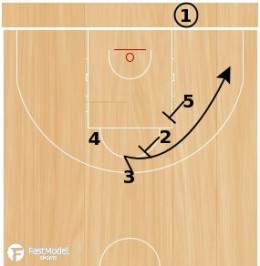
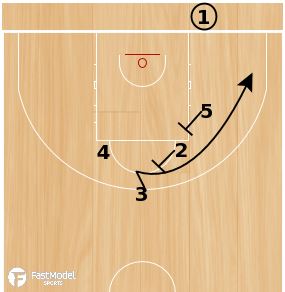
Croatia BLOB Pick the Picker

croatia1

3 cuts off the staggered screen from 2 and 5


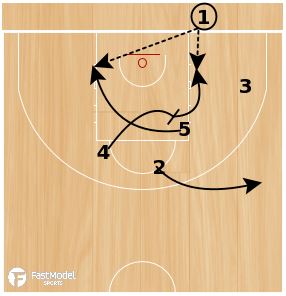
croatia2

4 steps in to screen for 5.

5 cuts to the basket.

4 dives to the ball.

1 looks to 4 or 5.


  • « Go to Previous Page
  • Page 1
  • Interim pages omitted …
  • Page 130
  • Page 131
  • Page 132
  • Page 133
  • Page 134
  • Interim pages omitted …
  • Page 288
  • Go to Next Page »

Primary Sidebar

  • Twitter
  • Facebook
  • Linkedin
coachestoolbox
personaldevelopmenttoolbox
basketballplayerstoolbox
basketballtrainer
athleticperformancetoolbox
coachingbasketball

© Copyright 2026 Coaching Toolbox

Privacy Policy