• Skip to primary navigation
  • Skip to main content
  • Skip to primary sidebar

  • Basketball Plays
    • Ball Screen Sets
    • Horns Sets
    • Man to Man Post Up
    • Man to Man Isolations
    • Backdoor Plays
    • Man to Man 3 Point Shot Plays
    • 2-3 Zone Attack
    • Baseline Inbound Plays
    • Sideline Inbound Plays
    • Combination Defense Attack
  • Drills
    • Defensive Drills
    • Offensive Drills
    • Competitive Drills
    • Passing Drills
    • Rebounding Drills
    • Shooting and Scoring Drills
    • Toughness Drills
    • Transition & Conversion Drills
    • One on One Drills
  • Blueprint
  • Practice
  • Mental Toughness
  • Skill Development
  • Offense
  • Defense
  • Store

Basketball Drills: Defensive Cut Throat

Basketball Drills: Defensive Cut Throat

By Brian Williams on February 29, 2016

This competitive defensive drill came from the FastModel Sports Basketball Plays and Drills Library.

You can also find out more about FastModel Play Diagramming software by clicking this link: FastDraw

This drill was contributed by Coach Greg White.

It is a way to play competitive cut throat so that to win, the team must get defensive stops and make defensive plays.

Defensive Cut Throat

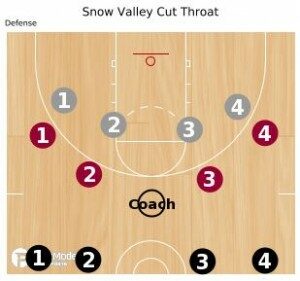
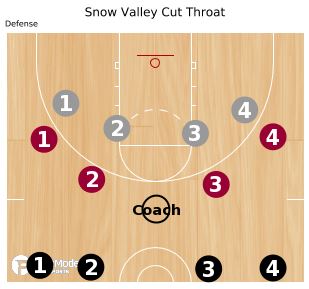
In the diagram below, gray, red, and black are 3 separate teams of 4 players. Gray is starting on defense, red on offense, and black is waiting to go on as the new offense at the end of the possession.

Each team has it’s own score. In Defensive Cut Throat, teams waiting to come on are at half court.

When the offense makes a basket, they go on defense, the defense steps off and goes back up to half court line, new team comes on on offense.

Teams do not score points by making baskets. Points are only scored for defensive stops and plays. When the offense makes a basket, they earn the right to play defense. Being on defense is the only way to score points. (To reward toughness, you can give a team a point, if they score and are fouled “and-one”)
defensivecutthroat

The scoring for defensive cut throat is as follows. All points are rewarded only on defense.
(You can adjust the scoring to emphasize whatever you need to emphasize for your defense.)

1 point for defensive team for a stop.

3 points for taking a charge.

Bonus point for a defense completing 3 consecutive stops. (To reward them outlasting 2 other teams)

You can create your own rules as to why the defense loses the right to play defense such as:

1. Not talking
2. Not taking a charge
3. Giving up middle or baseline drives
4. Not blocking out
5. Sloppy closeout.

You can set the expectations at whatever level will allow your players to improve. The coach can control the pace of the drill by how quickly you put the ball back into play after a stop or a score.
SLOB Diagonal Seal 5

By Brian Williams on February 28, 2016

Coach Vonn Read has submitted several plays from his playbook series The Basketball Encyclopedia of Plays to the Coaching Toolbox.

Vonn is an assistant coach at Houston.

He has also served as an assistant coach in the WNBA with the Phoenix Mercury, Orlando Miracle, and San Antonio Silver Stars.

He was an advanced scout for the Orlando Magic as well as The Charlotte Sting.

Diagrams created with FastDraw

A couple of ideas for short seconds inbounds plays (one under and one side) to think about using or adapting this year or filing for next year.


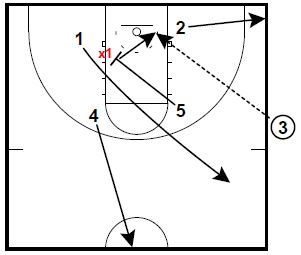
Diagonal Seal 5

sob

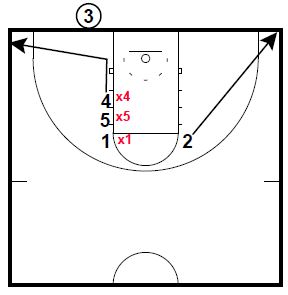
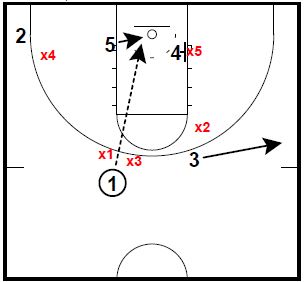
This is a good EOG Set for a Layup.

This set capitalizes against a team that switches everything at the End of Games.

The 4 player will pop out to half court and the 2 player will cut to the corner to space the floor.

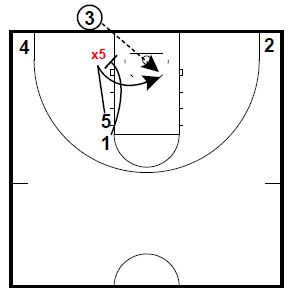
The 5 player set a diagonal screen for the 1 player, anticipating the switch.

The 5 player will screen and seal X1 on the switch for a lob pass layup.

X5 will be too short to defend the 5 player on the switch.

Also, you have a big on small mismatch on the perimeter.

Stack Rip Lob 51

uob2

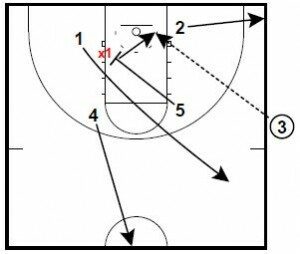
This is a good Short Clock or End of Game Play.

The 4 Player will dive to the block and cut to the corner.

The 2 player will space to the opposite Corner.


uob1

The 5 player will dive down the lane line right behind the 4 player.

The 5 player will ask for the ball coming down the lane to set up their defender.

The 1 player will come down the lane right behind the 5 player.

The 1 player will set the back screen lob for the 5 player.

Have the 1 player set the screen so they cannot easily switch the backscreen. X1 should be too short to stop the lob.

Coach Read has also put together The Basketball Encyclopedia of plays. You can check them out here: The Basketball Encyclopedia of Plays or read more about the books:

Any coach looking for the latest and innovative plays from the Professional, College, or High School levels can stop looking. With a compilation of over 7,700 different plays, you will never need to purchase another basketball playbook again. These playbooks can be used as a great reference tool for years to come. This 2 Volume Book includes plays from 19 different play categories, and they are the most extensive playbooks on the market.

The Basketball Encyclopedia of Plays (Platinum Series) contains over 7,700 Plays (Both Volumes combined) from the NBA, WNBA, USBL, and College levels from someone who has worked as an Advanced Scout or Coach on each level!!! This book has been intensely compiled over the last 21 years, with plays taken from a lot of NBA Coaches (past and present), WNBA coaches, and College coaches (Men’s and Women’s) from around the country.

Any coach that is serious about improving their knowledge of the game from an X and O standpoint will benefit tremendously from these books. These Books can be used to discover New Quick hitters, add a New Package to your playbook, or develop an entire Offensive System. There are a lot of new ideas and concepts in these books to study, and the Basketball Encyclopedia of Plays can be a great resource for coaches on all levels!!! This book is definitely for those X and O junkies who are always looking to improve as a Coach.

“THE GAME IS ALWAYS CHANGING? ARE YOU?” Vonn Read

Here is the link: The Basketball Encyclopedia of Plays

Here’s How to Build a Stronger Team Culture

By Brian Williams on February 25, 2016

By Stephanie Zonars, Life Beyond Sport

Every coach I meet wants to make a difference in the lives of others. But not every coach maximizes that opportunity.

Every coach I meet takes time to define team and perhaps, personal goals. But not every coach invests time in defining his/her purpose.

There’s a big difference between goals and purpose.

Goals: shorter in duration; focused on the “what”; task-oriented; measurable

Purpose: spans longer time frame; focused on the “why”; relationship-driven; largely immeasurable

On the long highway of life, goals are the signposts and purpose is the road itself. As you move through your career, you will achieve goals. But if your identity is tied only to performance goals, you’ll always be looking backwards to find validation.

It’s why some pro athletes come out of retirement and why coaches oftentimes feel lost at the end of their careers—they don’t know their purpose apart from achieving performance goals.

But knowing your purpose—why you coach—sustains you for the whole journey. —Tweet that!

You will achieve lots of goals along the way, but your validation will come from your underlying purpose, not the goals themselves.

I can’t overstate the importance of taking the time to explore and understand your purpose as a coach or leader. The biggest reason people don’t?

Because they can’t figure it all out in an hour at Starbucks.

It takes time.

It requires slowing your pace and creating space in your brain so you can think.

It means asking yourself some tough, and sometimes uncomfortable, questions.

But here’s why it’s crucial:

If you’re a head coach, your team culture starts with you. It’s a reflection of you. And the more clarity you have about who you are and why you coach, the more clear you’ll be about the kind of culture you seek to create.

If you’re an assistant coach, you’re looking for a head coach and team culture that fits you. Nothing is more miserable than working for someone whose core purpose diametrically opposes yours. But you can’t determine what a good fit looks like if you don’t know who you are and why you coach.

Randy Hatch and Patrick Steele know why they coach the Lady Jags at Carroll Academy—to teach life skills.  Their team provides refuge, family and hope to girls who’ve experienced very little of those things in their lives.

Winning is not the main objective for Coach Hatch and Coach Steele—the Lady Jags have won 6 games in 14 years. But the record isn’t the most important thing to these coaches and players (just listen to the girls’ emotion in this ESPN video).

What matters? That they are a family. That the players learn responsibility, discipline and a whole list of other lessons.

Success to them is a team full of girls who are doing their schoolwork and not drugs.

“The losses give us the tools that we need to teach, to build self-esteem and courage.”

—Patrick Steele

These coaches are ultra clear on their purpose and fulfilling it fuels their satisfaction.

You may be familiar with Joe Ehrmann and his book InsideOut Coaching. He asks 4 poignant questions that will help get your brain working around this concept of your purpose.

If you’re serious about creating a culture where your staff and players thrive, schedule time to write down your answers to these questions. If you’ve answered them before, revisit your answers and evaluate your current season to see if they still hold true.

Why do I coach?

Why do I coach the way that I do?

What does it feel like to be coached by me?

What do I want to accomplish by my coaching?

If you’re not a coach, just replace that word with “lead.”

These questions will surface some concepts and words that will help you get closer to articulating your purpose—one of the most important steps in creating the best culture for your team.

About Stephanie Zonars

Stephanie Zonars helps coaches build and maintain winning team cultures through her business, Life Beyond Sport. Teams at Penn State, Notre Dame, West Point and over 60 other schools have built stronger trust, communication and teamwork through her workshops. Stephanie spent three years on staff with the Penn State women’s basketball team, assisting the team to back-to-back Big Ten Championships. She’s also the author of three books. For more tips on leadership and team culture, visit LifeBeyondSport

Coaching Basketball: A Different Voice

By Brian Williams on February 23, 2016

Submitted by by Cory Dobbs, Ed.D.

As a coach I always considered it a privilege to participate in the growth and development of student-athletes.  Today I find myself in the unique role of trying to help student-athletes become better team leaders and thereby prepare for the leadership challenges of life.  If you were to take part in one of my workshops you’d notice very quickly that I try to get student-athletes to unlock their voice—that is to learn how to solve leadership problems through discussion and dialogue.  The voice of a student-athlete holds incredible potential to create, shape, and influence one’s self-concept and interpersonal relationships.

This article aims to give voice to a young student-athlete who cares enough to do his homework.  Concerned with what he was observing from the sideline, Jake Young, a high school student-athlete, crafted a research project to explore and describe the positive and negative effects coaches can have on athletes.

Whether or not you agree with Jake’s findings is not the point, this is simply an opportunity to hear the voice of a young athlete willing to invest time and energy in crafting a point-of-view.  As a student, Jake has taken sufficient steps to better understand his world.  As an athlete, he is challenging coaching methods with his research and my hope is that the insights resulting from his efforts will be appreciated.  –Cory Dobbs, Ed.D., The Academy for Sport Leadership

Site Editor’s Note from Brian.  I believe that as coaches, we can have high expectations, push and challenge athletes, hold athletes accountable, confront when necessary, and be intense, without being verbally abusive.  In short, we can have discipline and be demanding without being demeaning (Don Meyer).  It is also my opinion that coaching respectfully does not always mean that you will win a championship, but that it will help them to come nearer to reaching their potential.  And, more importantly, have a rewarding experience in many other ways.


A Different Voice
Respectful Coaching and the Respected Coach
by Jake Young, Student-Athlete

Throughout my life I have been very fortunate to experience many different coaches through my participation in sports and my brother’s too. These experiences include track and field, golf, power lifting, baseball, and football.  My brother has had the opportunity to play for some of the greatest select baseball programs in Texas, many with a reputation for winning. However, both of us have also had the opportunity to play on teams that were not as successful and lacked a successful reputation. Through these experiences of watching and participating in sports I have noticed that the coaching techniques of the coach have a direct positive or negative effect on their athletes.
[thrive_leads id=’36827′]
In these relationships I began to notice a trend; the higher the respect for the coach the greater the team’s performance and success. As I began to focus even more on this relationship I noticed the coaches that were more respected by their athletes seemed to use different coaching techniques than the coaches who were not respected.

I believe that some coaches feel that they have to be rough and tough to be respected by their athletes and to have a successful team. It is a kind of mentality that may be referred to as “hard-nosed” or in a sense “old-school” type coaching. My beliefs about becoming a successful program do not include “old-school” coaching, even though this still may be viewed as a respectable coaching technique. I believe that coaches need to be respected by their players to be successful in any sport.

One coaching technique that I believed caused the athlete’s respect for their coach to decrease was verbal aggression, which is defined as a verbal message sent to hurt the receiver. The reason for my choice of focusing on coaches’ verbal aggression is because of a personal experience as a brother. I watched my brother play baseball for at least eight years where he participated in select, high school, and collegiate leagues. Throughout all of these seasons he had coaches that fell into three different types of verbal aggressive categories: not verbally aggressive, somewhat verbally aggressive, and extremely verbal aggressive.

I mention these categories to show the relationships between the coach’s verbal aggression and the team’s success, the respect for the coach, and my brother’s motivation to play.

The teams he played on where the coaches were partially verbally aggressive, the players respected their coach but were not as successful as they could have been. In these seasons my brother’s motivation to play was somewhat skewed, although the drive to play in college kept him motivated.

The team where the coach was extremely verbally aggressive, there was no respect for the coach and the success of the team was far from where they would like it. In addition, on this team my brother’s motivation to play the sport was depleted.

The team in which the coach was not verbally aggressive the players all respected the coach and the team won the national championship and became ranked number one in the nation. In addition, on this team my brother’s motivation to play the sport was at its highest. I believed that the reason for the difference of respect, success, and my brother’s motivation to play had a great deal to do with the differences in the coaches’ verbal aggression on all of these teams.

This past year I have done a great deal of research in the field of sports psychology. Through the process of researching I began to focus on the coach-player relationship and more in-depth, coach’s verbal aggression, defined earlier as a verbal message sent to hurt the receiver.

I then conducted a study with my offseason program consisting of athletes who play football, basketball, track and field, and baseball. The study investigated the relationship of the athlete’s perception of the coach’s verbal aggression and its affect on the athlete’s motivation and attitude toward their coach. My hypotheses in the research were both null stating that there would be no relationship between the coach’s use of verbal aggression on the athlete’s motivation and attitude toward the coach, and there would be no relationship between the athlete’s motivation and attitude toward the coach.

I used three different surveys/scales to measure the coach’s verbal aggression, motivation of the player, and attitude of the athlete toward the coach. The surveys are listed respectively: Verbal Aggressiveness Scale (Infante & Wigley 1986, Martin 2009), Sport Motivation Scale – 6 (Mallet 2007), and a seven point Likert scale that asked the question: My overall attitude toward my coach is….

The Verbal Aggressiveness Scale measured the athlete’s average perception of the coach’s verbal aggression. The Sport Motivation Scale – 6 measures the athlete’s motivation to play the sport broken down into six types of motivations: Amotivation, Introjected Regulation, Integrated Regulation, External Regulation, Identified Regulation, and Intrinsic Motivation. The seven point Likert scale that asked the question “My overall attitude toward my coach…” measured the athlete’s attitude toward their coach using four seven point differentials: Good – Bad, Positive – Negative, Valuable – Worthless, Fair – Unfair.

As I mentioned earlier I asked team members from my offseason sport program to participate in the study. I handed out about fifty envelopes of surveys and received back thirty three. With the data that I analyzed I discovered three significant relationships. There was a positive relationship between the coach’s use of verbal aggression on the athlete’s amotivation (unwillingness to play the sport), which means that the higher the player perceives their coach to be verbally aggressive the more they do not want to participate in the sport.

The second relationship was a negative relationship between the coach’s use of verbal aggression on the athlete’s attitude toward their coach, which means the higher the player perceives their coach to be verbally aggressive the lower their attitude toward their coach(Attitude of bad, negative, worthless, and unfair).

The final relationship was a negative relationship between the player’s amotivation and the player’s attitude toward their coach. This relationship shows that the higher the player’s attitude toward their coach the lower their amotivation (unwillingness to play sport), which suggests that the lower the athlete’s attitude (bad, negative, worthless, and unfair) the more they do not want to play the sport.

This research has helped me learn how a coach can affect his athletes with the negative coaching technique of verbal aggression. Coaches use verbal aggression at many different times and in many different ways; whether it is to intentionally hurt the player or whether the coach does not realize what he is saying. The research that I have conducted has shown me that verbal aggression truly does have an effect on an athlete. I believe if coaches could realize this fact and adjust their coaching techniques to stop their verbal aggression, their athletes’ amotivation (unwillingness to play the sport) would decrease and their athlete’s attitude toward them (the coach) would increase.

Name: Jake YoungStatus: Junior at Cameron Yoe High School, Texas
Possible College Major: Sports Psychology Project Title: Relationship Between the Coaches Use of Verbal Aggression on the Motivation and Affect on the Player
Project Results: The project placed first in its category of Behavioral Sciences at the Central Texas Science and Engineering Fair and third overall for all categories.  The project also won an award from the Naval Research Association at the State Texas Science and Engineering fair.

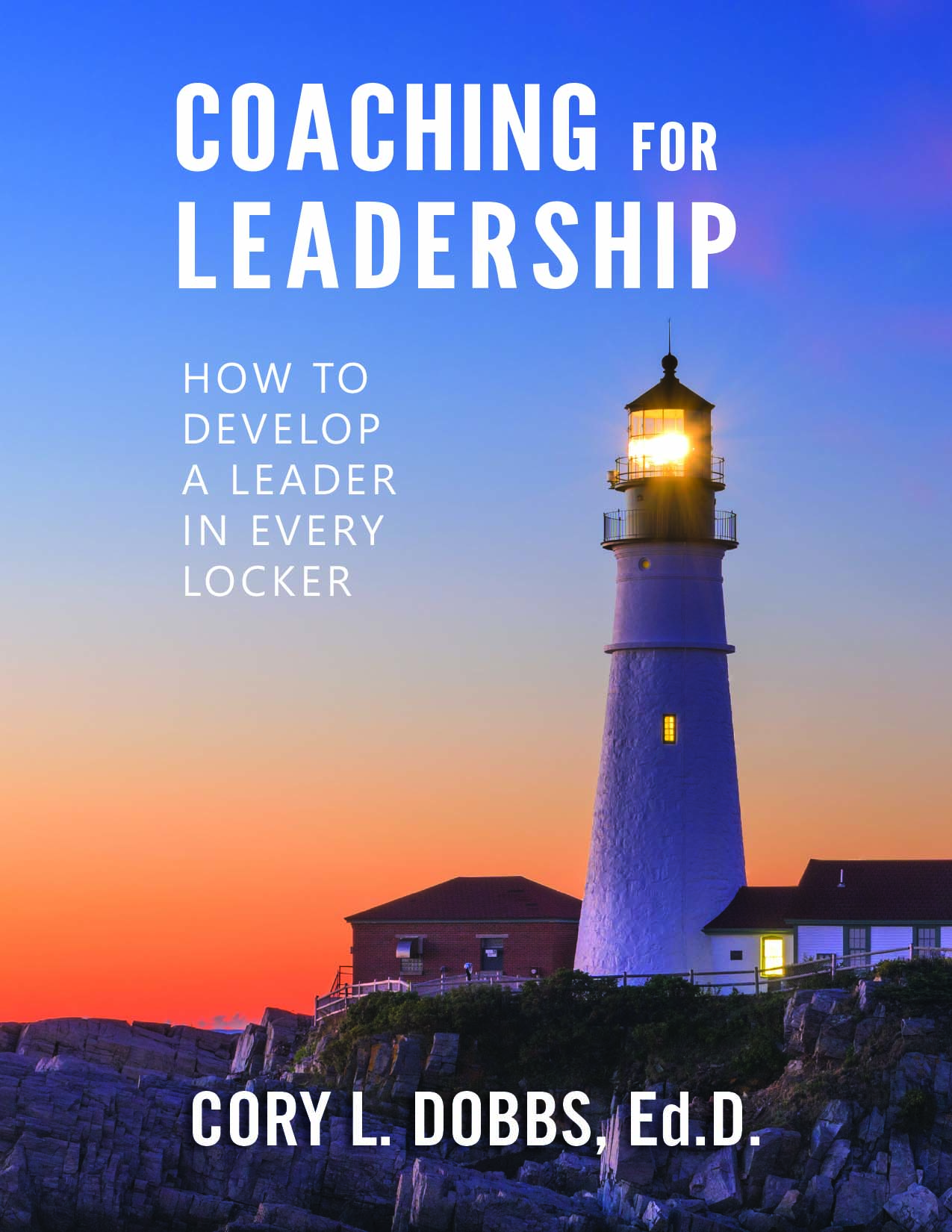
“Tell me and I’ll forget. Show me and I may remember. Involve me and I will care.” -Your Student-Athlete The world of coaching is changing. In Coaching for Leadership you’ll discover the foundations for designing, building, and sustaining a leadership focused culture for building a high-performance team. To find out more about and order Sport Leadership Books authored by Dr. Dobbs including Coaching for Leadership, click this link: The Academy for Sport Leadership Books

About the Author

A former basketball coach, Cory’s coaching background includes experience at the NCAA DII, NJCAA, and high school levels of competition. While coaching, he researched and developed the transformative Becoming a Team Leader program for student-athletes. Cory has worked with professional athletes, collegiate athletic programs and high schools teaching leadership as a part of the sports experience and education process. Cory cut his teeth as a corporate leader with Fortune 500 member, The Dial Corp. As a consultant and trainer Dr. Dobbs has worked with such organizations as American Express, Honeywell, and Avnet.

Cory has taught a variety of courses on leadership and change for the following universities:

Northern Arizona University (Graduate Schools of Business and Education)

Ohio University (Graduate School of Education / Management and Leadership in Sport)

Grand Canyon University (Sports Marketing and Sports Management in the Colangelo School of Sports Business)

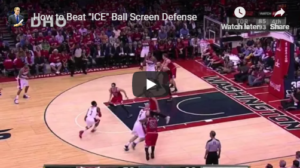
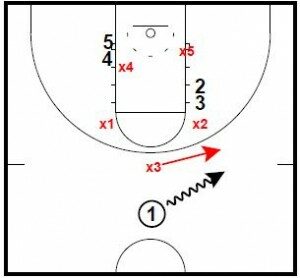
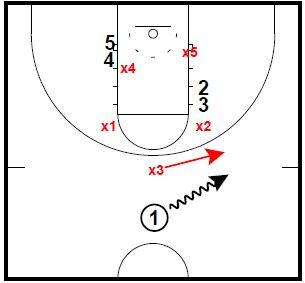
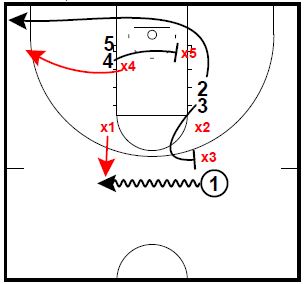
11 Ways to Beat Ice Ball Screen Coverage

By Brian Williams on February 22, 2016

University of Maine Men’s Assistant Coach Zak Boisvert has assembled some of his favorite ways to beat Ice ball screen coverage.

He has an outstanding site with posts on various coaching topics at www.pickandpop.net

His You Tube channel has several videos with various types of man to man plays, zone sets, and inbounds plays. You can subscribe to receive an update when he posts a new video Zak Boisvert You Tube Channel

You can follow him on Twitter at this link: @ZakBoisvert

You aren’t going to be able to use all of these, but I hope that you can find one or two that fit your player’s abilities.

The 11 Ways he has assembled in this video are:

Reverse into Down Screen
Reverse and Follow
Throwback and Follow
DHO (Dribble Hand Off)
Backdoor
Snake the Twist
Dive the stunt defender
Reject and misdirection
Short Roll into the gap
Weakside flare and skip
Stunt Weakside lob (to player being guarded by stunting defender)

Click play to see the video

This is a You Tube video, so you will need to be on a server that allows you You Tube access.

Basketball Plays: Double Stacks Up Runner

By Brian Williams on February 21, 2016

Coach Vonn Read has submitted several plays from his playbook series The Basketball Encyclopedia of Plays to the Coaching Toolbox.

Vonn is an assistant coach at Houston

He has also served as an assistant coach in the WNBA with the Phoenix Mercury, Orlando Miracle, and San Antonio Silver Stars.

He was an advanced scout for the Orlando Magic as well as The Charlotte Sting.

The “Best Zone Sets from the NCAA” is paired with Coach the NCAA Man to Man Sets Playbook as this week’s featured eBook Bundle. You can find out more here: Best NCAA Man to Man & Zone Sets Bundle

Diagrams created with FastDraw

runner1

This is a good quick hitter against a 1-2-2 zone that will produce a layup.

This is a timing play!!

The 1 player will dribble to the lane line extended area to set up the ball screen.


runner2

The 2 player will drop to the block and cut to the corner.

The 3 player will set a ball screen on the top player in the Zone.

The 4 player will screen X5 in the Zone.

The 1 player will use the ball screen, drawing both X3 and X1 together.


runner3

The 4 player screens X5 in the Zone, and X4 chases the 2 player
(Best Shooter) to the corner.

This should leave the 5 player wide open on the block.


Coach Read has also put together The Basketball Encyclopedia of plays. You can check them out here: The Basketball Encyclopedia of Plays or read more about the books:

Any coach looking for the latest and innovative plays from the Professional, College, or High School levels can stop looking. With a compilation of over 7,700 different plays, you will never need to purchase another basketball playbook again. These playbooks can be used as a great reference tool for years to come. This 2 Volume Book includes plays from 19 different play categories, and they are the most extensive playbooks on the market.

The Basketball Encyclopedia of Plays (Platinum Series) contains over 7,700 Plays (Both Volumes combined) from the NBA, WNBA, USBL, and College levels from someone who has worked as an Advanced Scout or Coach on each level!!! This book has been intensely compiled over the last 21 years, with plays taken from a lot of NBA Coaches (past and present), WNBA coaches, and College coaches (Men’s and Women’s) from around the country.

Any coach that is serious about improving their knowledge of the game from an X and O standpoint will benefit tremendously from these books. These Books can be used to discover New Quick hitters, add a New Package to your playbook, or develop an entire Offensive System. There are a lot of new ideas and concepts in these books to study, and the Basketball Encyclopedia of Plays can be a great resource for coaches on all levels!!! This book is definitely for those X and O junkies who are always looking to improve as a Coach.

“THE GAME IS ALWAYS CHANGING? ARE YOU?” Vonn Read

Here is the link: The Basketball Encyclopedia of Plays

  • « Go to Previous Page
  • Page 1
  • Interim pages omitted …
  • Page 128
  • Page 129
  • Page 130
  • Page 131
  • Page 132
  • Interim pages omitted …
  • Page 288
  • Go to Next Page »

Primary Sidebar

  • Twitter
  • Facebook
  • Linkedin
coachestoolbox
personaldevelopmenttoolbox
basketballplayerstoolbox
basketballtrainer
athleticperformancetoolbox
coachingbasketball

© Copyright 2026 Coaching Toolbox

Privacy Policy