• Skip to primary navigation
  • Skip to main content
  • Skip to primary sidebar

  • Basketball Plays
    • Ball Screen Sets
    • Horns Sets
    • Man to Man Post Up
    • Man to Man Isolations
    • Backdoor Plays
    • Man to Man 3 Point Shot Plays
    • 2-3 Zone Attack
    • Baseline Inbound Plays
    • Sideline Inbound Plays
    • Combination Defense Attack
  • Drills
    • Defensive Drills
    • Offensive Drills
    • Competitive Drills
    • Passing Drills
    • Rebounding Drills
    • Shooting and Scoring Drills
    • Toughness Drills
    • Transition & Conversion Drills
    • One on One Drills
  • Blueprint
  • Practice
  • Mental Toughness
  • Skill Development
  • Offense
  • Defense
  • Store

Defensive Pressure: It’s All In Your Head

Defensive Pressure: It’s All In Your Head

By Brian Williams on April 11, 2016

This post was written by John Carrier and originally posted on his Coaching Basketball Blog

Lately I’ve been reading bits and pieces of Stuff Good Players Should Know by Dick Devenzio. It’s a great book and I would encourage you all to get it. This is especially true if you are a coach who really strives to be a teacher of the game. As a preview, you can read some of the notes from an old blog post by Eric Musselman.

One of the things that Coach Devenzio talks about in his book is the idea that defensive pressure in basketball is only an illusion. Think about what a novel concept that really is! How many times have you seen players (and even coaches) panic when a team presses, traps, or just plays hard pressure man? It happens all the time and costs teams victories on a regular basis.

So what is pressure in basketball? It’s not like football where pressure can mean bodily injury. It’s more of a mindset that leads the team being pressured to panic. If you don’t panic however, now what? You will find that good teams relax when they are pressured. When you relax you are able to see more clearly and actually put the team that is pressuring at a disadvantage by playing smart, principled basketball.

It’s easy enough to preach to our players that they need to handle pressure, but we know talking a good game means nothing. How do you teach it then!? I was blessed this spring to work with a great group of athletes out at St. Croix Prep High School in Stillwater (MN). Our main focus for the development sessions focused on basketball IQ and understanding the game. They play in a conference and a section with teams that love to trap and pressure so we decided that we would spend some time teaching them how to handle that pressure. The following is what worked for us as we increased their ability to handle pressure.

  • Sold the Idea that Pressure is a Myth
    • This may have been the biggest, and hardest piece. They need to understand that pressure doesn’t matter. We even went as simple as having a defender pressure them while they just stood there. This made them realize that the defender wasn’t going to do anything to them – they were just waving their hands, not swords. Once they got used to the idea that being pressured wasn’t going to result in loss of limb or life, the rest was much easier. They started to relax and see the action much better.
    • The more comfortable they are with pressure (the less scared) the less pressure affects their ability to make decisions.
    • In order to be comfortable they need to experience pressure over and over again for this to happen. It’s like riding a roller coaster, the first time might be scary but by the second or third ride it isn’t nearly as bad. So we had them ride the roller coaster quite often during our session and experience hta tpressure.
  •  Taught Them How to Handle Pressure
    • As always, it’s important to teach the game.
    • What we did was showed them basic concepts to use when being pressured:
      • Backcut when denied
      • Cut at two speeds in two directions to get open
      • Don’t make the same cut to get open each time
      • GO-GO: get open or get out
      • Take your space on the catch – DO NOT go backwards
        • When you catch against pressure, take a tep forward, rip through hard, and take your space.
        • Makes it easier to pivot and pass as well as see the floor
        • This might be the most important one.
      • Eyes up
      • Pivot hard and rip hard with big elbows\
      • Don’t hold the ball above your head
      • Stay low and strong
      • Rip to the hip
      • Rip below the knees and above the head, not across the belly button
      • Take a deep breath and slow down
      • Take a five second call over a live ball turnover – just be patient
    • Drills should be a progression where you learn the technique first and then do it under pressure.
      • For example, you work on catching and ripping
    •  After learning technique drills should simulate game situations
    • After technique, drills should incorporate more pressure than you see in games with pieces such as extra defenders.
  • Drilled Them on Technique
    • Used a number of simple drills to teach the mechanics of how to handle pressure.
      • Staying low, ripping and pivoting, taking space, etc.
  • Let Them Learn in Small Sided Games
    • If you have not read Brian McCormick yet, do so now. He is huge on small sided teaching games and he is onto something, they work!
    • Small sided games are games of 1 on 1, 2 on 2, 3 on 3, or 4 on 4 that emphasize the skill you are working on while still playing.
      • So in the game you would emphasize being strong with the ball in this case.
    • Small sided games are great teaching tools because they put players in game like situations and allows players to teach themselves through experience.
    • You can create rules to overload the small sided game to make it harder than a real game. 
      • Example – 2 on 2 no dribble allows the defense to pressure and deny harder than in a game, also no dribbling forces players to be strong with the ball.
    • 1 on 1, 2 on 2, 3 on 3, or even 4 on 4 allows players more touches than a typical 5 on 5 game.
    • Small sided games allow players to apply the skill in a game situation and work on truly learning the skill in a trial and error environment.

 Drills and Progressions

The following is an example of a drill progression that we use to teach toughness with the ball. I believe in progressions because in my experience (although limited) progressions yield a better understanding of the skill. Players learn to apply it faster as opposed to just drilling it. For me a progression starts with a skeleton drill (no defense) to work on the technical aspects of the skill, then we add defense to a drill, then we make the drill game like, and then we play a small sided game. Sometimes the last two steps are blended into 1. Also, as the year goes on we spend less time with the drill and more time on small sided games.

As always, it’s not what drill you do it’s how you do it and what you  teach and emphasize within the drill.

Rip Throughs (Skeleton drill)This may be the most boring drill, but I always tell the players that if they go hard that we will do the drill for 2-3 minutes tops. If they don’t go hard we will do it all day.

Players move out around the floor, spin the ball out, catch it with two hands and two feet. Right as they catch they rip forward to take their space. Then they rip 3-4 more times hard with big elbows. They should rip to the hip. As they rip the ball should go below their knees or above their head. Once they are done they spin out and repeat.

Boss Drill (With defense)
Now we add some defense to the situation. In this drill you partner up with one ball. The defense starts with the ball about 2 feet from the offense. The defense throws the ball to the offense and comes up and really gets into them – hacking at the ball, pressuring them body to body,  and slapping their arms to try and force them to lose the ball. The offense can’t dribble and rips through hard with big elbows and tries to keep the defender off for 5 rip and pivots. Make sure we are emphasizing proper footwork in this drill. Players don’t try to hurt each other, but the drill should be overly aggressive with no fouls – making it harder than the game. If you can keep the ball against this type of pressure, whatever you get in a game. Unless, of course, it’s on the road and the coaches brother is the official! Even then you have prepared for the situation with this drill.

2 on 2 10 Pass Drill (With defense and closer to a game)
In this drill we now introduce something else to worry about outside of being strong with the ball. In this drill we add passing and moving to the equation. The drills has one ball with groups of four – 2 defense and 2 offense.

The offense has an entire 1/2 court (or 1/4 if you want to make it harder) to move around and they have to successfully complete 10 passes in a row. The offense cannot dribble or shoot. This means the defense pressures really close on the ball and denies the players off the ball hard. If they dribble or turn it over they have 10 pushups. If they successfully complete 10 passes the defense has 10 pushups. Defense and offense switch each time. This drill is great because again it puts your playres in a situation that is harder than a game, the offense now has to work harder to get open, make better passes, and still be strong with the ball on the catch while being mauled.

3 on 3 (or 4 on 4) No Dribble
Now we add in the small sided game. Players play 3 on 3 and try to score but cannot dribble the ball. Again, this creates a situation that is harder than the game.  Also another rule for the game is that if they are not strong with the ball it’s an automatic turnover. It is an automatic turnover if a player catches and doesn’t rip forward to take space take space, if they don’t rip and pivot, if they hold the ball over their head, or if they don’t rip to the hip. On a turnover the offense goes out and a the defense goes to offense.

Play the game to a set number of points or for a set time. You can also play it cutthroat style with 3-4 teams on one court. There is a dribble allowance if the player catches the ball cutting to the hoop and has to take a dribble to finish the layup (either that or you get some crazy – no game like shots).

As you can see, this is where the learning takes place. It’s easy for players to remember to use the skill in a drill where that’s all they have to focus on, but now they have to handle defensive pressure, other players cutting and moving, trying to score, trying to make passes, etc. If they can remember to be strong with the ball here they are going to have a better chance of doing it in a game. There is a much higher probability of carry over because in small sided games they are building habits.

 In Closing

Handling pressure is much more mental than physical. I’ve seen 5-5, spindly, weak players handle pressure better than 6-6 wings who weigh 230. It’s more about training their minds to do the little things (take space, big elbows, rip and pivot) than it is training their bodies. Hopefully the ideas above, although a little jumbled, will help you work with your players on better handling pressure. The more you can do drills and games that make it harder than the real game, the better your players will be. Lastly, teaching in a progression such as the one above is the very best way for players to learn how to be tough with the ball.
5 Continuous Game-Like Finishing Moves

By Brian Williams on April 10, 2016

This finishing drill was posted in the FastModel Sports Basketball Plays and Drills Library.

You can also find out more about FastModel Play Diagramming software by clicking this link: FastDraw

The drill was posted Marc Skelton, Head Boys Basketball Coach at Fannie Lou Hamer Freedom High School in the Bronx, NY.

Here is what Coach Skelton said about this drill:

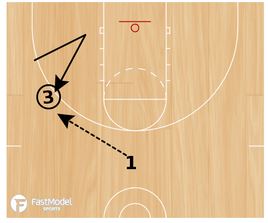
This continuous game-like finishing drill works on 5 different moves from 5 different spots on the floor.

These moves can be attempted at different spots using left or right hands.

This drill also helps develop footwork (pivots), rip through, and ball fakes. We name the moves after NBA players as it is easier to remember and embrace.

Bonus:1) Add Euro step 2) Add a blocking pad to finish with contact.

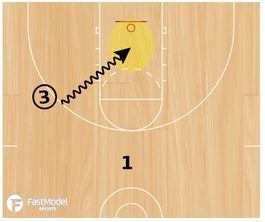
basketball-drill-game-like-finishes1

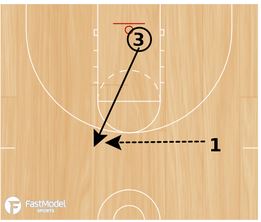
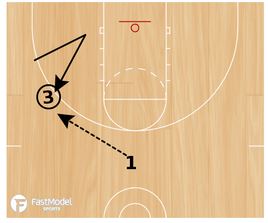
1st Move: “Chris Paul” fake

1) Wing executes a V-cut, catches the pass from coach (1 in diagram), and executes a double rip though.


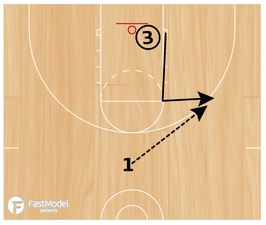
basketball-drill-game-like-finishes2

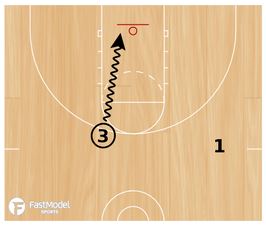
1st Move: “Chris Paul” fake continued

1) Attack with right hand into shaded area and performs an up and under move- finishing with the left hand.

Alternative move- rip though, attack with left hand and finish with right hand on left side.

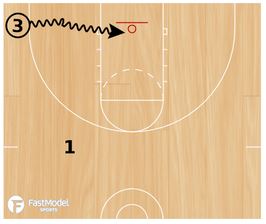
basketball-drill-game-like-finishes3

2nd Move: “Kemba Walker”

Starts as soon as the ball goes in from the first move.


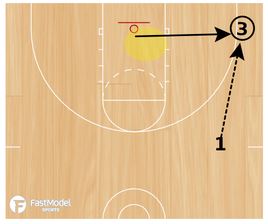
basketball-drill-game-like-finishes4

2nd Move: “Kemba Walker” continued

Drive with left hand and plants right foot around the dot for a step back jump shot.


basketball-drill-game-like-finishes5

3rd Move: “Jordan on Ewing”

1) Wing sprints to the corner. Drives left and performs a “half-moon” move coming back to the middle of the floor, then finishes at the rim.


basketball-drill-game-like-finishes6

4th Move: “Kawhi”

4th move starts as soon as the ball goes in from the 3rd move.

1) Wing back peddles to the corner. catches the pass from the coach, makes a ball fake back to the coach-essential to practice ball fakes. Drives left and performs a spin move when he gets into the shaded area.

basketball-drill-game-like-finishes7

5th Move: “Curry”

Starts as soon as the ball goes through the basket for move 4.

1) Wing sprints to the slot. Catch and face and rip to a left hand move.


basketball-drill-game-like-finishes8

5th Move: “Curry”

Jump stop in “restricted” area and use a high ball fake. Or you use the “peek-a-boo” ball fake around the defender’s waist-Think Larry Bird-


An Analytical Look at Rebounding

By Brian Williams on April 7, 2016

An article from Sean Lawless and John Olita of group-stats.com. You can also follow their work on Twitter @groupstats

Editor’s Note from Brian: I realize that not everyone has the resources to track all advanced basketball analytics, but anyone who keeps team rebounding stats can calculate rebounding percentage which is more meaningful than rebounding margin. You might not be able to track individual offensive or defensive rebounding percentages for the whole team, but if there is a player or two that you would want to have that individual feedback for, you could do it for them with a little extra data collection.

Dennis Rodman, Reggie Evans, and an Analytic Look at Rebounding

Rebounding (this will be the first and last time I refer to rebounding as a whole, from this point on it will be defensive rebounding and offensive rebounding) is an area of the game that makes a strong but simple case for the use of analytics for a couple of reasons. First, when looking at statistics like rebounds per game and rebound margin it is very easy to see the flaws that these stats present. Second, unlike some of basketball’s advanced stats, it is very easy to look at offensive and defensive rebounding analytically.

First, let’s get into the issues with the traditional stats mentioned above. The statistic rebounds per game (team or individual) runs into many problems. First and foremost, defensive and offensive rebounding are two different skills. The two skills are accomplished at much different rates. It is easier to pull down defensive rebounds than it is to grab offensive rebounds. So, naturally, the team whose defense forces the most missed shots will have the greatest amount of defensive rebounding opportunities. Thus the defense is being rewarded with lots of rebounds for forcing missed shots, right? Wrong.

The first issue arises with the following question: What if the defense forces a lot of turnovers? They will get very few defensive rebounding opportunities. Second, a team’s defensive rebounding should never be praised or criticized because of other areas of defense (like forcing or not forcing turnovers). Defensive rebounding is a skill that stands alone and statistics should represent that. The opposite applies for the offensive end as well. If your team turns the ball over a lot, the opponent will have less defensive rebounding opportunities. Now, thinking about everything you just read, consider how this might apply to rebound margin. Rebound margin is a stat that is talked about it locker rooms throughout basketball. As noted above one team, during a game, might have more defensive rebounding opportunities than the opponent. The team with more defensive rebounding chances will likely have a positive rebounding margin. Because the number of turnovers and missed shots is always varying, we should not use rebounding margin to determine a team’s rebounding ability.

Now what is the solution to the issues presented with traditional rebounding statistics? It’s pretty simple Offensive Rebounding Percentage (OR%) and Defensive Rebounding Percentage (DR%). These stats simply represent the percentage of offensive/defensive rebounds a team gets out of the amount of offensive/defensive opportunities the team has.

OR%=Offensive Rebounds/(Offensive Rebounds + Opponent Defensive Rebounds)

DR%=Defensive Rebounds/(Defensive Rebounds + Opponent Offensive Rebounds)

By isolating the rebounding, the stats give a true depiction of how good the team is at offensive and defensive rebounding. Applying this to individuals looks like this.

Individual OR%= Individual Offensive Rebounds/(Own Team Offensive Rebounds while individual is on the court + Opponent Defensive Rebounds while individual is on the court)

Individual DR%= Individual Defensive Rebounds/(Own Team Defensive Rebounds while individual is on the court + Opponent Offensive Rebounds while individual is on the court)

The formulas above show the percentage of offensive/defensive rebounds an individual gets divided by the amount of offensive/defensive rebounding opportunities there are while he’s on the court.

Defensive rebounding is best graded by the amount of defensive rebounds you get out of the amount defensive rebounding opportunities there are.

Offensive rebounding is best graded by the amount of offensive rebounds you get out of the amount of offensive rebounding opportunities there are.

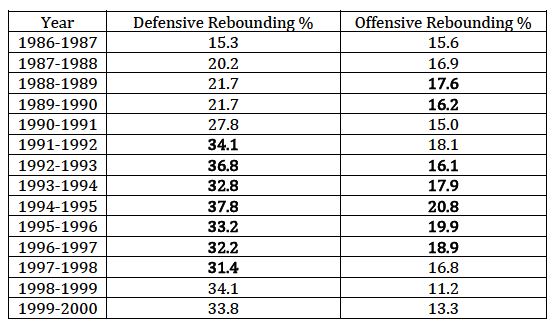
On the individual level, Dennis Rodman is looked at by most as the greatest rebounder of all time, regardless of what rebounding statistics you believe in. Examining his rebounding statistics is almost as entertaining as it was to watch him pull down those boards during his prime. Here is a look at his career rebounding percentages.

reboundingpercent

The numbers above are nothing short of incredible. Take a look at 1994-1995, his best year rebounding the ball. Rodman rebounded 37.8% of his opponents missed shots and 20.8% of his team’s missed shots. Both led the league (bold numbers are years in which Rodman led the NBA in the stat).

Understanding how impressive Rodman’s numbers allow one to truly appreciate Reggie Evan’s 2012-2013 season. Evan’s led the NBA in DR% and OR%. His OR% was a solid 15.5, but what really stands out is his DR% of 38.0. The number was higher than any mark Rodman ever put up. Reggie Evans is on the basketball court for one reason. To rebound the ball, and his 2012-2013 season was as good as you are going to see. His 37.8% mark is now the single season record for DR%.

Improvement Season 5 on 5 Guidelines

By Brian Williams on April 4, 2016

Thinking about spring and summer, here is a list that was published on Bob Starkey’s Basketball Coaching Blog, hoopthoughts.blogspot.com. He has been posting for several years and there are hundreds of posts with ideas to make your program better.

Pickup Game Guidelines

Bob Starkey

From my days at LSU, I have always had a list of guidelines for our team to follow in pick up.  Let’s be honest: pick will rarely if not never be a thing of beauty.  There is no atmosphere more conducive to slippage than that of players playing without supervision from a coach.  To me, there are four things needed for successful pick up play.

#1 A Definition of Good Pick Up Play
As a coach, you must paint a picture of what good pick up will be and what it will achieve.  For us, a good game of pick up has energy and enthusiasm.  It is a group of players that enjoying playing with each other and playing the game of basketball.  It is also a noisy proposition.  Lots of talking and chattering.  Players are talking the game.  They are encouraging each other and holding each other accountable.

#2 Leadership
Good pick up basketball has leaders that get things going.  It’s time to play — let’s get it!  They have a sense of urgency — here’s out teams…Maroon ball…let’s go!  They play hard and smart — they set a visual example.  They encourage and correct their teammates.  They are the eyes, ears and mouth of the coaching staff.

#3 Committed Team
Good pick up basketball has a team that is committed to improving.  They understand that every time they step on the court they will either get better or get worse. Teams that get better during the summer are holding each other accountable for effort and execution in pick up games.

#4 Guidelines
I’ve always believed that a good set of guidelines can help a great deal.  The team is “navigating” through the summer without you but you can provide a “road map” with some good guidelines.

Here is our list:

ALWAYS PLAY MAN TO MAN DEFENSE
Good pressure on the basketball (even if you get beat on the drive)
Get a hand up on every shot
Make contact, blockout, and finish the possession
Ball Screens: Hard Hedge and Recover
Off Ball Screens: No switching

START WITH HALF COURT GAMES
Even if you have enough for 5/5, start with a couple of half court games
Will help us to develop our man defense and offense principles

UTILIZE CONVERSION
After half court games, finish up with full court games

Progression will always be: Primary, Secondary, Offense
Even 4/4 games can be played full court

Regardless of situation, all 10 players should cross half-court on each possession

TAKE ADVANTAGE OF EVERY OPPORTUNITY TO PLAY
3/3, 2/2, 1/1
Play, play, play

COMMUNICATE
No music on during pick up
Talk: Encouraging, Corrective, Instructive

BE A GOOD TEAMMATE
Encourage teammates
Upperclassmen teach our freshman how we play
Help freshman to understand offensive/defensive principles

PLAY HARD
Is there any other way?!
THERE WILL COME A TIME

WHEN WINTER WILL ASK,

“WHAT HAVE YOU DONE THIS SUMMER?” 

The remaining ideas are from Alan Stein, Basketball Performance Coach at DeMatha High School of Pure Sweat Basketball

To ensure our players maximize their 5-on-5 play; we implement the following 5 rules:

  1. Every offensive player must be in the front court when a point is scored. If not, the basket does not count and it is a turnover. What happens on a quick steal or a long outlet pass? You better sprint!!
  2. Every defensive player must be in the front court when a point is scored. If not, the basket counts and the offensive team receives another possession. This helps eliminate standing and pouting after a turnover, missed shot or no foul call.
  3. Defense calls fouls. No arguments. No exceptions. However, we strongly encourage our players to limit calling fouls, as we want them to get used to playing with severe contact.
  4. Games are played to 21, with 2’s and 3’s. All 10 players are expected to call out the score on every possession. We choose to play to 21 because it simulates the length of a quarter (8 minutes-ish) and creates a superior platform for conditioning. It also allows for a comeback (if one team jumps out to a 12-2 lead, you still have plenty of time to come back and win).
  5. The player that scores the game winning point must immediately step to the free throw line and make a free throw. If so, the game is over. If not, the game-winning basket is erased and play resumes.

Swing and Skip Pass Shooting Drill

By Brian Williams on April 3, 2016

This zone shooting drill came from the FastModel Sports Basketball Plays and Drills Library.

You can also find out more about FastModel Play Diagramming software by clicking this link: FastDraw

The drills were contributed by Coach Bert DeSalvo. Bert has a regular coaching blog, Expressions from the Hardwood. You can also follow him on Twitter @coachDeSalvo

IMO, it is important to replicate the shots that you shoot in games from your offensive system during your improvement season workouts. That means shots you get against man to man defense as well as against zones.

Even if these shots are not a part of your zone attack, I encourage you to incorporate you cuts against zone and the shots you get into your shooting workouts.

Swing and Skip Pass Shooting Drill

Bert DeSalvo

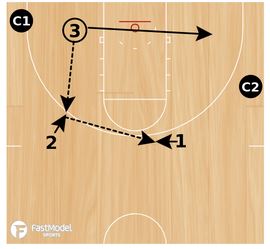
basketball-drills-zone-shooting3

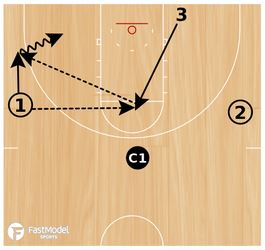
3 and Coach 1 and Coach 2 each start out with a ball

3 reverses to 2

2 steps to the pass and reverses to 1

1 steps to the pass

3 runs the baseline

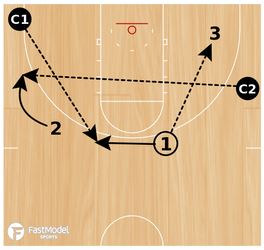
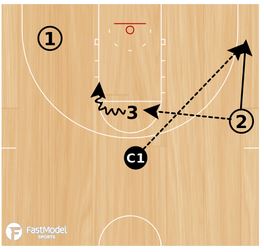
basketball-drills-zone-shooting4

1 hits 3 running the baseline for a curl jump shot (inside foot pivot)

Coach 1 passes to 1 for a 3pt shot attempt

Coach 2 skips to 2 for a 3pt shot attempt

**NOTE: Coaches can add shot fake 1 dribble shot, etc.

Zone Relocate and Flash Shooting Drill

By Brian Williams on April 3, 2016

This zone shooting drill came from the FastModel Sports Basketball Plays and Drills Library.

You can also find out more about FastModel Play Diagramming software by clicking this link: FastDraw

The drills were contributed by Coach Bert DeSalvo.

Bert has a regular coaching blog, Expressions from the Hardwood. You can also follow him on Twitter @coachDeSalvo

IMO, it is important to replicate the shots that you shoot in games from your offensive system during your improvement season workouts.

That means shots you get against man to man defense as well as against zones.

Even if these shots are not a part of your zone attack, I encourage you to incorporate you cuts against zone and the shots you get into your shooting workouts.

Zone Relocate and Flash Shooting Drill

Bert DeSalvo

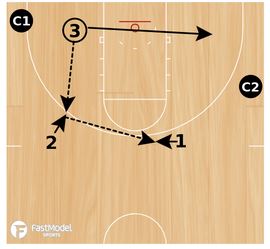
basketball-drills-zone-shooting1

1 passes to 3 who flashes to FT line area

1 relocates (slides) towards baseline

3 passes to 1 for one-dribble pull up baseline jumper


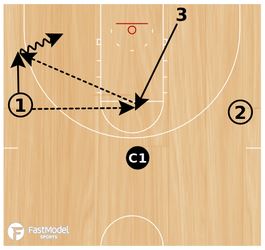
basketball-drills-zone-shooting2

3 turns and locates 2

2 passes to 3

3 steps to the pass, takes one-dribble and shoots a FT jumper

2 slides towards Baseline

Coach 1 passes to 2

2 shoots “catch and shoot” 3pt shot

  • « Go to Previous Page
  • Page 1
  • Interim pages omitted …
  • Page 124
  • Page 125
  • Page 126
  • Page 127
  • Page 128
  • Interim pages omitted …
  • Page 288
  • Go to Next Page »

Primary Sidebar

  • Twitter
  • Facebook
  • Linkedin
coachestoolbox
personaldevelopmenttoolbox
basketballplayerstoolbox
basketballtrainer
athleticperformancetoolbox
coachingbasketball

© Copyright 2026 Coaching Toolbox

Privacy Policy