• Skip to primary navigation
  • Skip to main content
  • Skip to primary sidebar

  • Basketball Plays
    • Ball Screen Sets
    • Horns Sets
    • Man to Man Post Up
    • Man to Man Isolations
    • Backdoor Plays
    • Man to Man 3 Point Shot Plays
    • 2-3 Zone Attack
    • Baseline Inbound Plays
    • Sideline Inbound Plays
    • Combination Defense Attack
  • Drills
    • Defensive Drills
    • Offensive Drills
    • Competitive Drills
    • Passing Drills
    • Rebounding Drills
    • Shooting and Scoring Drills
    • Toughness Drills
    • Transition & Conversion Drills
    • One on One Drills
  • Blueprint
  • Practice
  • Mental Toughness
  • Skill Development
  • Offense
  • Defense
  • Store

Cracking the Code to Building an Elite Team

Cracking the Code to Building an Elite Team

By Brian Williams on January 3, 2017

Cracking the Code to Building an Elite Team

By Cory Dobbs, Ed.D.

“A team is not just a collection of individuals.  When everyone clicks into place, a team is truly a community, a tightly knit fellowship.” 

Many coaches are expert tacticians, strategists, and teachers of techniques.   Few are adept at building teams.  I mean high-performing teams.  Think Seal Team Six.  The elite fighting force, the team that captured Osama Bin Laden.  Sure, your team may master an offense or a defense, but it’s a fact that most teams don’t reach an elite level of teamwork.  To do so requires a deliberate and intense effort to building the team.

As a researcher I’ve studied hundreds of teams and can only conclude few teams, won-loss records aside, ever achieve an elite level.  Study after study of elite teams, like Seal Team Six, continue to reveal it’s not the personnel but processes that lead to an elite level team.

Take a moment and re-read the quote above.  I’ve purposefully left off the name of the author.  I did so out of respect for his work, but I do find this quote to be lacking in terms of action-ability.   Most coaches and players unknowingly live by a “click or clash” framework of relationship building.  That is, some people just click together while others clash with one another.  And it’s rarely explicit, but very implicit—teammates prefer to go along to get along.  Not in elite teams.

At its most dynamic level a team is a system, a network of interdependent components that work together to try to accomplish the aim of the system architects.  This differs from the most basic level of a team as a collection of players.  When the process of team building becomes more strategic, the calculus changes.  A laissez-faire approach changes to a more direct and deliberate approach.  Relationship building becomes the central focus.  Relationship is everything.  When you see the process of team building as social system, then the integrity of every interpersonal interaction is essential to developing an intensive teaming capability.

I’ve uncovered, through wide-ranging research and practice, twenty principles and concepts and isolated eight “roles” that are necessary for building elite teams.  Yes, I’ve cracked the code to building high-performance teams.  High-performing teams make deliberate teamwork their focus.
[thrive_leads id=’36827′]
The Teamwork Intelligence approach is a disciplined way of thinking about and building a high-performing team; it involves discussing teamwork as both a system and a set of processes.  This allows us to explore the context in which teamwork occurs, the characteristics of the coaches and players, individual and team values, experience, the timing of events, the history in which teamwork is embedded, and how teamwork intelligence plays a role in individual and collective successes and failures.   Teamwork intelligence delves into team work as a process and as a way to understand the person (both players and coaches) embedded within a system.

To think about teamwork as a system, we need to consider the inputs, such as training for teamwork intelligence, the process, which we can describe as the system and the context in which the players and coaches interact, and the outcomes, which are the levels of motivation, performance, and well-being of players and coaches.

To leverage the process of teamwork intelligence I have designed five building blocks that must be operationalized:

(1) the four dimensions of team building and the associated eight roles of teamwork;
(2) the three mindsets of a team player;
(3) the three layers of a team player;
(4) the five core concerns of every team member, and
(5) the five forces of performance-enhancing relationships.

By optimizing these five components—the teamwork intelligence system—we are able to enhance each individual’s vital force and, in turn, the collective force of the team.

SO, WHAT IS TEAMWORK INTELLIGENCE?

Teamwork Intelligence is the purposeful and intentional relational process of team members together raising one another to higher levels of motivation, collaboration, compassion, and performance.  It’s deceptively simple: in order to build a high-performing team you have to create the conditions for team members to commit and unify—to coalesce into a single organism.  Such oneness is not inevitable; it is forged methodically and deliberately.

WHY IS TEAMWORK INTELLIGENCE THE SMART THING TO DO?

A significant aspect of teamwork intelligence is knowing the expectations one should have of one’s teammates.  One of the most significant expectations is that of high-level ownership with the purpose of each player investing in the development of a high-performing team.  Through expectations and collective achievements, identification, loyalty, and trust are built.  The goal and expected outcome is the development of the team’s full potential.

Extreme Ownership is a central concept of Teamwork Intelligence.  Teamwork Intelligence is not only about teaching student-athletes how to comply with a set of rules and procedures; it is about recognizing the profound difference between compliance-based behavior and values-based performance.  Extreme Ownership is about creating a culture in which every team member is committed to performance excellence and team member wellness based on personal commitment to the best interests of the team.  Extreme Ownership occurs when student-athletes own their personal learning and performance as well as team learning and performance.

Teamwork Intelligence generates higher levels of autonomy, extra effort, commitment, performance, and satisfaction.  High performance is what the student-athlete wants to do, not because it brings personal glory, but because they feel a sense of extreme ownership of the team.  The extreme owner is all in as a team player and willingly goes all out for the team.

I’ve seen enough to validate the claim that knowing what to do can lead to higher levels of doing.  However, I’ve also observed far too frequently a high degree of learned helplessness.  Student-athletes have, for the most part, grown up in a sport system in which they prefer to wait for the coach to take corrective action, to “instill” motive and values, and basically avoid taking responsibility for the building of the team.  This is why elite teams are emphatic about deliberately building a team and insistent on teamwork intelligence.

Teamwork Intelligence provides a framework for seeing interrelationships of the elements of the team system rather than static “snapshots” that tend to distort the differences between a mediocre team and a high-performing team.   Teamwork Intelligence provides a set of principles and includes a set of specific tools and techniques (such as role clarification provided by The Eight Roles of Teamwork) for building a high-performance team.  Investing in the development of relationships will pay off.

Okay, so are you willing to invest time, energy, and resources into developing an elite team?  If so, get started as soon as possible.   Explore the principles and practices The Academy for Sport Leadership has discovered and developed and teach in our Teamwork Intelligence Workshop.
“Tell me and I’ll forget. Show me and I may remember. Involve me and I will care.” -Your Student-Athlete The world of coaching is changing. In Coaching for Leadership you’ll discover the foundations for designing, building, and sustaining a leadership focused culture for building a high-performance team. To find out more about and order Sport Leadership Books authored by Dr. Dobbs including Coaching for Leadership, click this link: The Academy for Sport Leadership Books
About Cory Dobbs, Ed.D.

Cory Dobbs is the founder of The Academy for Sport Leadership and a nationally recognized thought leader in the areas of leadership and team building.  Cory is an accomplished researcher of human experience. Cory engages in naturalistic inquiry seeking in-depth understanding of social phenomena within their natural setting (visit www.aleaderineverylocker.com).

A former basketball coach, Cory’s coaching background includes experience at the NCAA DII, NJCAA, and high school levels of competition.  After a decade of research and development Cory unleashed the groundbreaking Teamwork Intelligence program for student-athletics. Teamwork Intelligence illuminates the process of designing an elite team by using the 20 principles and concepts along with the 8 roles of a team player he’s uncovered while performing research.

Cory has worked with professional athletes, collegiate athletic programs, and high schools teaching leadership and team building as a part of the sports experience and education process.  As a consultant and trainer Dr. Dobbs has worked with Fortune 500 organizations such as American Express, Honeywell, and Avnet, as well as medium and small businesses.

Dr. Dobbs has taught leadership and organizational change at Northern Arizona University, Ohio University, and Grand Canyon University.
Warrior Shooting Drill

By Brian Williams on January 2, 2017

This shooting drill was contributed by Joel Hueser FastModel Sports Basketball Plays and Drills Library.

Coach Hueser is the Head Boys Coach at Papillion-LaVista South High School High School in Nebraska.

The comments along with each diagram are from Coach Hueser.

You can also find out more about FastModel Play Diagramming software by clicking this link: FastDraw

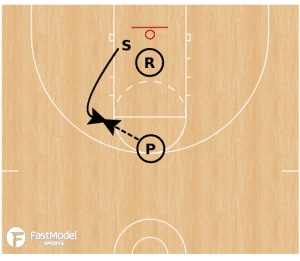
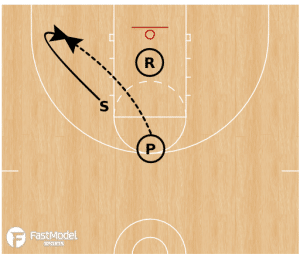
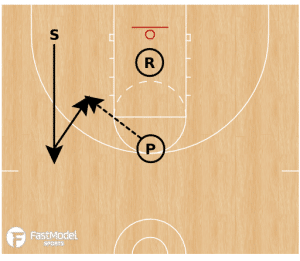
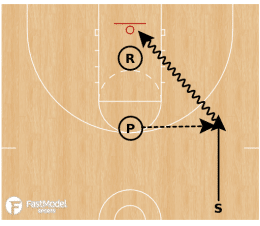
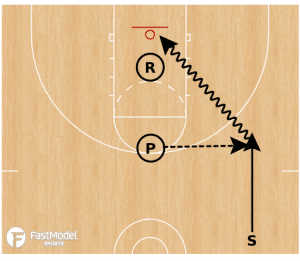
Warrior Shooting is a great drill simulating a variety of cuts:
1) Basket Cut
2) Using a Pin Down
3) Using a Flare Screen and
4) Back Cut.

The purpose of this post is to get your thoughts going about creating a similar drill that incorporates the shots that your players get in games.

In addition to game spots, I like to have shooting drills include a scoring and timing element as well.

Shot #1 Worth 1 Point:

Shooter starts at half court (or top of the key extended if space doesn’t allow), catches on the move and attacks the basket.

Points of Emphasis:

-Catch on the run and attack the basket with a 45 degree angle cut.

Shot #2 Worth 2 Points:

Shooter continues his cut to simulate using a pin down screen and shoots near the freethrow elbow.

Points of Emphasis:

-Emphasize inside-pivot.


Shot #2 Worth 2 Points:

Shooter continues his cut to simulate using a pin down screen and shoots near the freethrow elbow.

Points of Emphasis:

-Emphasize inside-pivot.


Shot #4 Worth 1 Points:

This will be the same as shot #1 but on the opposite side.

There are two ways to do this: 1) Sprint to halfcourt, or 2) Cut hard to ball level and simulate a back cut. We prefer this more times than not.

Points of Emphasis:

-Shot #5 & #6 will also be the same as #2 & #3.
-After the 1st shooter is done, the passer becomes the shooter and the rebounder passes.
-Repeat this again, but start on the opposite side.

And, below is a short video demonstrating the drill

10 Commandments of Defense

By Brian Williams on December 29, 2016

This post was written by Micah Hayes and posted with permission from PGCBasketball.

Micah is the owner of ‘The Sweatbox Decatur’ and serves athletes through intense individual & group athletic performance training. Micah is also the strength & conditioning coach at Decatur High School.

It has been said that the cornerstone of defense is not just effort but multiple effort.

I argue that if defense was just about effort then we could pick up anyone off the street, offer the right motivation and they could get the job done. Defense is so much more than that. You have to know how to guard multiple actions and understand angles, assignments and rotations. That being said, every part of the game involves effort. In fact, that is a baseline for participation at any level of play. If you don’t bring your multiple efforts, you won’t be great at defense, and your game won’t be complete.

Knowing that defense isn’t that easy, I want to offer 10 defensive commandments to help sure up that part of your game.

1. BE COMMITTED

Everyone wants to put the ball in the hoop, but few basketball players find that same joy in getting a big stop, holding a great offensive player below their season average or snagging a pivotal rebound that gives their team an extra possession.

The game truly becomes easier when you can experience equal joy on both ends of the court.

2. DON’T TALK, COMMUNICATE

Too often, I hear players call out a term like “help,” “ball,” “dead,” etc. In a vacuum, those terms mean nothing. You could be helping from anywhere, the ball could be doing anything, and what is exactly is “dead?” Instead, I believe players should communicate their position or exactly what they believe the opposing player is going to do on that possession. It would sound more like, “I got your help on the left!” “Shooter right corner!” “Right hand driver, send her my way!”

Don’t waste energy saying the same thing over and over again. Communicate your message loud and clear once or twice. The game happens fast and you need to be ready to communicate your new position and your player’s next move.

3. GUARD YOUR YARD

Your help should typically be about one to two steps away, which is about a yard in either direction. If you can guard your yard, send the ball into your help and keep the ball in front of you. The offense will be forced to take tough, out-of-rhythm, contested shots. Many of those which will be off the bounce (the worst shot in basketball).

Over the course of a game and a season, the percentages will favor your defense and the offense will make fewer shots which will hopefully result in you winning more games.

Sometimes a better player having a great night will hit a tough shot and all you can do is tip your hat and move on to the next play. Keep doing your job, the odds will end up in your favor.

4. HELP THE HELPER

I will guarantee you one thing: you will get beat. An offense player will have an incredible peek fake, explosive first step or dribble move that will beat you, and you will need help. You can’t quit on your play; you have to be ready to assume the next help responsibility.

If someone helps you, it is your job to get your head on a swivel and recognize how you can help them and then get on your horse and make a play. One easy way to remember that is to “see a need and fill the need.”

Special defenders will help as many times as needed whether it is their responsibility or not. They show up BIG with their voice, body language and mentality and get the job done.

5. ANTICIPATE

Basketball is a game of chess, and the ones who get caught playing checkers are routinely beat over and over again. You have to be thinking one step ahead at all times. Is there a screen coming? What kind of screen is it? Is he about to drive or shoot – and from where? Where is my next help responsibility?

Anticipation is a key ingredient to success on either end of the floor. If you can couple anticipation with advanced preparation (you know your player’s tendencies), you will have success guarding them. It will look like you are in two places, but you know that you are just thinking a step ahead.

Basketball is a game of chess; think one step ahead. Don’t get caught playing checkers.

Click To Tweet

6. COVER TWO

One of the easiest ways the offense can score is in transition. It’s your job to get back and stop the offense in its tracks. The two things you need to cover are 1) the ball and  2) the streaking offensive player running to the open lane or rim, trying to gain an advantage in the open court before the help is set.

You and one other teammate need to communicate and decide who is going to stop the ball or get their head in the rim and make a stand until the rest of your teammates get matched up.

It’s not enough to just get back. You have to be ready to make a play and turn sometimes what might be a bad situation into a good one by getting a deflection or funneling the offense away from an open lane.

7. GET F.A.T.

When you are on the court, you want to find yourself constantly faking and threatening the offense.  Make them think you are playing the drive when you are really anticipating a jumper; jab at the ball handler, help early and bait the offense into a bad pass.

Offense isn’t the only place where fakes are useful. If you can use fakes on the defensive end, you will take your game to another level. Threaten the defense by showing up big with your body language and your voice. We all know that noise can be used as a distraction, and you can’t distract anyone showing up small. (If you’ve ever been to a haunted house before, you know it’s always the demonstrative and screaming actor that comes out of nowhere that gets you.)

8. HIT FIRST

When you are boxing out, it’s not enough to hit the offensive player. You have to hit first and get them off balance so you can go and grab a board.

I don’t believe in the idea of holding a box out and letting it hit the floor. There is only so long you can maintain a box out without getting a holding foul called or just getting beat. A good offensive player wants the ball just as bad as you do so hit them first and then attack the rebound with everything you’ve got.

It’s not enough to hit the offensive player, you have to hit FIRST.

Click To Tweet

9. RUN OPPOSITE

Seventy percent of rebounds come off on the opposite side of the rim. That means more than half of the rebounds you go after will have to be run down.

After you hit your box out, get to the opposite side of where the ball was shot and start attacking the glass. You will turn yourself into a rebounding machine and gain extra possessions for your team just by playing the numbers on this one.

10. SOLVE PROBLEMS

Every time the offense comes down the court they are presenting a new problem for you to solve. Which player is going to shoot it? What set are they going to run? Who might get beat?

Each of these is an opportunity for you to show up like one of three players. You can be a Preventer and solve the problem early by making a play on the ball or in help. You can be a Fixer and show up like a repairman and start plugging holes like a teammate getting beat off the bounce or a smaller teammate getting posted up. Or lastly, you can be an Eraser and at the last second take a charge, show up on a rotation and get a steal, or come out of “nowhere” and block a wide open shot or lay-up.

No matter where you are in a defensive possession, there is always a problem to be solved, and you need to be ready to solve it.

I am going to offer up one bonus commandment for defense and that is, “Have Fun.” The best competitors look forward to this end of the floor. They relish the opportunity to beat the offense at their own game of deception, timing and anticipation. It is an opportunity to be disruptive, earn easy possessions and show off your toughness. Take pride in your ability to not only give someone a bucket but also take one away.

To learn more about PGC Basketball, including additional training tips and videos, you can visit their YouTube Channel

Icing a Side Pick and Roll

By Brian Williams on December 26, 2016

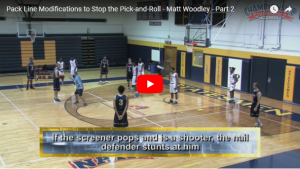
This post contains videos of two defensive drills from Matt Woodley, Asst Men’s Coach at Wake Forest.

At the time when the video was made, Matt was the Head Coach of the Iowa Energy of the G League.

He is a former assistant for Tony Bennett at Washington State.

For the 2017-18 season, he is on the Men’s Staff at Pitt.

Make sure your sound is on as you watch.

All videos are You Tube videos.

Make sure that you are on a server that allows You Tube access.

If you are interested in finding out more about the DVD that these video samples came from, click here:

Pack Line Modifications to Stop the Pick and Roll

Icing a Side Pick and Roll

Ice Breakdown Drill

If you are interested in finding out more about the DVD that these video samples came from, click here:

Pack Line Modifications to Stop the Pick and Roll

Rick Torbett Practice Plans

By Brian Williams on December 23, 2016

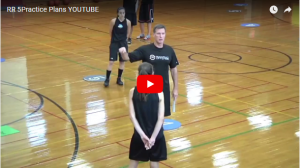
This post is a 5 minute video segment of Rick Torbett going through some ideas on improving the segment of your practice where you work on offense.

Regardless of what offensive system you use, I think you can get some ideas from this video. Not just the movements and spacing, but also how to work on your system and how to practice what you want to see happening.

It is also a very good way to make sure that you are covering all of the reactions that your players need to make when the defense disrupts your actions.

What do you want your players to do if the defense takes away your entry pass or other cuts and movements that are integral parts of your offensive attack?

Your second team defense might not be able to take those things away in a live practice scrimmage, but by the coach saying that those options are not available, first in 5 on 5, and then in 5 on 5, you can prepare your players for what they will face in a game.

Or, if your players are used to you calling for specific actions, you might be able to isolate a certain mismatch in the post or on the perimeter.

I believe that if you put some sustained thinking behind it, you can find away to apply some of these concepts in a way that improves your practices in preparing you for the games.

To find out more about the DVD that these sample clips came from, you can click on this link:

Read and React Practice Planning

Change Your Coaching Staff Dynamic (in 20 minutes)

By Brian Williams on December 22, 2016

this article was written by Stephanie Zonars. You can follow her on Twitter @StephanieZonars

Shares

A team can’t develop healthy team cohesion if the leadership team (i.e. coaching staff) isn’t cohesive. [Tweet That!]

Seems logical, yet somehow coaches believe they can still build a unified team despite distrust and other fractures among the staff.

Won’t happen. Can’t happen.

Patrick Lencioni’s The Advantage: Why Organizational Health Trumps Everything Else in Business reviews some of the key points of his other best seller, The Five Dysfunctions of a Team. 

Namely, that the core issue on dysfunctional teams is a lack of trust.

That’s so obvious that you’d think leadership teams and coaching staffs would be pretty good at building trust. Yet, more than often, they aren’t.

In The Advantage, Lencioni says it may be because they have a misunderstanding of the kind of trust needed on teams:

Many people think of trust in a predictive sense; if you can come to know how a person will behave in a given situation, you can trust her….The kind of trust that is necessary to build a great team is what I call vulnerability-based trust. This is what happens when members get to a point where they are completely comfortable being transparent, honest and naked with one another, where they say and genuinely mean things like “I screwed up,” “I need help,” “Your idea is better than mine,” “I wish I could learn to do that as well as you do,” and even, “I’m sorry.” (p.27)

I cannot tell you the number of times I’ve watched vulnerability completely change a team dynamic. One person willing to “go there” gives everyone else permission to open up a little more.

Compassion and empathy develops, resulting in a stronger ability to trust.

I worked with a business team on which many of the individuals had worked together for a number of years. It seemed like they knew one another well and genuinely liked one another. I was a little nervous that my trust-building exercises might fall flat.

What happened blew my mind!

During one of the exercises an individual shared a hardship she was going through. Her co-workers had no idea—even someone who had gone through something similar.

Through tears deeper connections developed that took their team to a new level of trust.

One 15-20 minute exercise Lencioni uses can give your team the opportunity to develop that kind of vulnerability-based trust.

At your next coaching staff meeting, have each person share three things*:

  • where they were born
  • how many siblings they have and where they fall in the order of children
  • the most interesting or difficult challenge they faced as a kid

This simple exercise helps individuals feel more comfortable being vulnerable in the group and develops a new level of understanding, admiration and respect.

Even if you are rolling your eyes right now, and think you know a lot about your staff team, give it a try. It never disappoints!

Then shoot me an email to let me know what happened.

*I recommend having the leader go first.

Change Your Coaching Staff Dynamic (in 20 minutes) appeared first on Life Beyond Sport.

About Stephanie Zonars

Stephanie Zonars helps coaches build and maintain winning team cultures through her business, Life Beyond Sport. Teams at Penn State, Notre Dame, West Point and over 60 other schools have built stronger trust, communication and teamwork through her workshops. Stephanie spent three years on staff with the Penn State women’s basketball team, assisting the team to back-to-back Big Ten Championships. She’s also the author of three books. For more tips on leadership and team culture, visit LifeBeyondSport

  • « Go to Previous Page
  • Page 1
  • Interim pages omitted …
  • Page 103
  • Page 104
  • Page 105
  • Page 106
  • Page 107
  • Interim pages omitted …
  • Page 288
  • Go to Next Page »

Primary Sidebar

  • Twitter
  • Facebook
  • Linkedin
coachestoolbox
personaldevelopmenttoolbox
basketballplayerstoolbox
basketballtrainer
athleticperformancetoolbox
coachingbasketball

© Copyright 2026 Coaching Toolbox

Privacy Policy