• Skip to primary navigation
  • Skip to main content
  • Skip to primary sidebar

  • Basketball Plays
    • Ball Screen Sets
    • Horns Sets
    • Man to Man Post Up
    • Man to Man Isolations
    • Backdoor Plays
    • Man to Man 3 Point Shot Plays
    • 2-3 Zone Attack
    • Baseline Inbound Plays
    • Sideline Inbound Plays
    • Combination Defense Attack
  • Drills
    • Defensive Drills
    • Offensive Drills
    • Competitive Drills
    • Passing Drills
    • Rebounding Drills
    • Shooting and Scoring Drills
    • Toughness Drills
    • Transition & Conversion Drills
    • One on One Drills
  • Blueprint
  • Practice
  • Mental Toughness
  • Skill Development
  • Offense
  • Defense
  • Store

Basketball Zone Offense Philosophy

Basketball Zone Offense Philosophy

By Brian Williams on May 18, 2017

Submitted by Coach John Kimble of CoachJohnKimble.com

Retired high school and college coach

Follow him on Twitter @CoachJohnKimble

ZONE MOTION OFFENSES vs. ZONE CONTINUITY OFFENSES

Some coaches believe in choosing various forms of motion offenses in their zone offensive attacks that will then give freedom to their offensive players and also create a high level of unpredictability to opposing defenses. Coaches  disagreeing  with  this type  of  philosophy will state  that unpredictable movement is good, but movement with no purpose or fundamental value is not good.

It is difficult for the proper player to have proper movement at the proper time. This ‘motion’ philosophy may also give individual offensive players so much freedom that their indecisiveness in choosing their movement may actually stifle the movement desired.   Many offensive players (and teams) may need more structure in their offensive play and more help in their  offensive  decision  making.

Another group of coaches believe in maintaining a high level of controlling what their individual players can and cannot do, based on the coaching staff’s evaluations of individual and team’ offensive abilities.  This can be achieved by utilizing half-court continuity offenses that provide structure to offensive players.

Opponents of using the continuity offense philosophy complain that it makes the offensive players too predictable in their movements and the predictability makes it easier for opponents to defend.  Additionally, some coaches believe that it makes offensive players ‘robots on specific tracks.’

We want to institute somewhat of a blend of both philosophies and try to get the best of both worlds.  And that is a continuity offense that can smoothly transition from one phase to the final phase, which is a continuity offense that has some freedom as well as a structure in the form of rules.  Every time a player has the basketball and makes a pass to one of his other four teammates, there is a rule that provides structure and helps guide the movement of all five players.

It is not a rigid offense because the player with the ball realistically has at least three (of his four) teammates that he can almost  always  pass the ball.  Each pass from any of the five “spot-up” locations then has at least three potential pass receivers.  Therefore, there is the freedom of making the pass to different players and thus a high degree of unpredictability of what movement takes place after the unpredictable pass is made.

Depending on which zone offense is utilized, there are various (movement-of-players) rules based on the type of pass that is made. The various types of (purposeful and fundamentally sound) movement by players are dictated by the type of pass that is made. There are possible passes from a ‘wing spot-up’ location down to a ‘deep corner spot-up’ location that includes a corresponding movement rule.  Passes from a ‘wing spot-up’ location down to a ‘short-corner spot-up’ location has its own movement rule.

There can be passes made to post players that possesses “inside pass” rules.  There must be “wing pass” rules, “skip pass” rules, “down pass” and “up pass” rules as well as “reverse pass” rules. The opposition will have a high degree of difficulty knowing the type of movement that follows the specific pass that was made and therefore defending that type of movement.  These rules give the offense a degree of structure, but still provides freedom of fluid and unpredictable movement by all offensive players.

SMOOTH TRANSITION FROM ONE PHASE OF THE ZONE OFFENSEINTO THE FINAL PHASE of ATTACK

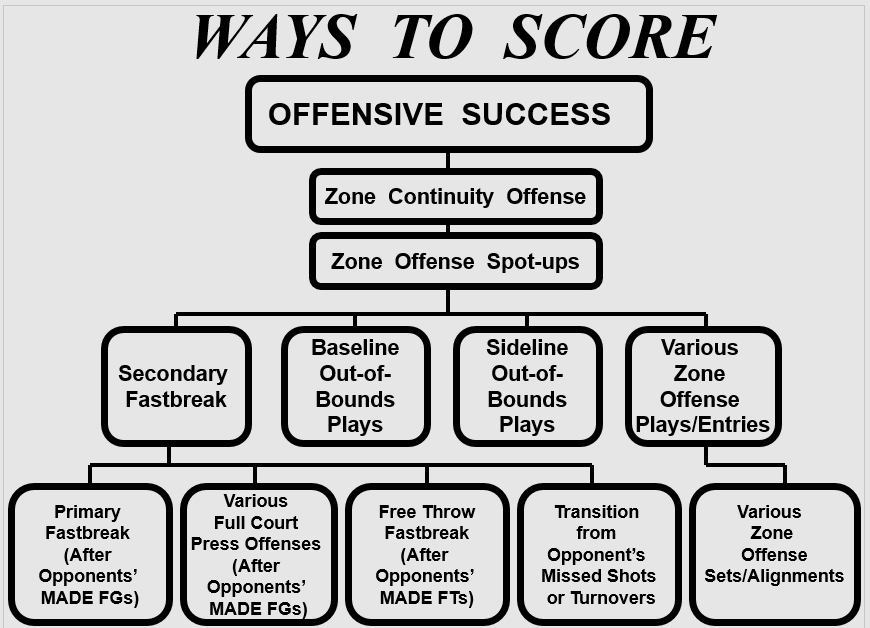
We want to place all of our offensive players “in positions to succeed.”   This means that every offensive play/entry out of the offensive sets/alignments has multiple objectives.  The initial objective of every play/entry is to immediately “place the right people in the right place” so that those players can utilize their specific strengths, minimize their individual weaknesses and therefore have better opportunities to score quickly  and  directly off of the play.

Another major (but not immediate) objective of each play is that if the entry does not produce a shot, all five offensive players end up in what we call “spot-ups.”  These “spot-ups’ are the five specific locations/positions on the floor that allow the designated continuity offense to immediately flow from the finished entry into the designated continuity offense—giving the opposition’s defense absolutely no time to adjust or recover from their attempt of defending the offense’s entry.

This philosophy of flowing smoothly and immediately from half-court entries/plays (that do not produce shots) should and is incorporated from the other offensive avenues of attack—Press Offenses flowing into Primary Fastbreaks that flow into Secondary Fastbreaks into the designated continuity offense as well as from ‘Defense-to-Offense’ Primary Fastbreaks that flow into Secondary Fastbreaks into the desired continuity offense.

In addition, all Baseline and Sideline Out-of-Bounds plays should also possess the ability of smoothly and instantly flowing into the continuity offense that is to be executed.

Utilizing various plays can highlight individual player’s offensive skills while attacking weaknesses of both individual defenders as well as the overall team defense in the form of quick-hitting  plays.  These plays can also serve as a conduit to smoothly flow into the designated continuity offense.

The entries can move the zone defenders as well as disguising how the offensive team is proceeding to attack the zone defense.  This adds another layer of unpredictability to the overall offensive attack.  The zone defense must first place all attention and effort into attempting to stop the entry/play and without any time for reorganization or regrouping to then attempt to defend the continuity zone offense.

This is the philosophy behind each and every zone continuity offense and its package of entries/plays that we firmly believe in.  It must be emphasized that a team can have an excess of entries/plays as well as too many different continuity zone offenses.  Therefore, a coaching staff must evaluate its personnel both physically and mentally to make sure the correct offenses and the correct number of offenses are chosen.
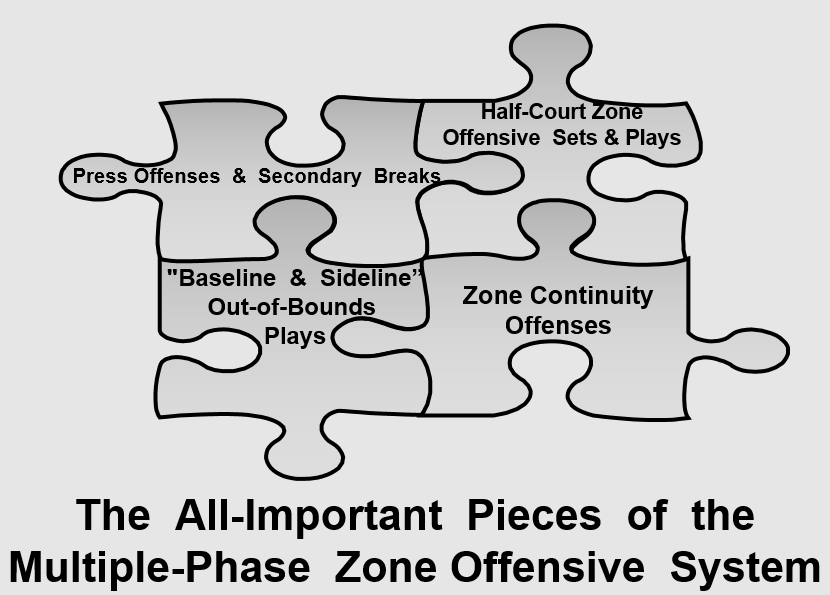


“ZONE  OFFENSE  CONCEPTS”

Concept 1:  A successful zone offensive package must require simplicity (for its own offensive players) possibly as its main component.  Players must know what their assignments and responsibilities are in each phase of the offensive attack.  Coaching staffs must evaluate their team’s mental abilities as much or more than their squad’s physical skills and talents to determine its mental capacity and how much that team can utilize other important characteristics and traits such as ‘’Fluidity,’ Multiplicity,’ ‘Flexibility,’ ‘Expandability,’ ‘Adaptability’ and ‘Unpredictability.’  From these characteristics comes the ability to be so unpredictable to opposing defenses that the offense can have such high degrees of success.

Concept 2:  Regardless of the number of offensive sets utilized and the number of offensive plays/entries/quick-hitters that are implemented; each play must have the ability to instantly, seamlessly and fluidly flow into the chosen continuity zone offense.  This gives the offensive package separate (on paper) phases of offensive attack that blend so smoothly that it appears on the court to be one long continuous offensive assault on the opposition’s zone defense. This is the very important ‘Fluidity’ characteristic.

Concept 3:  Once the ‘Simplicity’ factor and the ‘Fluidity’ trait has been integrated into the package, many other very important characteristics/traits can be implemented, with the ‘Multiplicity’ trait quite possibly being the most important.  This is because the ‘Multiplicity’ characteristics are the bridge to many other more valuable traits.  Being able to have multiple plays, multiple sets/alignments and multiple continuities is invaluable to an offensive system.  This allows the offense to be more varied and less predictable to opposing defenses, while still maintaining a degree of simplicity for your own team.

Concept 4:  An offensive package that is ‘Multiple’ also allows the offense  to  be ‘Flexible,’  ‘Expandable’ and ‘Adaptable.’   If an offensive team has the ability to change its method of attack because of the opposition’s defensive strengths and weaknesses, it will be a much more successful offense and add more ways to attack the opposition’s defense, then it increases its offensive strengths exponentially.  This is the important characteristic of ‘Flexibility.’

Concept 5:  An overall offensive scheme that possesses the strength of also being expandable  always gives the offensive team the potential to add other types or forms of attack as the season progresses to become a more explosive offensive team. This is the characteristic we call ‘Expandability.’

Concept 6:  If an offensive team has the ability to change or vary its plan of attack because of  game ‘time and situation’ factors in the middle of a game or because of personnel changes in the middle of the season, then it increases a team’s chance for a more successful season. This is the important characteristic of ‘Adaptability.’

Concept 7:  An offensive package that is ‘Multiple,’ and/or ‘Flexible,’  and/or ‘Expandable’ and/or ‘Adaptable’ will very much possess the all-important weapon of being unpredictable to all opposing teams.   If an offensive team can make changes in how it attacks opposition’s  defenses from game to game and even from quarter to quarter of the same game, it makes it extremely difficult for any defense to attempt to solve the offensive plan that can constantly change. This is the important characteristic of ‘Unpredictability.’

Concept 8:  Utilize a primary and secondary fast break system that is compatible with and that fully complements your zone offense package.

Concept 9:  Use different sets/alignments and entries/plays to be more varied and less predictable to opposing defenses.  Various sets and entries can be used to become less predictable to the opposition while still maintaining a degree of simplicity for your own team.

Concept 10:  Every zone defense has inherent weaknesses.  Coaches should learn the particular styles of the zone defense that are being used by your opponents (the basic slides and responsibilities in that zone) so that they may attack and capitalize on the weaknesses of each defense.

Concept 11:  Capitalize on the strengths of the offensive alignment/set by distorting the shape of the original zone defense to stretch the zone  both  vertically as well as horizontally (such as wing players slightly below the FT line extended and/or post players aligned in the ‘short corner’ area.)

Concept 12:  Having a zone offense continuity with clearly defined responsibilities and assignments can create levels of specialization that will showcase individual player’s talent levels and improve the overall effectiveness of the zone offense.

Concept 13:  Capitalize on your offensive personnel’s individual strengths via various entries/plays or different alignments/sets.

Concept 14:  Use different entries and/or alignments to capitalize on an opposing individual’s defensive weaknesses. Make sure that the ending spot-ups of each entry/play fit the beginning spot-ups locations of the designated continuity offense.

Concept  15:  With some zone offensive sets, begin certain offensive plays/entries with ‘false ball movement’ and/or ‘false player movement.’ This concept could be compared to a football team “shifting” from one offensive formation and      actually ending up in a different offensive formation before the action actually begins (causing defensive problems).

Concept 16:  If an offensive team is mentally able to handle it, some offensive sets can be camouflaged by actually beginning in one alignment, then using a form of ‘false ball movement;’ before then ‘shifting’ into the actual desired zone offense set.

Concept 17:  Make sure that defensive transition responsibilities (i.e., preventing opponents from getting into their fast break offense) are clear-cut and carried out by all five players in the zone offense.

Concept 18:  Have clear-cut offensive rebounding responsibility rules for all five players in the zone offense and make sure that they are executed by every player in the zone offense.

Concept 19:  Reverse the ball to force the defensive zone to defend both sides of the floor. This allows  the zone to horizontally stretch and therefore weaken the defense.

Concept 20:  Attack the zone defense from behind the defense’s back-line of the zone  with various types of cuts, often from along the baseline.  This is another  way of stretching the zone defense vertically.

Concept 21:  Flatten the zone defense by getting the basketball down to the baseline and then reverse the ball quickly to the opposite side of the floor.  This is another way of stretching the zone first in a vertical manner and then in a horizontal manner.

Concept 22:  Maintain good floor balance and spacing in the zone offense.

Concept 23:  Zone offensive players should know the value of the dribble and utilize the dribble properly.  Utilize the various dribbles in each of the various zone offenses:  Pull Down Dribbles, Gap Dribbles, Pull Up Dribbles and Freeze Dribbles

Concept 24:  When catching the basketball, zone offensive players should be prepared to become immediate offensive threats as  shooters, passers, or dribblers.

Concept 25:  Zone offensive players should remember the value of ball fakes and shot fakes.  All zones are ball oriented  and will react to the basketball.

Concept 26:  Zone offensive players should remember the value and then utilize skip passes.

Concept 27:  Screen defenders in the zone defense with on-the-ball screens and/or off-the-ball screens (such  as  back, flare, pin and interior screens).

Concept  28:  Using cutters (from the perimeter who cut through the heart of the zone defense to the opposite side of the offense) is another effective method of attacking zone defenses.

Concept 29:  Anytime the ball is passed into the middle of a zone defense, the receiver should look to ‘extend the pass,’ to a teammate that is closer to the basket and on to the opposite side of the floor from where the original pass originated.

Concept 30:  If the ball is passed inside to a post player, perimeter players should flare-cut to the various soft spots in the zone defense and be prepared to quickly catch and shoot off of the pass.  This cutting action after inside passes are made again can stretch the zone both vertically as well as horizontally.

Concept 31:  Post players should ‘gap-cut’ in the middle of the zone defense. Once the defense’s perimeter has been stretched thin, the middle is vulnerable and should be attacked.  Attacking the middle of the zone with ‘gap cuts’ starting from behind the zone should be very productive.

Concept 32:  Zone offenses should have an ‘inside-out’ perimeter shooting attack as well as  an ‘outside-in’ type of attack.

Concept 33:  When passing the ball to offensive post players, perimeter players should use bounce-passes away from the post defenders (unless it is a lob pass to a player behind the zone).

Concept 34:  Offensive post players should look to obtain (and maintain) body position advantages over their post defenders.

Concept 35:  If  zone defenses try to deny the inside scoring of the offense, ‘skip passes’ should be utilized to attack the defense’s weaknesses in its over-commitment of its interior defense.

Concept 36:  After ‘skip passes’ are  made, post players should seal off the post defenders that deny them the ball on the original ballside and be prepared to receive the pass from the original weakside.

Concept 37:  When zone defenders react to the ‘skip pass,’ a second ‘skip pass’ back to the original ballside can be very effective.  A phrase “One good ‘skip pass’ deserves another” should be taught and utilized in every type of offense that is used.

Concept 38:  Post players should know and effectively implement specific offensive post  moves after catching the ball in the zone defense’s interior, such as:

*The “Show-and-Go-Opposite” offensive post move.

*The “Square-Up and Up-and-Under” move.

*The “Whirl” Move (sometimes called the ‘Olajuwon Move’).

*The “Duck-In” Move into either a power move or  a  face-up move.

*The “Spin-­and-Post-Up” move when the  defense is fronting the ‘duck-in’ move.

Concept 39:  The “Shifting” concept is simply when offensive personnel move or shift (on cue) from their original locations to different locations before the play/entry/quick-hitter begins—changing the offensive set from one to another (before the defense can adjust.)

Concept 40:   The “(False) Motion” concept is when offensive personnel move from their original locations (on a designated time) after the ball and player movement—disguising what the offense’s final alignment and intended action (to confuse and weaken the defense.

Concept 41:  The “Combo Offense” concept is executing one continuity offense and when at a designated ‘trigger point,’  the offense simply converts to an entirely different continuity offense with no delays or interruptions.

About the Author

Coach Kimble was the Head Basketball Coaching position at Deland-Weldon (IL) High School for five years (91-43) that included 2 Regional Championships, 2 Regional Runner-Ups and 1 Sectional Tournament Runner-up. He then moved to Dunlap (IL) High School (90-45) with 2 Regional Runners-up, 1 Regional, 1 Sectional and 1 Super-Sectional Championship and a final 2nd Place Finish in the Illinois Class A State Tournament. He was an Assistant Basketball Coach at Central Florida Community College in Ocala, FL for 1 year before becoming Offensive Coordinator and then Associate Head Coach for 3 additional years He then was the Head Basketball Coach at Crestview (FL) High School for 10 years, averaging over 16 wins per season.

He has had articles published in the following publications such as: The Basketball Bulletin of the National Association of Basketball Coaches, the Scholastic Coach and Athletic Journal, Winning Hoops, Basketball Sense, and American Basketball Quarterly. He has also written and has had five books published along with over 25 different DVDs by Coaches Choice and Fever River Sports Production.

See him on Twitter @CoachJohnKimble and his Web Page “www.CoachJohnKimble.com”
Houston Rockets Half Court Plays

By Brian Williams on May 17, 2017

This post contains two man to man plays from Mike D’Antoni and the Houston Rockets Playbook.

Adjust these sets to fit your players and philosophy and/or take bits and pieces to combine with what you already run.

I realize that the NBA defensive rules are different than high school and college, but I hope you can use these sets as food for thought for improving your system.

The plays are from The Houston Rockets Playbook assembled by Chris Filios.


Diagrams created with FastDraw

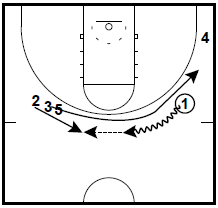
Stack Double Slide Mix Ball Scren


4 fakes ball screen for 1 and cuts to corner.

Certainly, you could have him/her slip to the rim and then space to the corner.


3 slide screens for 1.

2 pops out to receive a pass from 1;


5 runs a step up screen for 2 and rolls.


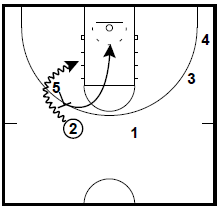
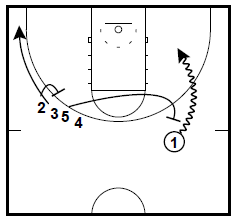
Stack Hammer

5 sprints and sets ball screen towards baseline.

2 sets flare screen for 3 to corner.

1 can pass to 3 when he or she gets to the basket if open.


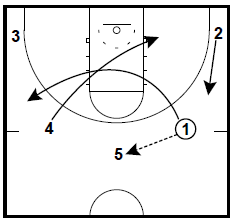
Post Kickout

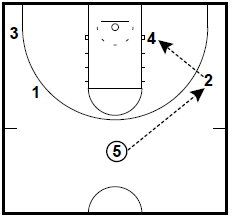
1 passes to 5 and cuts into the lane, then to the opposite wing.

4 dives through the lane, then to the block.

2 lifts.


5 passes the ball to 2 on the wing.

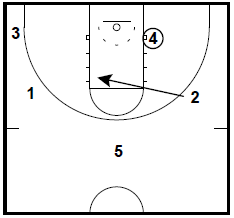
2 feed 4 in the post.


2 cuts into the lane.


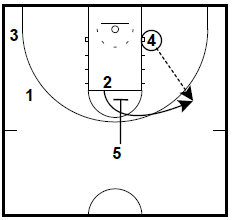
2 cuts off a screen from 5.

4 passes to 5 for an inside out shot.

You can have 3 and 1 interchange.

You could also finish with a staggered screen from 2 and 5 to 1 or 3.

The post is to offer ideas for you to apply to your coaching situation.

The plays are from The Houston Rockets Playbook assembled by Chris Filios.


1 on 1 Wolf Drill

By Brian Williams on May 16, 2017

This one on one drill came from the FastModel Sports Basketball Plays and Drills Library.

You can also find out more about FastModel Play Diagramming software by clicking this link: FastDraw

The drill was contributed by Randy Sherman of Radius Athletics:

Defending the 1v0

“Wolf” – Chase the dribbler from behind

Sprint back. “You are never too late on defense.”
Attempt to block the shot low with the near hand
Rebound – do not go past the backboard!
Catching the dribbler from behind to block or change a shot is momentum changing play!

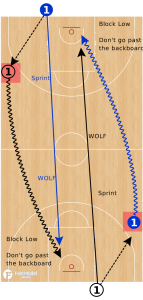
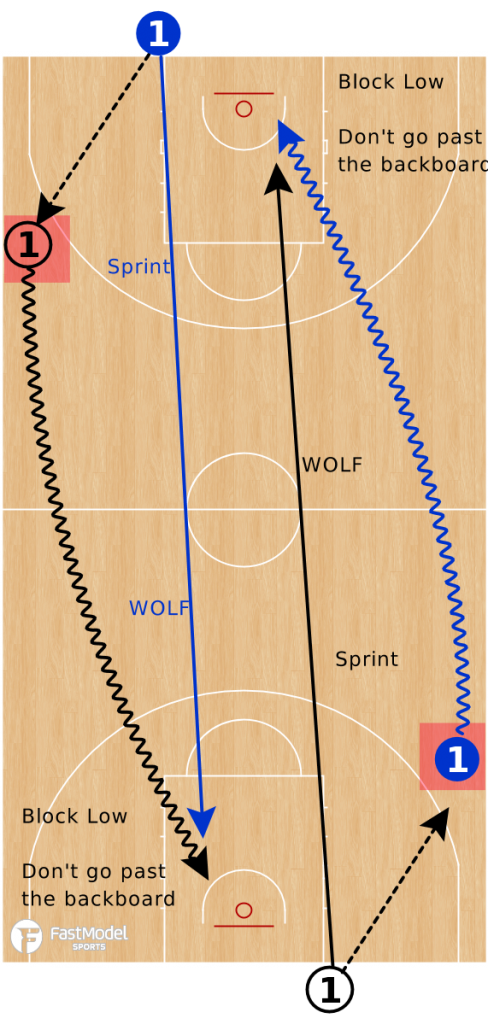
1v1 WOLF

Offensive player (BLUE1) starts in outlet box.

Defensive player (BLACK1) is out of bounds with ball on baseline. He/she is the “wolf”

Defense inbounds to offense and begins to chase the offensive player. Offense wants to finish with an extended layup if defense is trailing or an outside-inside stride stop if defense gets on inside hip.

Defense tries to block the shot low using the near hand. Defense avoids over-pursuing. DO NOT GO PAST THE BACKBOARD! Rebound any missed shot!

If the defense is able to catch up and get in front of the offense, it becomes 1v1 Live.

Offense and defense switch for the return trip down the opposite side of the court


Andy Enfield 5 Minute Toughness Shooting Drill

By Brian Williams on May 11, 2017

This toughness shooting drill is among the resources for both coaches and player available from basketballhq. They have several more videos as well as basketball coaching resource articles.

Please make sure your sound is on to see the video.

BasketballHQ has just released their Basketball Coaches Training Group. In the group you will get access to different workout plans that are going to be for the team as a whole, by position, by the number of players and more. This is an all inclusive training group that is going to allow you to walk onto the court with a full workout plan in hand for your players through our easy to use Iphone and Android App. Every drill comes with a video breaking down the details of the drill, and all of the videos are instructed by a Pro or College coach and demonstrated by a high level player. click here for More Information on the Basketball Coaches Training Group.

Click the play arrow so see the drill. The drill is a You Tube video, so you will need to be able to access You Tube to see the drill.

The Coach in the video is Ryan Panone, one of the co-founders of Basketball HQ. He credits Andy Enfield as the Coach he got the drill from.

The video was shot when Andy Enfield coached at Florida Gulf Coast. He has since moved on to USC.

Any drill you pick up from another program or coach has to be modified to fit your needs. My philosophy behind the post is to get you thinking about ways to improve the drills that you use.

Players can compete against themselves or against a teammate. The goal is to get in the high 40s of makes in 5 minutes. In the drill, the players only go for 3 minutes so that are not close to that. You will need to adjust your standards and the types of shots you shoot in the drill. You might want to start at 3 minutes and work your way up to 5.

If you run the drill for 5 minutes, there certainly is an aspect of toughness required.

These types of toughness shooting drills are good at working on shooting when fatigued, getting shots off quickly as players must do in a game, and maintaining fundamentals and proper shooting form.

Andy Enfield 5 Minute Shooting Drill

Here is a 2:00 minute sample of the type of content that is available in the BasketballHQ Coaches Training Group.

Competitive Zig Zag Drill

By Brian Williams on May 9, 2017

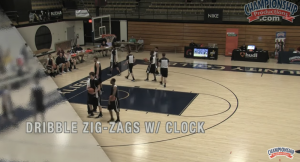
This video is with Baylor’s Scott Drew making the traditional zig zag drill competitive by putting a time on it.

If the offense does not make it end to end in 8 seconds, the defense wins. If the offense does make it without losing the basketball, the defense wins.

Coach Drew also discusses a version of the drill where the defender must get a stop to get out of the drill.

The video is a You Tube video so make sure that you are on a server that allows You Tube access.

If you are interested in learning more about the DVD that this sample was taken from, click here: Scott Drew: Improving Performance with Competitive Practice Drills

Make sure your sound is on

The video is 4 minutes long.

A Leader in Every Locker

By Brian Williams on May 4, 2017

The End of Yesterday
By Dr. Cory Dobbs
The Academy for Sport Leadership

Excerpt from A Leader in Every Locker

“I’m not used to supposing. I’m just a working man. My boss does the supposing . . .”

This quote is a line from the classic movie 12 Angry Men. During the opening dialogue among jury members, each feeling out their place and role in the deliberation of the fate of a young man’s life, a blue‐collar working man makes this declaration of powerlessness. The implication is that all the power—at least that of “supposing” rests in the hands of his superior. Just a movie? Hardly.

It’s been the rule for over a century in team sports to install a hierarchical leadership structure. This is accomplished by appointing a couple of players as team captains (as well as modeled by the hierarchy of the coaching staff). Surely everybody knows that on any sports team only a few players are able to really perform peer leadership. This is the team captain axiom, the basic axiom of traditional team leadership.

An axiom, of course, is a truth so self‐evident it doesn’t need to be proved. After all, everybody knows an axiom is accurate and correct. So then, it’s indisputable that you need a pecking order in order to get things done.

Not too fast, things are not what they always seem to be on the surface. The bad news is that far too often our intuitive ways of thinking about the world are wrong. Yes, axioms can be wrong. The good news is that it’s possible to set them right.

What’s self‐evident, what’s obvious, what everybody knows, has deep roots and of course isn’t in need of change. Yet, paradoxically that which is self‐evident hides something–covers over what might be a deeper truth. Axioms, by their nature, are anti‐learning. Nobody ever questions an axiom. Nobody ever discusses an axiom (save for a few propeller heads). It’s just taken as a given. And nobody ever talks about the possible counterproductive consequences of what everybody knows. The fish, after all, never questions the water he lives in.

Then, all of a sudden, someone comes along with a breakthrough idea and turns the old axiom upside down. The taken‐for‐granted truth, it turns out, wasn’t really the truth after all. “The world is flat,” was the truth people lived by for thousands of years. Then, along comes Nicolas Copernicus who proves to the world the old axiom to be wrong.

Twenty years ago, to choose a different model of team leadership was unthinkable. In elaborating on the end of two decades as a premier athlete Kobe Bryant had much to say when asked the question, if he could go back in time and offer advice to himself as a rookie, what would he say? His response: “It’s hard to tell somebody ‐‐ a player at that age ‐‐ to understand compassion and empathy, but that would be my advice.”

Why of all things would Bryant endorse caring, compassion, and empathy? “Well,” Bryant continued, “because that’s the biggest thing about being a leader, I think, and winning a championship is understanding how to put yourself in other people’s shoes.” “That’s really the most important thing. It’s not necessarily the individual skill you possess. It’s about understanding others and what they may be going through. And then, in turn, when you understand that, you can communicate with them a little bit better and bring out the best in them. Bringing out the best in people isn’t passing them the ball and giving them open shots. It’s about how to connect with them, how to communicate with them so that they can navigate through whatever issues they may be facing. That’s a very, very hard thing to do.”

I’ve never been a fan of Kobe Bryant, and I seldom look to professional sports for deep insights and understanding on leadership, but it appears that the wisdom in Bryant’s words fit hand‐inglove with today’s call for a more heartfelt approach to coaching and leading. So what’s the way forward in this brave new world?

Don’t worry. While you’ve been trapped in the axiom of team captaincy, I’ve been turning over rocks to find a better way of designing a high‐performing team, its culture, and of course, leadership. I’m not done yet. It might be another decade or so before I’m finished. But this workshop workbook is a start.

So, What is Leadership?

There has been a long running debate in scholarly circles about whether people learn to lead from their experiences or if leadership is something a person is born with. Today, however, most academics agree that leadership is best considered as a set of skills and qualities that can be learned and developed along within a wide‐range of personal styles. It’s widely agreed that all people have the potential to develop leadership skills. I point this out because it is also clear that leadership is viewed and valued differently by various fields, disciplines, and cultures.

So then, what is leadership? This is the big question that every person, group, team, organization, community and society seeks to answer. Our American culture, which of course includes a heavy dose of sporting influence, exalts the lone ranger, the hero, the charismatic leader. We see this in the election and glorifying of politicians, the deifying of business tycoons, and the adoration and idolization of great coaches and athletes. This notion falls in line with the traditional ideas of leadership—that it is the make‐ up of the leader that makes all the difference. Individual determinism has been and will continue to be an easy and favored explanation of things. But traits such as self‐confidence, intelligence, and a can‐do attitude—favored qualities of a leader—do not always predict the effectiveness of a leader; rather, they can be very misleading.

However permeable the traditional mental model of leadership seems, it does not provide a path to sustainable effectiveness as it leaves out the detail and nuance of the context in which a leader takes action. It also ignores the fact that it tends to reduce followers to passive participants; resulting in deliberate apathy and often conscious withdrawal from the leadership provided by one’s peer. Careful examination of this aspect of team captaincy suggests it may promote the discounting or dismissing of the potential of all members of the team to learn and perform in a leadership role.

Both the context and followers are foundational to leadership and are central to The Academy for Sport Leadership’s search for a new conceptualization of team leadership. The leader in every locker approach to team leadership is, no doubt, a paradigm shift. Paradigms, as you know, are the common patterns and ways of looking at things in order to make sense out of them. Leadership has long been presented as an elusive phenomenon available to only a select few. It is my contention, however, that understanding the relational nature of leadership and followership opens a team up to an immensely practical and dramatically richer form of team
member involvement.

The basic foundation of any leadership process is relational. As leadership expert Margaret Wheatley notes, “None of us exists independent of our relationships with others.” At the core, it is a relationship which comes into existence because of some sense of commitment by people to a common purpose. Thus, the ASL framework for answering the question “What is leadership?” begins by grounding it in the following core assumptions:

1. Conventional views of leadership are changing. Leadership is not limited to a chosen few; it is an educational component of participation in student‐athletics and must contribute to the growth and development of all athletes. A leader in every locker embraces the potential of all student‐athletes to take on leadership roles now and in the future.

2. Leadership is a relational process. That is, leadership is a socially constructed phenomenon consisting of student‐athletes working together to accomplish something.

3. Team leadership is distributed. Leadership is not the sole responsibility of the coach, coaching staff, or selected team captains. The best team leadership results from the actions and activities of those best positioned to provide leadership contingent on the context.

4. Leadership is a process to create change. Leadership is about making things happen; transforming people and programs. Effective leadership accelerates change. Change is necessary for growth, development, and improvement in performance.

5. Leadership growth and development is personal. There is no time frame related to progressing through stages of development. It’s also recognized that all potential leaders begin at a different starting point. Leaders grow and develop through deliberate practice, informal practice, roles, reflection, and the observation of role models.

6. Leadership is a process that involves followership. All coaches and student‐athletes participating in a leader in every locker understand and embrace both roles—leading and following. Followership implies a relationship to the leader, but does not imply one that places the follower in a less important position.

7. Leadership develops over time. There is no one way to lead. The practice of leadership involves the continual practice of finding the best way to lead with the particular capabilities that the student‐athlete possesses at a specific time, while constantly working to improve and expand those capabilities.

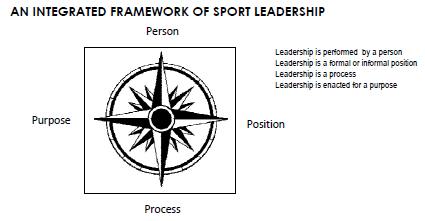
Embedded in the seven assumptions above are the four P’s of team leadership. The framework highlights the integration of the four key domains of leadership. The framework answers the question What is Leadership? Leadership is a position, it is a process, and it is performed by a person for a purpose.

Too often leadership is narrowly defined exclusively as a person. Conceptually this leads us back to a focus on the leader, her traits and disposition. But leadership is more than the idiosyncratic actions taken by a chosen person. It is a process. A process is simply a
coordinated way of doing things. Can student‐athletes, including those that don’t possess the so‐called necessary traits, learn a process for doing leadership things? Of course they can.

Leadership is also a position. In The Academy for Sport Leadership’s way of doing things we suggest giving each student‐athlete a “role” to on‐board them into the leadership team building development process. You’ll see this later when I introduce you to my 8 Roles of Teamwork. A leader’s words and deeds provide purpose, a compelling vision of the future. Effective team leadership answers, for all team members, the questions, “why am I doing this?”

The four P’s, like the compass that they form, are only a tool for answering the question “What is leadership.” Each student‐athlete (and coach too) brings his or her own unique values, skills, experiences, and personality to the leader role; and each student‐athlete has his or her own personal way of making change happen. The compass is a simple model that represents the key domains of an effective leadership development program.

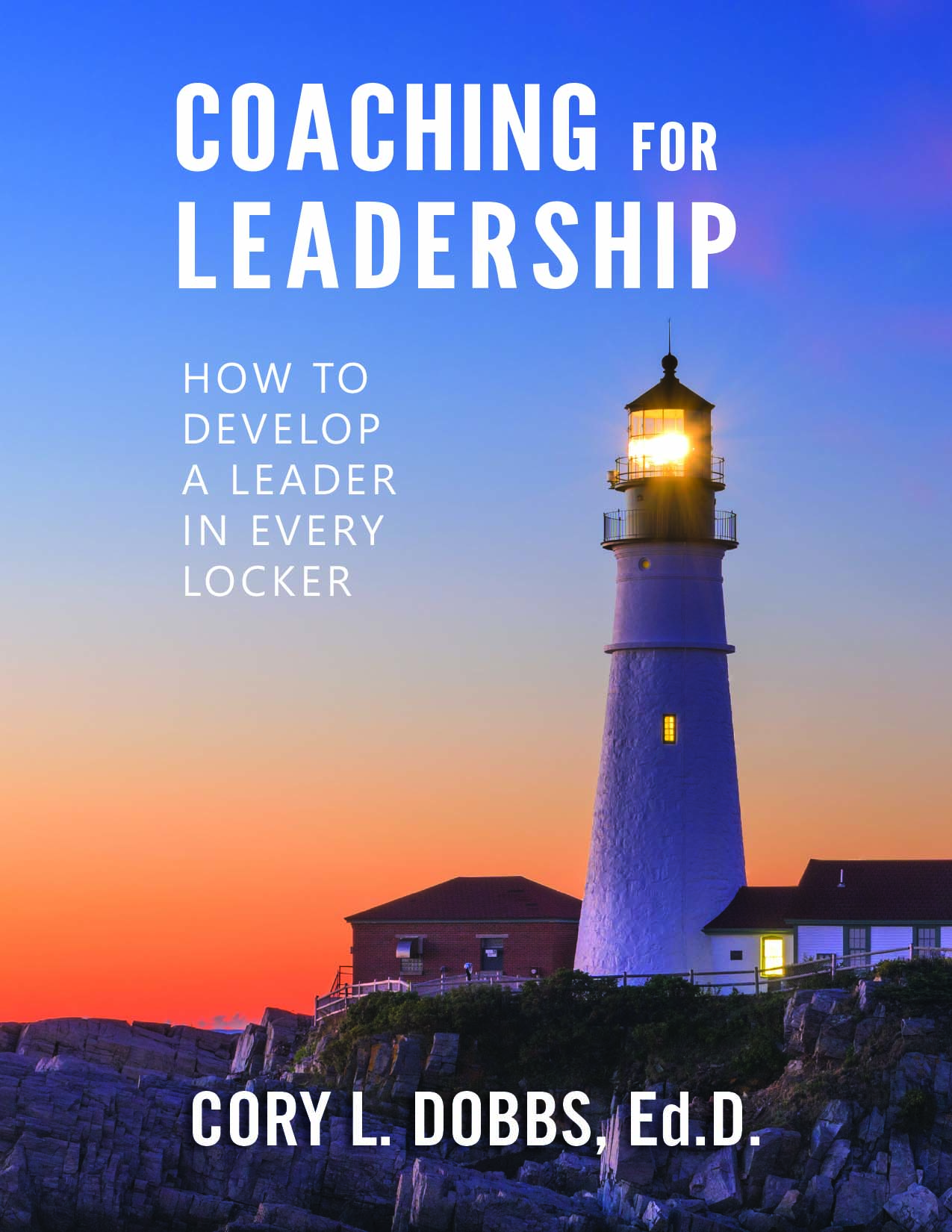
We are pleased to announce a new chapter to the second edition of the best-selling Coaching for Leadership. The chapter, The Big Shift: Unlock Your Team’s Potential by Creating Player-Led Teambuilding, connects the previous edition of this book to its origin, as well as to the future of team sports. The new chapter sets forth a practical and applicable agenda for change and improvement. The reader is introduced to seven vital elements of change; seven shifts of traditional mental models that lead to the new core principles necessary for creating a player-led team culture. Click here for more information about Coaching for Leadership

  • « Go to Previous Page
  • Page 1
  • Interim pages omitted …
  • Page 93
  • Page 94
  • Page 95
  • Page 96
  • Page 97
  • Interim pages omitted …
  • Page 288
  • Go to Next Page »

Primary Sidebar

  • Twitter
  • Facebook
  • Linkedin
coachestoolbox
personaldevelopmenttoolbox
basketballplayerstoolbox
basketballtrainer
athleticperformancetoolbox
coachingbasketball

© Copyright 2026 Coaching Toolbox

Privacy Policy