• Skip to primary navigation
  • Skip to main content
  • Skip to primary sidebar

  • Basketball Plays
    • Ball Screen Sets
    • Horns Sets
    • Man to Man Post Up
    • Man to Man Isolations
    • Backdoor Plays
    • Man to Man 3 Point Shot Plays
    • 2-3 Zone Attack
    • Baseline Inbound Plays
    • Sideline Inbound Plays
    • Combination Defense Attack
  • Drills
    • Defensive Drills
    • Offensive Drills
    • Competitive Drills
    • Passing Drills
    • Rebounding Drills
    • Shooting and Scoring Drills
    • Toughness Drills
    • Transition & Conversion Drills
    • One on One Drills
  • Blueprint
  • Practice
  • Mental Toughness
  • Skill Development
  • Offense
  • Defense
  • Store

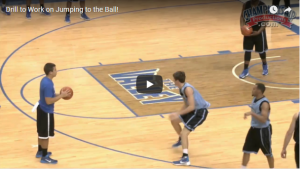
Greg Lansing 3-Line Closeout Drill

Greg Lansing 3-Line Closeout Drill

By Brian Williams on June 15, 2017

This closeout drill is from former Indiana State Men’s Coach Greg Lansing.

You can construct the drill to get reps for additional defensive skills like Coach Lansing has.

I like the idea of having several different drills to offer a variety of ways to work on closeouts since it is something most teams do frequently.

There is sound with the video, so please make sure that your sound is on.

The videos are hosted on YouTube, so you will need to be on a network that allows you to access that site.

The videos are from the Championship Productions You Tube Channel..

Click the play arrow to play the video with the drill.

If you are interested in learning more about the Championship Productions Basketball Coaching DVD that this drill came from, you can click the following link: Open Practice: Defense Drills
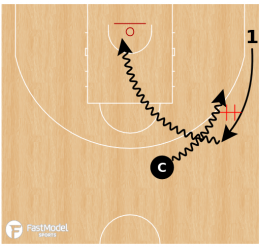
Will Wade and Sherri Coale One on One Drills

By Brian Williams on June 13, 2017

These videos are with LSU Men’s Coach Will Wade and Oklahoma Women’s Coach Sherri Coale.

They go through a couple of ways they use one on in summer individual workouts and practices.

The first video with Coach Wade is a way to make your one on one play more like transition.

In her video, Coach Coale explains how important she thinks one on one play is and a way that she makes it competitive with her team

Hopefully, you can take these ideas and mix them with what you already do or are considering doing to come up with something that works for you.

There is sound with these videos, so please make sure that your sound is on.

The videos are hosted on YouTube, so you will need to be on a network that allows you to access that site.

The videos are from the Championship Productions You Tube Channel..

Click the play arrow to play the video with the drill.

If you are interested in learning more about the Championship Productions Basketball Coaching DVD that this drill came from, you can click the following link: Will Wade 1-on-1 Exercises to Improve Individual Skills

If you are interested in learning more about the Championship Productions Basketball Coaching DVD that this drill came from, you can click the following link: Sherri Coale: Getting the Most Out of Your Team

Creating with Dribble Hand Offs

By Brian Williams on June 12, 2017

This one on one drill came from the FastModel Sports Basketball Plays and Drills Library.

You can also find out more about FastModel Play Diagramming software by clicking this link: FastDraw

The drill was contributed by Randy Sherman of Radius Athletics:

Phase teaching of the dribble hand off.

This is an example of how one coach teaches the Dribble Hand Off concept.

This might not be the best way for you or your program to have this skill taught, but I do think it is important to break down the skill and teach your players to make decisions out of it if you are going to use it as a part of your offense.

You might want players running the dribble at instead of a coach so that they can work on their skills as well.

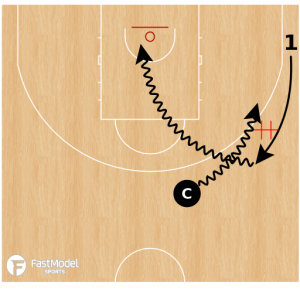
PHASE A Drive & Finish

Coach looks at, dribbles at 1, 1 blast cuts from corner and accepts the hand off

Finish with extended layup with various release angles, different hands or the stride stop to a power layup on opposite side of rim

trail read

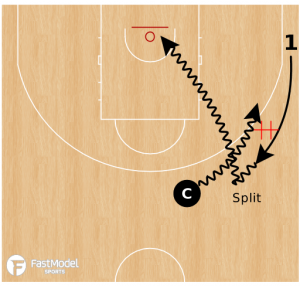
PHASE A – Split

Coach looks at, dribbles at 1, 1 blast cuts from corner and accepts the handoff

Split the defense with a hard crossover then finish with extended layup with various release angles, different hands or the stride stop to a power layup on same side of the rim

switch or hedge read
 

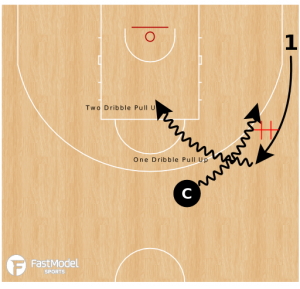
PHASE A – Pull Up

Coach looks at, dribbles at 1, 1 blast cuts from corner and accepts the handoff

Take shot off the one dribble pull up or two dribble pull up

drop read


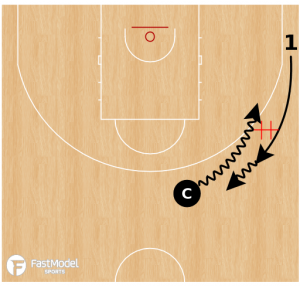
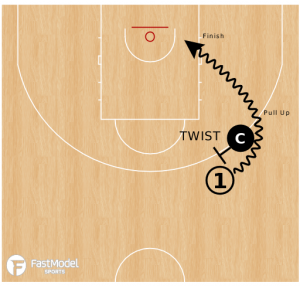
PHASE A – Twist
Coach looks at, dribbles at 1, 1 blast cuts from corner and accepts the handoff

Player 1 stretches the dribble…

matched no advantage read


PHASE A – Twist (continued)
Coach “twists” the DHO and balls screens for Player 1

Player 1 accepts the ball screen. may either take the pull up or finish at rim with extended layup or stride stop into a power layup


PHASE B
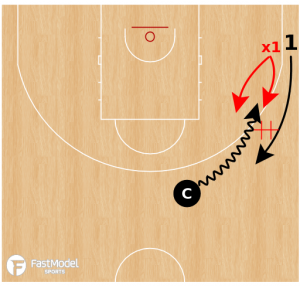
Coach looks at, dribbles at 1, 1 blast cuts from corner and accepts the handoff against the guided defender (x1). x1 is instructed to either trail or go under

Player 1 make appropriate read and finish


PHASE C
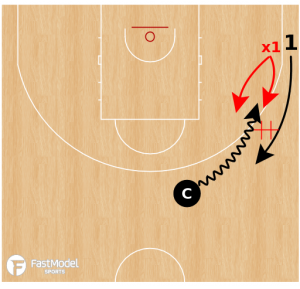
Coach looks at, dribbles at 1, 1 blast cuts from corner and accepts the handoff against the guided defender (x1). x1 is live, he/she may trail or go under -their choice.

Player 1 make appropriate read and finish. Coach may need to twist into the ball screen


PHASE D
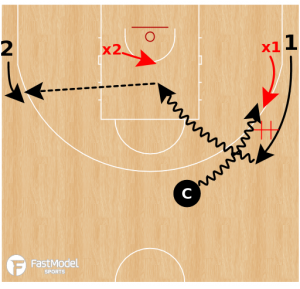
Coach looks at, dribbles at 1, 1 blast cuts from corner and accepts the handoff against the guided defender (x1). x1 is instructed to either trail (shown) or go under

Player 1 make appropriate read and finish and play with Find Use Create rules with an offensive advantage

Coach delivers hand off and gets out of the drill (may need to twist into a rescreen)

Mike Neighbors Transition Offense

By Brian Williams on June 11, 2017

These notes from Dallas Wings Assistant Mike Neighbors. The topic starts as Transition offense, but there are a few ideas from other areas as well. They were originally posted on Bob Starkey’s HoopThoughts Blog

Two clinic curses:
1. Can’t take it all back
2. I can’t do that because…

“Be good at the things you do a lot.” -Pete Carril

Chart success of your line ups

How fast can you function

Reward role players
1. Win race
2. How many screens set

Transition is about race and space

MN: Player loses two races in a row and she comes out.
Not running floor you’re either tired or unengaged

Rim runners (MN calls “Rabbits”) make for a great transition offense.

Goal for rabbit is to occupy the deed defensive transition player

“Locks” are the left and right corner runners.

“Ball” refers to point guard

“Dragon” refers to trailer

Defender back peddling can’t defend offensive player running down hill

“Make the defense wrong.”

“Reward decision making, not actions.”

Outlet — must be quick or long (or both)

Point guard is passing up the street or crossing the street with the dribble

Doesn’t like to feed the “rabbit” below the foul line on the run — chases her opposite the ball.

“Quick Strike” drill

“Boom” is call for double drag when Rabbit is late.

“Pirate” = roll and post up

Need a good zone offense because people don’t want to guard you.

MN: We only have 4 players (with options)

Man: defense decides match up

Zone: offense decides match up

“If your best player isn’t getting the most shots, you suck as a coach.”

Key ball screen concepts: Arrive w/out a defender (change speed, direction, angles)

How are you occupying the help

“Argue with an idiot long enough and no one will know who the idiot is.”

Green light shooting…player is given “green light” on game day because she met a set numbers from a series of shooting drills. Players have to earn their “license.”

Ball screen defense — you need to play it more than one way. “Switchin’ and Fixin’”

Post defense: chin on shoulder

Wall up because their aren’t enough good post players to score

If transition defense walls up as a team to take point guard penetration away, your trailer has to be open.

Don’t let coaches pass in drills…use players do all the passing to improve their passing.

Advice he got from Coach Gary Blair: Be great at something.

Program Culture Thoughts

By Brian Williams on June 8, 2017

This article was sent to me by Dennis Hutter Coach Hutter is the Head Women’s Coach at Mayville State University. Dennis also has a coaching website. The URL is http://www.coachhutter.com/

Six Ways to Create Culture Within an Organization – Andy Stanley

  1. Name It – Create a name for it, easiest part – MSUWBB = “The Comet Way”
  2. Brand It – Phrase, Idea, Terms, Slogans, Images
  3. Wear It – “Model It” – Leader must be seen doing this DAILY
    People can see it in the leader, what the leader sees in them
  1. Teach It – Have to teach it intentionally
    Talk about it enough to get ALL on the same page
  1. Institutionalize It – Make it part of the “rhythm” of the organization, Schedule Daily
  2. Recognize It – When you see something, say something

What is rewarded, will be repeated

Make sure you are always trying to find ways to praise your players, when you find or hear about them representing the team and the culture on a high level:

**What we try to do here at Mayville State WBB, is when we receive an email or a note, or a tweet about a player or players representing our program at a high level we will print off that note and hi lite their name and write a quick note saying ”thanks” and put into their locker room.**

Improvement creates momentum within a culture and organization.

Great organizations are always evaluating and always inspiring:

Evaluate what they are doing.

Inspire what others are doing.

“Pride of Ownership” – if we did not come up with the idea – we don’t want to look like we are copying or borrowing – A BIG REASON WHY SOME CULTURES DO NOT IMPROVE OR MOVE FORWARD.

We are not looking for our best ideas, we are looking for THE best ideas.

Improvement involves change – people are not always excited about change.

There is a big difference between a “personal commitment” to something and a culture of something.  Personal commitment means the person at the top is committed, but no one else it, a culture is an attitude throughout the entire organization.

Culture Defined – Organizational Culture is the personality of the organization “How things are done Here”

In great organizations culture is created, in bad organizations culture is inherited.

Eight Ways to Infuse Passion into Your Team – Cory Dobbs

  1. Keep your fire burning
  2. Take charge of your moods
  3. Listen to teammates and players
  4. Be there for others
  5. Act with integrity
  6. Be genuine
  7. Refrain from excuse-making
  8. Men broken fences

Coaches want players who serve to inspire those around them to do things that will make the team better – WE WANT MORE OF THESE PLAYERS

A fun energizing environment is much more productive than a routine and stale environment

Celebrate and get excited about the successes and accomplishments of your players and teammates

THE SUCCESS OF ANY ORGANIZATION, GROUP OR TEAM IS GROUNDED IN THE EFFECTIVE APPLICATION OF LEADERSHIP – Cory Dobbs

“Arete Hoops” – How Process Praise Makes You More Resilient

Children who receive “process praise” (i.e. – the things within the child’s control:  hard work, effort, perseverance and diligence, etc….) were more likely to develop a resilient approach towards difficult challenges later in life

The children who received “process praise” when they were younger were more motivated learners and ended up doing better in math and reading compared to their peers, who were praised for their talents or innate abilities alone.

When we make it clear to our teams that a commitment to the process is the only key to success, we are giving them the tools to be successful both on the floor and in life

BEGIN TODAY TO HELP YOUR TEAM DEVELOP THE MENTAL TOUGHNESS IT NEEDS TO PUSH THROUGH THE UPS/DOWNS BOTH IN BASKETBALL AND IN LIFE

Are You Absolutely Positive??? – PGC Basketball

If a customer is within ten feet of you, you have ten seconds to speak to them and look to serve them in some capacity – IS THIS A DAILY OCURENCE WITHIN YOUR PROGRAM???

Whether one realizes it or not, each of us is selling something to those around us every day. We are either selling positive or negative – which is it for you????

DO WE CONTRIBUTE OR CONTAMINATE PRACTICE

Wake up every morning with one drive in mind – TO SERVE OTHERS

Set a goal to do something special for someone TODAY, who isn’t expecting it

Attention flows where energy goes

“Quit Being So Stinking Hard to Play For” – PGC Basketball

One coach will impact more people in one year, than the average person does in a lifetime – Billy Graham

Coaches should be passionate about changing the lives of young people every day

Desiring fair treatment – is the mindset of the mediocre

Far too often, our identity becomes wrapped up in our overall win/loss record

As coaches, we fall victim to the power-empower-power cycle

Power-Empower-Power Cycle – that is where coaches start out with the power, and then through trust and time, start to empower some of the players within the team.  Then when things are not going well or at some point, the coach takes the power back from the player(s).

Coaches – giving away our power is one of the greatest gifts we can give as a coach

If we fall into the power-empower-power cycle, the players will view us as the enemy rather than the ally.

When the pressure to win is prevalent, we as coaches, stop directing and start demanding

The best coaches around have the highest level of accountability

If players can discover how to pursue greatness on their own, it will become a life-long virtue

Does your “WHY” match up with your “WHAT”????

We should be in constant pursuit of being the coach that one day players reflect on as a hero!!!!!!

Mayville State Women’s Basketball Culture

Over the past six years we have developed, built and maintained our Program Culture – DAILY

We have branded our Culture as “The Comet Way” – this exemplifies everything we do within our Mayville State Women’s Basketball Culture

A lot of what we do today, was taken from the book “Leading with the Heart” by Mike Krzyzewski

Four “cornerstones” of our “The Comet Way” Culture are:

Academic Development

Leadership/Teammate Development

Player Development

Servant Leadership

Here are some of the ideas that we do within each cornerstone of our Culture:

Academic Development

“Basketball may have brought you here, but it is not why you are here” – getting your degree

Study Tables at least twice per week with players AND coaches

Progress Reports for players

Constant guidance to make sure players stay on track to graduate

Academic Planners

Player Notebooks

Program Weekly Schedule

Leadership/Teammate Development

Players will have a difficult time growing and developing if we don’t give them a chance to lead, have to give some our “power” as coaches away, and allow our players a chance to lead and grow.

Effort & Attitude – Have an “attitude of gratitude” – Have players write “thank you” notes to people/supporters/professors, etc……………….

We are trying to build strong relationships within our program – DAILY – player to player, coach to coach and coach to player.

Relationship Building Ideas:

Sign In Sheet Every day for Players

Personal Notes/Texts to Players praising positive traits

Individual Player Meetings:  Discuss Family, Classes, Basketball – IN THAT ORDER

Leadership Council for Players

Academic Involvement with the Players

Trust = Character + Competence – Character is who you are as a person, competence is your ability to do your job

Communication is the “glue” that keeps our Family together

Peer Coaching – Player to Player Coaching

Player led practice sessions

Post Workout/Practice Notes to players & staff

Player Notebooks

Team Meals

Player Development

“The single best way to improve the team, is to improve the individual skills of the players on that team”

When I get better, WE get better

Shooting Groups during the week

Individual Development Workouts

Game/Practice Film Sessions

Player Notebooks

Tough Competitive Practices built around player/team improvement

Servant Leadership

Campus/Community Service Projects – Find a way to get players involved with campus/community

Be the “Helping Team” both on and off the floor

Vets/Rookies – Veterans helping the rookies become a part of our family

Summer Camps

Must read Books for Culture & Leadership

The Power of Positive Leadership……………………………………………….Jon Gordon

You Win in the Locker Room First……………………………………………….Jon Gordon & Mike Smith

The Hard Hat………………………………………………………………………………Jon Gordon

How Lucky You Can Be………………………………………………………………..Buster Olney & Don Meyer

Inside Out Coaching…………………………………………………………………….Joe Ehrmann

Relentless……………………………………………………………………………………Tim Grover

The Big Book of Belichick…………………………………………………………….Alex Kirby

The Legacy Builder………………………………………………………………………Rod Olson

Villanova Pressure Release and Finish Drill

By Brian Williams on June 6, 2017

This drill from Jay Wright and Villanova came from the FastModel Sports Basketball Plays and Drills Library.

You can also find out more about FastModel Play Diagramming software by clicking this link: FastDraw

The drill was contributed by Mike Shaughnessy is a Player Development Coach for Dr1ven Training LLC.

This is what Coach Shaughnessy said about the drill:

Villanova is known for being a very fundamentally sound basketball team.

They do a tremendous job of valuing the ball (1.4 Asst./TO Ratio) and finish around the rim at a high percentage (66% avg. past 2 years).

This is a drill that the men’s basketball team does in practice throughout the year to work on getting open versus pressure, working on their triple threat (pivots, jabs), and finishing strong around the basket.

There are also two videos with the diagrams of the Villanova coaching staff teaching the drill (above the diagrams) and then of the players applying the skills in games (below the diagrams).

This video came from the Jay Wright Open Practice Skill Development DVD. You can click the link for more information about the DVD.

Click the play arrow to view the Youtube video.

I do realize that there are times in the video when the players travel. You can clean that up in your practices. The idea behind posting the video is for you to see the Villanova staff’s coaching points to possibly apply to your fundamental drills.

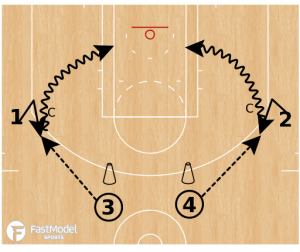
Player’s 1 and 2 get open versus the pressure given by the coaches by stepping across their feet and body to put them on their hip/back similar to a post up. This is to have assurance that the defender can’t shoot the passing lane.

Player’s 3 & 4 will pass to the outside hand away from the coaches. Player’s 1 & 2 will release to the basketball on the flight of the pass. To create space and face up to the basket.

Player’s 1 & 2 will work out of their triple threat utilizing jabs and rip through’s to drive to the basket. Player’s will finish off a jump stop (two feet) to finish strong at the rim.

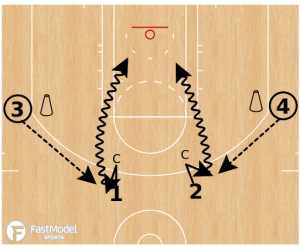
Player’s 3 & 4 would replace player’s 1 & 2’s spots after they drive. 1 & 2 will rebound their ball and go to the end of the line where the cones are.

The same drill is performed with player’s 3 & 4 entering the ball to 1 & 2 lane line extended.

Player’s will work out their triple threat using their pivot and jabs to drive down the alley.

Player’s will use a jump stop to play off 2 feet to finish around the rim.

Here is a short video of the concepts applied in game situations:

  • « Go to Previous Page
  • Page 1
  • Interim pages omitted …
  • Page 91
  • Page 92
  • Page 93
  • Page 94
  • Page 95
  • Interim pages omitted …
  • Page 288
  • Go to Next Page »

Primary Sidebar

  • Twitter
  • Facebook
  • Linkedin
coachestoolbox
personaldevelopmenttoolbox
basketballplayerstoolbox
basketballtrainer
athleticperformancetoolbox
coachingbasketball

© Copyright 2026 Coaching Toolbox

Privacy Policy