• Skip to primary navigation
  • Skip to main content
  • Skip to primary sidebar

  • Basketball Plays
    • Ball Screen Sets
    • Horns Sets
    • Man to Man Post Up
    • Man to Man Isolations
    • Backdoor Plays
    • Man to Man 3 Point Shot Plays
    • 2-3 Zone Attack
    • Baseline Inbound Plays
    • Sideline Inbound Plays
    • Combination Defense Attack
  • Drills
    • Defensive Drills
    • Offensive Drills
    • Competitive Drills
    • Passing Drills
    • Rebounding Drills
    • Shooting and Scoring Drills
    • Toughness Drills
    • Transition & Conversion Drills
    • One on One Drills
  • Blueprint
  • Practice
  • Mental Toughness
  • Skill Development
  • Offense
  • Defense
  • Store

Virginia Curl Stagger Pin BLOB

Virginia Curl Stagger Pin BLOB

By Brian Williams on October 4, 2017

Today’s post is a man to man inbounds play from the Virginia Men’s Program.

The play is from The Best of Special Situations Playbook assembled by Chris Filios

It is combined with the Ultimate Matchup Zone Defense as this week’s featured playbook bundle.

You can find out more about the playbooks at this link: Best of Special Teams and Ultimate Matchup Zone Playbooks

Or, you can purchases any four of our digital playbooks for $35 (62 titles in all–Virginia, Texas Tech, Duke, Kentucky, Brad Stevens, and many others included!) 20 new titles on July 11!

Click this link for all choices! 4 digital playbooks for $35

Quick note. It is difficult to get the timing for the play, but obviously, you need to set your own timing so that 2 and 4 are not in the lane for 3 seconds.

You probably won’t be able to use the play “As is” but you might be able to take a few of the actions that make up the play and use them to improve what you already do.

Diagrams created with FastDraw
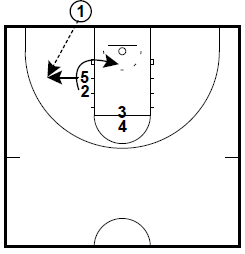
 

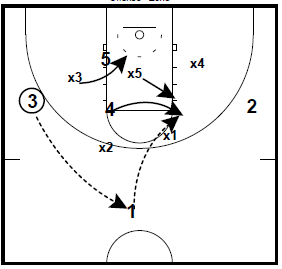
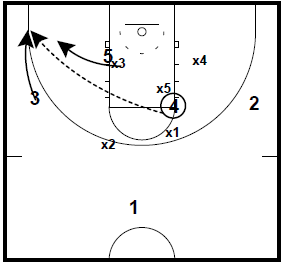
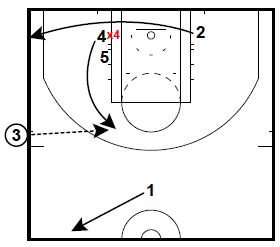
2 curls around 5.

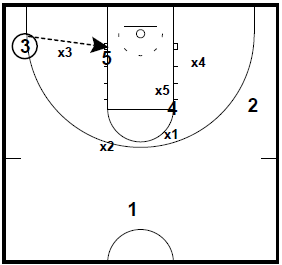
1 passes to 5.
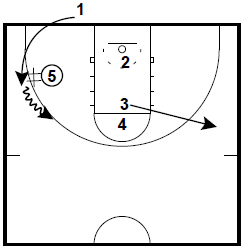


1 cuts off 5 and receives a hand off from 1.

3 pops to the opposite wing.
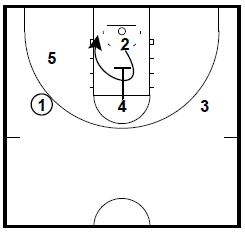


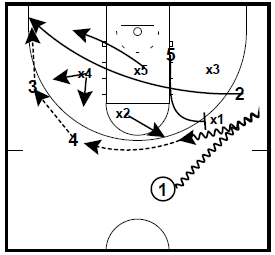
4 down screens for 2.

2 curls the screen.

1 has the option to hit either 2 or 4 if open.
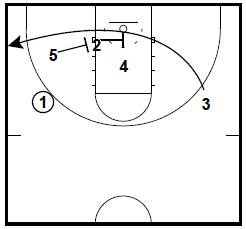


4 should clear the lane if he/she doesn’t receive a pass from 1.

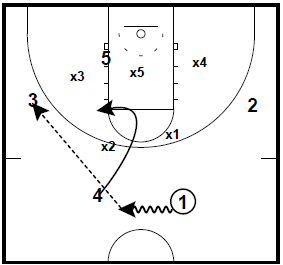
2 and 5 set a staggered screen for 3.
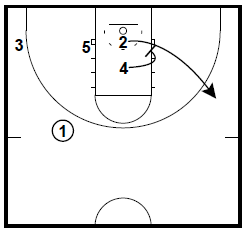


4 screens for the screener (2)


The play is from The Best of Special Situations Playbook assembled by Chris Filios

It is combined with the Ultimate Matchup Zone Defense as this week’s featured playbook bundle.

You can find out more about the playbooks at this link: Best of Special Teams and Ultimate Matchup Zone Playbooks

If you have any questions or would like to call in or text an order, you can do so at ‪317-721-1527.

Double Crossover Finish Drill

By Brian Williams on October 1, 2017

This drill is among the thousands of resources for both coaches and player available from basketballhq. They have several more videos as well as basketball coaching resource articles.

Please make sure your sound is on to see the video.

Click the play arrow to see the drill.

The drill is a YouTube video, so you will need to be able to access YouTube to see the drill.

The Coach in the video is Ryan Pannone of BC Prievidza (SBL)


Double Crossover Finish Drill

The Inspirational Leader

By Brian Williams on September 28, 2017

Jane Albright

Former WBB Coach University of Nevada

By Dr. Cory Dobbs

The coach-athlete relationship can be an intense interconnection that ignites change in both parties.  In the case of Jane Albright and her players this certainly holds true.  Albright doesn’t necessarily set out to change her student-athletes, but it happens because of the ways in which she goes about building relationships.

Relational leadership begins with a fundamental belief that people are more important than processes, strategies, and tactics.   The best leaders truly care about people.   And while it might be a cliché, it’s true that when people know they’re cared for, they willingly bring the best of their talents and gifts to a relationship.  More than most of us realize, care and concern for others can make all the difference.

Jane Albright is deeply committed to providing her players opportunities for personal growth and development.   She walks alongside them, helping them attain their goals no matter what challenges emerge.
[thrive_leads id=’3019′]
Coach Albright deploys a simple model that serves to shape her coaching practice and  the growth and development of her players.  This simple model holds her accountable for coaching the whole person; it’s kind of a balancing mechanism to ensure she doesn’t overdevelop the athlete at the expense of the student or the person.

 “To me, coaching is about more than knowing the game, the X’’s and O’s.  It’s about how you use the game to teach life lessons to a young person.  We want to put our players in a position where we develop them as athletes, as students, and as people.”

“We want to try to develop each of our players in all three areas.  They’re going to be a student for four years, an athlete for four, but they could get injured tomorrow and they’re no longer a player.  We honor the fact that they’re going to be a person far longer than the other two.  Oh, we want to win, but this model keeps us grounded in winning in every phase—student, athlete, and person.”

This framework helps Albright articulate a set of values for the team.  It provides a template for talking through life events and encourages her coaching staff and players to apply the values in their choices and actions.  And finally, this straightforward model serves as a guide for Albright in critical reflection of the values to make sure they are appropriate for the team and the individual.

SETTING THE TONE

Building a high performance team is only possible with committed partnerships—an extraordinary relationship in which leaders and followers commit to the success of each other.   When this happens both leader and followers understand that the team’s performance requires deep commitment to shared purpose and goals, yet, done so while honoring the uniqueness of each individual player.

“Many years ago I asked John Wooden ‘how will I know if I’m good at this.’  He smiled and said ‘Jane you won’t know for about twenty years.’”

Leaders make a real difference in this world when they are willing to build vibrant and positive relationships. An imperative of team leadership is that the leader has to set the tone for the quality of relationships.  If she doesn’t care about the quality or well-being of relationships, everybody catches on quickly.  But if she cares deeply, everybody is quick to recognize that too.

“I haven’t had to suspend a lot of players, but in the early years of my coaching I had to suspend a young lady.  I sat with her to talk through why we had to suspend her.  She thought she was getting suspended for getting caught. That if she hadn’t been caught there wouldn’t have been any consequences.  That was a huge lesson for me, walking her through why it was wrong.” 

“What she was taught growing up shaped her thoughts on right and wrong.  I learned that how I define ethical behavior is not how someone else might; that not everyone was brought up under the same ethics.

Leading by and with purposeful values is a practical and philosophical imperative because it builds the type of trust that builds loyalty that builds enduring relationships.  A leader must be able to anticipate, recognize and empathize with the varied wants and needs of her team members.  This only happens when trust is the foundation of relationships.  It takes great courage to invest one’s self in understanding others.  But when you do trust emerges.

Teams succeed and sustain success when trust flourishes.  In his book, Trust, political scientist, Francis Fukymaya says that trust functions as a form of social glue binding people and organizations together.  But that trust does not stem from authority, rather from one’s words and actions.

“I use the game to teach life lessons.  Knowing the game is of great importance, but I use it to teach life lessons. But to successfully teach life lessons my players have to trust me.  I have to live my life by values.  They have to see that or my lessons won’t mean anything.” 

John Wooden was the ultimate example of leading by one’s words and actions.  Coach Wooden modeled this in every relationship.

“Years ago I asked Coach Wooden ‘How did you win all those games?’  He chuckled and said ’Jane, I had better players.’  I’m sure that’s not why, it’s certainly not the only reason.” 

“You do have to have people who can produce, and you do have to provide ways for them to produce.   I do believe you have to have a baseline of talent, but also character and attitude are factors in a team’s success.  I think that’s why Coach Wooden chuckled.”

CONNECTING TO PURPOSE

To build a great team you need to invite people who are very different from you—skills, abilities, perspectives—to contribute and help grow the team members and develop the team.  And in Coach Albright’s world she willingly extends trust to those in support positions, allowing different voices and perspectives to serve her team.
[thrive_leads id=’36827′]
“To keep players aligned with our mission, vision, and values you have to use a lot of people to do that.  We have a support system made up of other’s within the university.   I think it takes a whole village to raise one of these athletes.  It can’t be just me.”

You have to willingly look in the mirror and rigorously examine your motives for asking others to follow.  Often, the mirror is another person.  Through relational dialogue we open ourselves to understanding others, and being understood by others.

“I help my players understand that I don’t get to write ‘your’ story for you, you do.  You may not value things that I do, and likewise I may not value things you do.  As individuals writing their own story they don’t have to agree with each other on personal things, but they have to agree to respect one another. 

“For example, my faith may be important to me, but not to you.  However, you have to respect my faith and I have to respect that you don’t have a belief system like mine.  I let them know that I’m not going to change them as individuals.  But we have to have team values and team standards that we all agree to.”

In today’s workplace teams are a fundamental way of organizing people to get things done.  Sports teams, like businesses and other types of organizations, orient their activities to pursue or achieve a stated purpose.  The primary difference is that businesses direct their activities toward earning money, while a sports team directs its activities toward winning contests.

Albright finds purpose in serving her players, helping them mature and grow as a person.

“For me the purpose of leadership is to create a culture where individuals can thrive and reach their potential.  Sometimes you put them in situations where they’re scared and help them through that…help them go to places [physically, emotionally, and mentally] that they’ve never been and do things they’ve never done.”

A traditional way of thinking about coaching is to emphasize the importance of achieving results.  Results matter.  But how you achieve those results is the focus of Albright’s coaching.

“We’re not a sorority, we are an athletic team and our goal is to win games and compete at the highest level.  That’s what we train for.  However, success—winning and whatever else we consider success—is the by-product of doing the right things and doing so with character.”

When you have a purpose, and that purpose is clear, then everyone is more likely to connect emotionally and socially.  Purpose provides an emotional and motivational connection that is often overlooked, yet it has enormous influence on the team experience. The bottom line is motivation

In today’s workplace teams are a fundamental way of organizing people to get things done.  Sports teams, like businesses and other types of organizations, orient their activities to pursue or achieve a stated purpose.  The primary difference is that businesses direct their activities toward earning money, while a sports team directs its activities toward winning contests.

Albright finds purpose in serving her players, helping them mature and grow as a person.

“For me the purpose of leadership is to create a culture where individuals can thrive and reach their potential.  Sometimes you put them in situations where they’re scared and help them through that…help them go to places [physically, emotionally, and mentally] that they’ve never been and do things they’ve never done.”

A traditional way of thinking about coaching is to emphasize the importance of achieving results.  Results matter.  But how you achieve those results is the focus of Albright’s coaching.

“We’re not a sorority, we are an athletic team and our goal is to win games and compete at the highest level.  That’s what we train for.  However, success—winning and whatever else we consider success—is the by-product of doing the right things and doing so with character.”

When you have a purpose, and that purpose is clear, then everyone is more likely to connect emotionally and socially.  Purpose provides an emotional and motivational connection that is often overlooked, yet it has enormous influence on the team experience. The bottom line is motivation comes from working with people we care about and doing things we’re passionate about.

 “These are the values that we use in everything we do as a team.  We call it All the Right STUPH.”

S
-servanthood
T-thankfulness
U-unity
P-passion
H-humility

STEWARDSHIP

Legendary football coach Bill Walsh, attributed a good deal of his success to what he called the “Standards of Performance.”   Walsh said, “It was a way of doing things, a leadership philosophy that has as much to do with core values, principles, and ideals as with blocking, tackling, and passing.”  Walsh considered these “organizational ethics” to be crucial to a team’s ongoing success.

Like Walsh, Albright too asserts a sense of organizational ethics.  She does it by establishing what she calls the “Negotiables and the Non Negotiables.”

“For our team setting we have what we call “negotiable” and “non-negotiables” that are a part of our standards and expectations.  We have them in basketball and in how we run our team.  So for basketball a negotiable might be how many days this week are we going to practice, and how long to practice.  So we can talk about such things—they’re negotiable.” 

“ Non-negotiables would be like we’re going to sprint back on defense, not sometimes but at all times.  Those are the kinds of things that we’ve determined are non-negotiable.  Graduation is a non-negotiable.  It’s a standard and an expectation that we’ve all agreed to.  We’ve agreed that honesty is a non-negotiable.  If they’ve agreed to the things we consider non-negotiable then I can hold them accountable.  I’ll say ‘did that align with what we’re trying to do as a team?’  They’ve already bought in because as a team they’ve agree that that is our standard.”

Leaders are stewards.  Great leaders are great stewards.  Stewardship is based on a simple but profound idea: that people are responsible for the world and should take care of it.

Coach Albright is a steward.  She has a robust conviction for helping take others to the limits of their potential.  In order to perform stewardship you have to help others see the value of taking care of their world.  As the leader you have to help others understand what the team is trying to accomplish, why we’re here, and where we’re going.  That’s not always as easy as it sounds.

“We tell them the person is first, the student is second and the athlete is third.  They stand on all three, but we prioritize treating them as a person.  We work to develop them to their potential in all three areas.  So, again, if graduating is non-negotiable and as a student you’re failing I might say ‘don’t come to practice’ or not take them on a road trip letting them know they need to take care of the class.  And they can’t say anything about it.” 

“Years ago while I was coaching at Wisconsin I had a young lady ask me if she could pledge her sorority on the same day of a game.  It was really important to her that she go through the sorority rush.  We were traveling to play Iowa that night and she asked if we’d fly her the next day to Columbus for our game with Ohio State.   I wanted to say ‘Are you kidding me?  What world do you live in?’  But I couldn’t say it.  I had to honor my commitment to her as a person first.  I said ‘Absolutely’ and we flew her to Ohio to meet up with the team.”

EARNING TRUST

Every generation has its share of social, political, religious, and business wrong doings—events of ethical lapses that lead to a national wake-up-call.  That said, the pervasiveness of reckless unethical behavior in recent years has been astounding.

Study after study reveals the sad fact that increasingly people distrust organizations, the government, leaders, and people in general.  The world today is one in which distrust dominates and dishonorable dealings and public scandals are the norm.

On a daily basis we seeing lives affected by poor judgment and indiscretions of those we trust to lead.  People have grown cynical and weary of organizations and the leaders running them.  Former Harvard Business School professor and author Shoshana Zuboff says, “The chasm between individuals and organizations is marked by frustration, mistrust, disappointment, and even rage.”

No doubt about it, leaders today are on the hot seat.  More and more we are looking for leaders to provide moral and ethical courage—to stand for positive values, fulfill commitments, and demonstrate moral leadership.  We want, and desperately need, leaders that can create an ethical climate by prioritizing transparency and accountability.   People will flock to leaders that are authentic and ethical, that live up to their values and lead with a bent on serving others.

Coach Jane Albright is such a leader.  She is comfortable setting the example she would like to see her players live by.

“Great leadership starts by being who you say you are.   As a team we talk about values and character all the time.”  “We take stories from the national news and discuss such things as unethical behavior as a team.  I want the players to think about how to learn from others mistakes.  Not to judge them, but to learn lessons and then apply them.”

It is virtually impossible to earn trust if you aren’t honest.  In fact, research consistently shows that followers expect honesty from their leaders.   Leadership writers James Kouzes and Barry Posner write, “If people are going into battle or into the boardroom, they first want to assure themselves that the person is worthy of their trust.”  So, if you show people through your words and actions that you have their best interests at heart, they just might trust you.

“What matters is the person behind the action.  My role as a leader is to be an example to my players.  A person of character.  They need to see character in my action and hear character in my words.  They need to see it, hear it, and then do it.”

The truth is that what goes on at the top trickles down through the organization.  Earning trust, and this is no little thing, requires being truthful—in all aspects of your actions and communications.  The leader must set the moral tone.

 “I strive to tell the truth to my players.  I try to do it in a way that they will accept it.  I do have to be truthful and that means saying things they might not want to hear, but doing it in a way that they will accept it.   It may be a lot easier to sugar coat things because none of us like conflict, but they expect me to be truthful.

“They expect trust from me.  They expect consistency in how I behave as a leader.  They expect communication, and love from me.  Sometimes that’s a tough love.”

“Tell me and I’ll forget. Show me and I may remember. Involve me and I will care.” -Your Student-Athlete The world of coaching is changing. In Coaching for Leadership you’ll discover the foundations for designing, building, and sustaining a leadership focused culture for building a high-performance team. To find out more about and order Sport Leadership Books authored by Dr. Dobbs including Coaching for Leadership, click this link: The Academy for Sport Leadership Books

This article was written by Cory Dobbs, Ed.D., President of The Academy for Sport Leadership.  The Academy for Sport Leadership is a leading educational leadership training firm that uses sound educational principles, research, and learning theories to create leadership resources.  The academy has developed a coherent leadership development framework and programs covering the cognitive, psycho-motor, emotional and social dimensions of learning, thus addressing the dimensions necessary for healthy development and growth of student-athletes.

ABOUT COACH JANE ALBRIGHT

Jane Albright is one of a select group of coaches to reach the 500 win mark as a collegiate head coach.  She began her collegiate coaching career as a graduate assistant to Pat Summitt at the University of Tennessee from 1981-83. She assisted with UT’s first NCAA Final Four team in 1982. After Tennessee, she spent one season as an assistant coach at the University of Cincinnati in 1983-84 before earning her first opportunity as a head coach at Northern Illinois.

Albright went on to become the winningest coach in Northern Illinois history with a 188-110 record in 10 years from 1984-94, Albright’s Huskie squads turned in five 20-win seasons and four NCAA Tournament bids. Northern Illinois also won three conference championships and had three runner-up finishes during her tenure.

Albright had tremendous success in turning around the program at the University of Wisconsin. She left the University of Wisconsin as the winningest coach in Badger history with a 161-107 record (.600) from 1994-2003, Albright led Wisconsin to seven postseason appearances in nine seasons, including five trips to the NCAA Tournament. Her 1999 team was the runner-up in the Women’s National Invitation Tournament, while the Badgers won the WNIT in 2000.  After leaving Wisconsin, Albright coached the Shockers of Wichita State University for five seasons.

About The Academy for Sport Leadership

The Academy for Sport Leadership is a leading educational leadership training firm that uses sound educational principles, research, and learning theories to create leadership resources.  The academy has developed a coherent leadership development framework and programs covering the cognitive, psycho-motor, emotional and social dimensions of learning, thus addressing the dimensions necessary for healthy development and growth of student-athletes.

The Academy for Sport Leadership’s underlying convictions are as follows: 1) the most important lessons of leadership are learned in real-life situations, 2) team leaders develop best through active practice, structured reflection, and feedback, 3) learning to lead is an on-going process in which guidance from a mentor coach helps facilitate learning and growth, and 4) leadership lessons learned in sport should transcend the game and assist student-athletes in developing the capacity to lead in today’s changing environment.

Zone Flash and Zone Overload

By Brian Williams on September 27, 2017

Today’s post contains two quick hitting plays that you can run against a 2-3 zone defense.

Adjust these sets to fit your players and philosophy and/or take bits and pieces to combine with what you already run.

These plays are from The NCAA Best Zone Plays Playbook assembled by Wes Kosel.

It is combined with the NCAA Best Man to Man Plays as this week’s featured playbook bundle. The playbooks contains 170 basketball plays from 68 different NCAA teams.

You can find out more about the playbooks at this link: Best NCAA Man to Man and Zone Sets

Or, you can purchases any four of our digital playbooks for $35 (62 titles in all–Virginia, Texas Tech, Duke, Kentucky, Brad Stevens, and many others included!) 20 new titles on July 11!

Click this link for all choices! 4 digital playbooks for $35

Diagrams created with FastDraw

Florida Gulf Coast Zone Flash


4 moves in to the middle of the zone.

1 dribbles left and passes to 3.


3 passes back to 1 and 4 moves to the right elbow.

1 passes to 4 causing x5 to move up and x3 to dive in front of 5.


5 then pins x3 in.

4 passes to 3 for a shot.


As x3 closes out, 5 may be open inside.


Farleigh Dickinson Zone Overload Ball Screen

2 runs to the corner and 5 sets a ball-screen for 1.

The idea is to get x2 and x4 shifted towards the ball leaving 2 in the corner for a shot.


These plays are from The NCAA Best Zone Plays Playbook assembled by Wes Kosel.

It is combined with the NCAA Best Man to Man Plays as this week’s featured playbook bundle. The playbooks contains 170 basketball plays from 68 different NCAA teams.

You can find out more about the playbooks at this link: Best NCAA Man to Man and Zone Sets

Tilt Pick and Roll Defense

By Brian Williams on September 26, 2017

This ideas was contributed by Randy Sherman to the FastModel Sports Basketball Plays and Drills Library.

Coach Sherman s the owner and founder of Radius Athletics – a basketball coaching consulting firm – where he consults with basketball coaches at all levels on coaching philosophy, practice planning, Xs & Os and teaching a conceptual style of basketball.

You can also find out more about FastModel Play Diagramming software by clicking this link: FastDraw

This post is to provide an idea to consider using in certain situations and against certain players as a part of the way you cover on ball screens. It is not meant to say that this is the only way you should defend ball screens or that it is right for every team at every level. As a coach, you have to make a decision as to whether or not it applies to your situation.

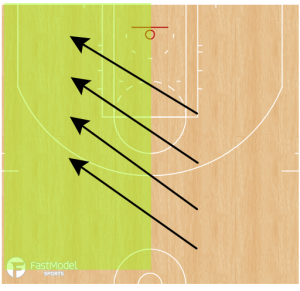
“Tilting” the offense to the left side of the floor and forcing players to use non-dominant hand in ball screens….


“TILT” – The purpose is to TILT the offense to left side of the floor and force ball handlers to use their left hand (assuming it is their weak hand)


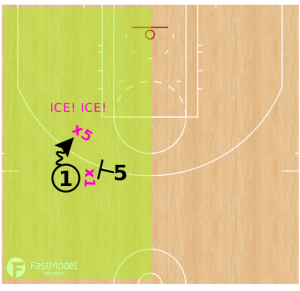
Therefore, on any ball screen on the left side of the court we ICE the ball screen. Forcing them away from the screen makes the ball handler use left (weaker) hand.

X5 must alert the on-ball defender… “ICE! ICE!”

X1 adjusts to force the ball handler away from the screen

X5 gets in line between ball and rim to contain dribbler

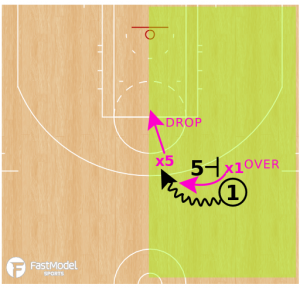
On right side of the floor, we use OVER + DROP

X1 goes over the screen.

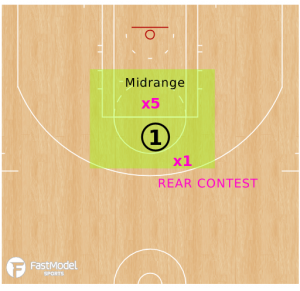
X5 provides a flat hedge and gives ground (drops) as dribble attacks. Keep an eye on the second hand of the dribbler touching the ball. That’s when you must contest the pull up.

Ball handler is attacking with left (weaker) hand and giving cushion baits him/her into the midrange two off the dribble.


By dropping, we’ve induced Player 1 into the midrange pull up.

X1 makes a “rear contest” and attempts to swipe at, block or change the shot from behind


Shaka Smart Evans Shooting Drill

By Brian Williams on September 25, 2017

This shooting drill is presented by Shaka Smart.

There is sound with the video, so please make sure that your sound is on.

The video is hosted on You Tube, so you will need to be on a network that allows you to access that site.

The videos are from the Championship Productions You Tube Channel..

The drill requires the player to shoot from 5 spots on the floor–2 corners, 2 wings, and top of the key.

The player stays at the same spot until she misses 2 in a row.

You could add a time factor to the drill by saying that the player has a specific amount of time to complete the drill.

The competitive aspect is to see how many shots the player can make after shooting from all 5 spots. The most Coach Smart has seen is 219.

You can have players compete against themselves, or against teammates, or against standards that you assign by players position or age.

If you are interested in learning more about the Championship Productions Basketball Coaching Video (available in both DVD and Instant Video Format) that this drill came from, you can click the following link: Competitive Drills for Shooting, Ball Handling, and Finishing

  • « Go to Previous Page
  • Page 1
  • Interim pages omitted …
  • Page 82
  • Page 83
  • Page 84
  • Page 85
  • Page 86
  • Interim pages omitted …
  • Page 288
  • Go to Next Page »

Primary Sidebar

  • Twitter
  • Facebook
  • Linkedin
coachestoolbox
personaldevelopmenttoolbox
basketballplayerstoolbox
basketballtrainer
athleticperformancetoolbox
coachingbasketball

© Copyright 2026 Coaching Toolbox

Privacy Policy