• Skip to primary navigation
  • Skip to main content
  • Skip to primary sidebar

  • Basketball Plays
    • Ball Screen Sets
    • Horns Sets
    • Man to Man Post Up
    • Man to Man Isolations
    • Backdoor Plays
    • Man to Man 3 Point Shot Plays
    • 2-3 Zone Attack
    • Baseline Inbound Plays
    • Sideline Inbound Plays
    • Combination Defense Attack
  • Drills
    • Defensive Drills
    • Offensive Drills
    • Competitive Drills
    • Passing Drills
    • Rebounding Drills
    • Shooting and Scoring Drills
    • Toughness Drills
    • Transition & Conversion Drills
    • One on One Drills
  • Blueprint
  • Practice
  • Mental Toughness
  • Skill Development
  • Offense
  • Defense
  • Store

Close Out and Rebounding Drill

Close Out and Rebounding Drill

By Brian Williams on October 6, 2025

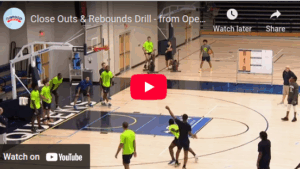
In the video below  Coach Grant Leonard from Queens University shares a Close Out and Rebounding Drill.

The set up is quite simple. Two offensive players vs one defensive player. The first offensive player has the ball in the slot and the offensive player is on the opposite wide of the floor. The defensive player is in the gap and must help to stop the middle drive of the first offensive player and then close out with high hands to the shooter on the pass.

On the catch the offensive player may shoot or drive. Play is live until the offensive player scores or the defensive players records a stop.

This is just one of many drills that you can get with Coach Leonard’s DVD. To learn more about that product click the following link Defensive System Mastery – Close Outs, Drills & Ball Screens

The YouTube video below has audio so please make sure that your speakers are turned on.

Click the arrow to play the video


Fred Hoiberg: Secondary Break Options

By Brian Williams on October 5, 2025

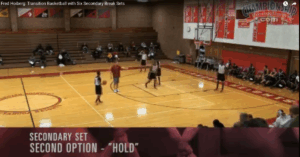
In the video below, Coach Fred Hoiberg details secondary break options in the Iowa State system.

Coach Hoiberg utilizes the following 6 sets in his transition offense.

  • Flex Set ( with six options)
  • Wide Pin Down Set (four options)
  • Drag Series (four options)
  • Isolation Set (three options)
  • “1” Transition (three options)
  • “2” Transition (two options, plus transformation into 3-out-2-in, 4-out-1-in, 5-out set ups)

In the video below he details 4 options in his Flex Set.

For more information about all of the sets in Coach Hoiberg’s transition offense click the following link: Fred Hoiberg: Transition Basketball with Six Secondary Break Sets

The YouTube video below has audio so please make sure that your speakers are turned on.


Clemson Dorman 30 Shooting Drill

By Brian Williams on October 5, 2025

In this video, Clemson Coach Brad Brownell demonstrates the Dorman 30 Shooting Drill.

In this drill, the player will take 3pt shots from five different perimeter spots. After completing the shots at each spot, the player will sprint to halfcourt and then return to the next spot for a transition 3pt attempt. The drill works best with a rebounder and a passer.

The player will take one 3pt shot from the left corner, two 3pt shots from the right wing and then three 3pt shots from the top of the key. He or she continues with 4 shots from the right wing and then 5 shots from the right corner to complete the first 15 shots of the Dorman 30 Drill.

The player then repeats the sequence with 1 shot from the right corner, 2 shots n he right wing, 3 shots from the top of the key, 4 shots from the left wing and 5 shots from the left corner.

The goal is to make 21 shots.

The video is taken from Coach Brownell’s coaching DVD. For more information regarding that DVD click the following link How to Get More Shots Up in Your Practices + Shooting Drills for the Whole Season!

This is a YouTube video. Make sure you are on a server that allows this video

Click the arrow to play the video.

Thinking Through Your Personal Brand

By Brian Williams on April 4, 2024

How do you cultivate a dynamic personal brand?  Many coaches think that focusing  on personal branding is unnecessary.  They shy away from engaging in personal branding–viewing it as self-promotion.  However, the reality is that we all have personal brands, whether we focus on them or not.  We should be aware of how others view us, and how it may help or harm our ability to succeed on and off the playing field.  The following three questions can help you assess your personal brand.

  1. What do I want to be known for?  Think wide and deep.
  2. What results do I want to deliver through my coaching efforts? It’s not only about wins and losses.
  3. How do I want others to describe me?  Consider your legacy.


An Introduction to the Introverted Leader

Several years ago, Susan Cain, a Harvard Business School professor, delivered one of the most well-received Ted Talks of all time. Today the YouTube video counts more than 18 million views of her talk on introversion. Cain wrote her 2012 book “Quiet: The Power of Introverts in a World That Can’t Stop Talking,” which has sold two million copies worldwide. With the Ted Talk and book, Susan Cain has single-handedly triggered a deeper awareness of and appreciation for the many facets of introversion.

She’s introduced a myth-shattering perspective that has transformed the way we view introversion and introverts.

On the surface, introversion looks a lot like shyness; both effect social interaction, but for differing reasons. The shy find socializing difficult. On the other hand, an introvert simply prefers to spend time alone. Introverts are collectors of thoughts, and solitude is where the collection is curated and rearranged to help them make sense of their thoughts.

Far more than we are consciously aware of, we live in a society dominated by extroverts. Susan Cain’s research points out that the American culture glorifies extroversion. Sports stars and movie stars are highly paid and followed, and social media thrives on people exposing their innermost thoughts and feelings. Extroverts are highly visible in most settings and situations. Bold personalities are rewarded.

Cain writes, “We’re told that to be great is to be bold, to be happy is to be sociable. We see ourselves as a nation of extroverts—which means that we’ve lost sight of who we really are.” In fact, she notes, one-third to one-half of Americans are introverts. So if you’re not one yourself, she often advises audiences,

“You’re probably raising or managing or married to one.”

For the past 20 years, I’ve been working with coaches and athletes in the areas of leadership and team building. During this time I’ve noticed a deficit in time, effort, and energy when it came to identifying and developing high potential coaches. It seems as if excellence in leadership is a given. But it’s not! You don’t become a high–potential coach by merely “putting in the time.” Just working hard isn’t the x-factor. Neither is high potential a natural gift.

I’m helping high achievers and high potentials become self-aware and increase their personal effectiveness. If you’ve got a deep commitment to excellence, building right relationships, guiding with influence and accelerating change, let’s talk.

I’m looking for high-potential coaches with a desire to be mentored one-to-one by me. My coaching program is for those coaches willing to pay the price, ready to invest in developing their career for the long-term. If you are interested in talking about how you can go from high potential to high achievement—let’s talk. [Cory 623.330.3831]

Sample of What You Will Learn
-Deep Coaching: Inspiring Others to High Performance
-Humility is not Optional: It’s a Necessity
-What Coaches Need to Hear
-Entering the High Impact State of Coaching
-The Social Context: Intrapersonal and Interpersonal Dynamics
-Conquering Denial
-Managing Envy

Kind regards,
Dr. Cory Dobbs
Ready to Coach You!
(623) 330..3831

New to the Second Edition of Coaching for Leadership!

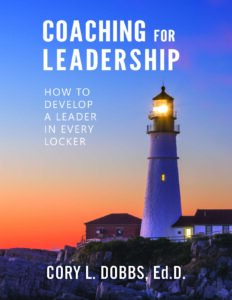
We are pleased to announce a new chapter to the second edition of the best-selling Coaching for Leadership. The chapter, The Big Shift: Unlock Your Team’s Potential by Creating Player-Led Teambuilding, connects the previous edition of this book to its origin, as well as to the future of team sports.

The new chapter sets forth a practical and applicable agenda for change and improvement. The reader is introduced to seven vital elements of change; seven shifts of traditional mental models that lead to the new core principles necessary for creating a player-led team culture. Click here for more information about Coaching for Leadership

About Cory Dobbs, Ed.D.

Cory Dobbs is the founder of The Academy for Sport Leadership and a nationally recognized thought leader in the areas of leadership and team building.  Cory is an accomplished researcher of human experience. Cory engages in naturalistic inquiry seeking in-depth understanding of social phenomena within their natural setting.

A college basketball coach, Cory’s coaching background includes experience at the NCAA DII, NJCAA, and high school levels of competition.  After a decade of research and development Cory unleashed the groundbreaking Teamwork Intelligence program for student-athletics. Teamwork Intelligence illuminates the process of designing an elite team by using the 20 principles and concepts along with the 8 roles of a team player he’s uncovered while performing research.

Cory has worked with professional athletes, collegiate athletic programs, and high schools teaching leadership and team building as a part of the sports experience and education process.  As a consultant and trainer Dr. Dobbs has worked with Fortune 500 organizations such as American Express, Honeywell, and Avnet, as well as medium and small businesses. Dr. Dobbs taught leadership and organizational change at Northern Arizona University, Ohio University, and Grand Canyon University.


Putting the Person Before the Athlete

By Brian Williams on March 22, 2024

As a leadership educator your main task is to create a psychologically safe environment in which your players want to learn how to become team leaders.  This is not a trivial distinction. A learning climate characterized by trust and openness is critical to encourage young people to respect and appreciate their teammates, coaches and the learning process.  Strategies for transformative learning should be purposeful, planned, and productive.  When we say put the person before the player we imply that the process of navigating life’s challenges should be the over-arching goal of learning to lead.

The following seven conditions are helpful in creating a psychologically safe learning environment favorable to promoting a transformational experiential approach to leadership development.

  1. Student-athletes need to feel comfortable with the concepts of leadership.
  2. Student-athletes need to know about the practice and the processes of leadership.
  3. Student-athletes need permission to make mistakes.  Healthy relationships transform conflict into cooperation.
  4. Student-athletes should have a sense of purpose as it relates to leadership.  They need to have an answer to the question “Why lead?”
  5. Student-athletes should begin to develop an awareness of their individual strengths and weaknesses as leaders.  They need feedback.
  6. Student-athletes need to monitor and adjust behaviors intended to influence others. They need to take the appropriate action suggested by feedback.
  7. Student-athletes should begin to learn the complex practices of self-reflection, self-acceptance, and self-compassion.
For the past 20 years, I’ve been working with coaches and athletes in the areas of leadership and team building. During this time I’ve noticed a deficit in time, effort, and energy when it came to identifying and developing high potential coaches. It seems as if excellence in leadership is a given. But it’s not! You don’t become a high–potential coach by merely “putting in the time.” Just working hard isn’t the x-factor. Neither is high potential a natural gift.

I’m helping high achievers and high potentials become self-aware and increase their personal effectiveness. If you’ve got a deep commitment to excellence, building right relationships, guiding with influence and accelerating change, let’s talk.

I’m looking for high-potential coaches with a desire to be mentored one-to-one by me. My coaching program is for those coaches willing to pay the price, ready to invest in developing their career for the long-term. If you are interested in talking about how you can go from high potential to high achievement—let’s talk. [Cory 623.330.3831]

Sample of What You Will Learn
-Deep Coaching: Inspiring Others to High Performance
-Humility is not Optional: It’s a Necessity
-What Coaches Need to Hear
-Entering the High Impact State of Coaching
-The Social Context: Intrapersonal and Interpersonal Dynamics
-Conquering Denial
-Managing Envy

Kind regards,
Dr. Cory Dobbs
Ready to Coach You!
(623) 330..3831

New to the Second Edition of Coaching for Leadership!

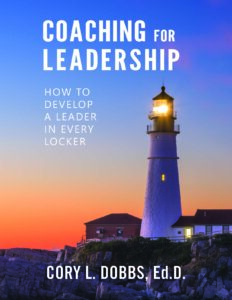
We are pleased to announce a new chapter to the second edition of the best-selling Coaching for Leadership. The chapter, The Big Shift: Unlock Your Team’s Potential by Creating Player-Led Teambuilding, connects the previous edition of this book to its origin, as well as to the future of team sports.

The new chapter sets forth a practical and applicable agenda for change and improvement. The reader is introduced to seven vital elements of change; seven shifts of traditional mental models that lead to the new core principles necessary for creating a player-led team culture. Click here for more information about Coaching for Leadership

About Cory Dobbs, Ed.D.

Cory Dobbs is the founder of The Academy for Sport Leadership and a nationally recognized thought leader in the areas of leadership and team building.  Cory is an accomplished researcher of human experience. Cory engages in naturalistic inquiry seeking in-depth understanding of social phenomena within their natural setting.

A college basketball coach, Cory’s coaching background includes experience at the NCAA DII, NJCAA, and high school levels of competition.  After a decade of research and development Cory unleashed the groundbreaking Teamwork Intelligence program for student-athletics. Teamwork Intelligence illuminates the process of designing an elite team by using the 20 principles and concepts along with the 8 roles of a team player he’s uncovered while performing research.

Cory has worked with professional athletes, collegiate athletic programs, and high schools teaching leadership and team building as a part of the sports experience and education process.  As a consultant and trainer Dr. Dobbs has worked with Fortune 500 organizations such as American Express, Honeywell, and Avnet, as well as medium and small businesses. Dr. Dobbs taught leadership and organizational change at Northern Arizona University, Ohio University, and Grand Canyon University.

Quick Strike Transition Offense

By Brian Williams on July 10, 2023

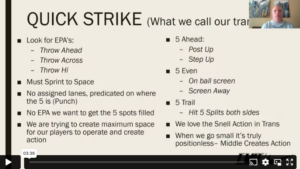
In the clip below Coach Josh Shertz explains the key concepts in his transition offense that he calls Quick Strike.

Coach Shertz’s system is unique in that there are no assigned lanes, he has his players sprint to space and look to pitch ahead.

This clip is taken from Coach Shertz’s complete coaching course. To learn more about that course click the following link: Transition Offense & Quick Hitters

  • « Go to Previous Page
  • Page 1
  • Interim pages omitted …
  • Page 3
  • Page 4
  • Page 5
  • Page 6
  • Page 7
  • Interim pages omitted …
  • Page 288
  • Go to Next Page »

Primary Sidebar

  • Twitter
  • Facebook
  • Linkedin
coachestoolbox
personaldevelopmenttoolbox
basketballplayerstoolbox
basketballtrainer
athleticperformancetoolbox
coachingbasketball

© Copyright 2026 Coaching Toolbox

Privacy Policy