• Skip to primary navigation
  • Skip to main content
  • Skip to primary sidebar

  • Basketball Plays
    • Ball Screen Sets
    • Horns Sets
    • Man to Man Post Up
    • Man to Man Isolations
    • Backdoor Plays
    • Man to Man 3 Point Shot Plays
    • 2-3 Zone Attack
    • Baseline Inbound Plays
    • Sideline Inbound Plays
    • Combination Defense Attack
  • Drills
    • Defensive Drills
    • Offensive Drills
    • Competitive Drills
    • Passing Drills
    • Rebounding Drills
    • Shooting and Scoring Drills
    • Toughness Drills
    • Transition & Conversion Drills
    • One on One Drills
  • Blueprint
  • Practice
  • Mental Toughness
  • Skill Development
  • Offense
  • Defense
  • Store

Stop Wasting Transition Opportunities — Run These 3 Drills

Stop Wasting Transition Opportunities — Run These 3 Drills

By Brian Williams on April 17, 2026

Barbara Nelson, Myers Park HS, NC, Former Head Girl’s Basketball Coach

Coach Nelson retired with 804 career wins and nine state championships.

This video is a segment from one of the 156 Videos in Glazier Drive Basketball.  Explore coaching clinic replays, practice plans, skill development videos, and more.  Click here to see all that’s included.

Full video on Glazier Drive:   Building Shooting & Skill Work into Your Practice Plan

KENTUCKY THREE-POINT SHOOTING DRILL (130 MAKES)

The team runs a five-minute three-point shooting drill with a goal of 130 team makes. Players start staggered to avoid crowding the same basket, shoot, get their own rebounds, and rotate. The drill emphasizes transition threes and requires genuine focus to hit the target. If the team falls short of the goal, they run as a consequence. The coach notes the goal is attainable but demands consistent effort — someone is always going to be shooting well, so there’s no excuse for the whole team to be off.

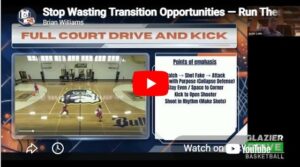
FULL-COURT DRIVING AND KICK DRILL

Players line up on the baseline on both sides of the court. The drill involves a player receiving a pass at half court (via a hand slap), executing a shot fake, then kicking the ball out to a corner shooter. A key coaching point is that the corner player must fade to the corner on the shot fake — staying even with the ball and the dribble penetration — not drifting too early or too late. The drill runs two to three minutes per side, with a team goal of around 12 makes for a two-minute block. Though the volume of shots isn’t high, it builds habits around full-court catching, driving, and kicking — all critical to game success.

COACHING TAKEAWAYS

Both drills work well early in practice as conditioning tools while also developing game-specific skills. The driving and kick drill can be used to emphasize different things depending on the focus of the day, and it doubles as a way to work on defensive positioning. Setting team goals with consequences keeps players dialed in and creates a competitive, purposeful practice environment.
Designing Efficient & Effective Practice Plans (9x State Champ System)

By Brian Williams on April 14, 2026

Barbara Nelson, Myers Park HS, NC, Former Head Girl’s Basketball Coach

Coach Nelson retired with 804 career wins and nine state championships.

This video is a segment from one of the 120 Videos in Glazier Drive Basketball.  Explore coaching clinic replays, practice plans, skill development videos, and more.  Click here to see all that’s included.

Full video on Glazier Drive:  Designing Efficient & Effective Practice Plans

DAILY PRACTICE ESSENTIALS

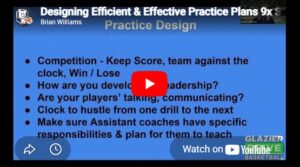
Every practice must include player development — whether 15 or 30 minutes — to ensure players are genuinely improving over the course of a season, not staying stagnant from November to February.

LEADERSHIP & CULTURE

Build leadership opportunities into every practice. Include at least one drill where coaches stay silent and let players struggle, communicate, and self-correct. Culture shouldn’t be just locker room talk — hold players accountable in practice for the values you preach, whether that’s teamwork, hustle, or communication.

TEACHING METHOD

Use a whole-part-whole approach: show the full concept, break it into pieces, then reassemble it. Whatever your method, be consistent. Hold players to excellence in executing your system — don’t let them get away with half-effort.

COMPETITION & ADVERSITY

Keep score in almost everything. Team vs. team, team vs. clock, individuals — it all counts. If you’re not building adversity into practice daily, you won’t know how your team will handle it in a game.

PRACTICE DESIGN & ADAPTABILITY

Read what your team needs each day. Stay on schedule — if a drill isn’t clicking, apply a consequence and move on, revisiting it the next day. Build in some “fluff” that can be cut if needed, and always protect the non-negotiables.

STAFF & REVIEW

Give assistant coaches specific responsibilities and let them teach daily. After practice, have them send you a quick note on what went well, what didn’t, and what should be in tomorrow’s plan. That after-action review keeps everyone invested and improves your next session.

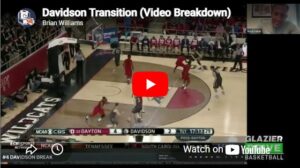
Davidson Transition (Video Breakdown)

By Brian Williams on April 10, 2026

Robi Coker, Asst Men’s Basketball Coach, McNeese State

This video is a segment from one of the 120 Videos in Glazier Drive Basketball.  Explore coaching clinic replays, practice plans, skill development videos, and more.  Click here to see all that’s included.

Full video on Glazier Drive:  Davidson Break & Euro Continuity Ball Screen Offense

OVERVIEW

Coach Coker walks through film from Davidson College’s basketball offense, explaining how they adapted its principles for their high school team.

BASIC PERSONNEL SPACING

In Davidson’s system, the two-man goes to the right corner, the three-man to the left corner, and the big man runs straight to the rim — ideally positioning himself at the center of the basket so the defense can’t dictate which side he works from.

THE TRAIL BIG AND BALL SCREEN ACTION

The four-man (the inbounder) stops at the three-point line with feet facing the rim. This eliminates moving screen violations and keeps him ready to shoot if both defenders collapse on the ball handler. The point guard plays cat-and-mouse off flat ball screens to gain an early advantage in each possession.

TRANSITION AND FAST BREAK PRINCIPLES

The point guard stays in the middle third of the floor in transition. This spacing kept defenses honest in the corners, often creating open layup opportunities or a trail three-pointer for the big man following the play.

STAGGER SCREEN ACTION

A key piece of the offense involves a stagger screen (two screens set in succession) for the two-guard. The ball handler has three options: reject the screen (go under), curl around it, or come off the stagger for a catch-and-shoot three. Defenders trained to stop one option become vulnerable to another.

HIGH SCHOOL ADAPTATIONS

Because the coach’s team was small, they ran a five-out formation (no post player) rather than Davidson’s traditional setup. They also improvised a unique sequence — a down screen flowing directly into a ball screen on the weak side — which they discovered by accident in practice but found highly effective given their personnel.

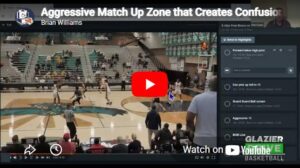
Aggressive Match-Up Zone that Creates Confusion & Turnovers

By Brian Williams on April 10, 2026

Matt Dunn, Head Boys Basketball Coach, St. John Bosco HS, CA

This video is a segment from one of the 120 Videos in Glazier Drive Basketball.  Explore coaching clinic replays, practice plans, skill development videos, and more.  Click here to see all that’s included.

Full video on Glazier Drive:  2-3 Matchup Zone: Create Confusion & Turnovers On Defense & Baseline-Out-of-Bounds Plays

OVERVIEW

This video covers a matchup zone defense system, walking through specific drills and game film to teach coaches how to build the right defensive habits. The presenter emphasizes forcing multiple passes, stealing passes in rotation, and keeping forwards from ever being on the same side.

SCRAMBLE DRILL

The foundation drill uses four offensive players in perimeter spots with a coach holding the ball under the basket. Forwards are trained to show out, take away the shot, get the outside hand outside, and drop down. Guards rotate quickly to cover both spots. The goal is to force 3-4 passes, which the presenter considers a successful defensive rep. No flashing to the high post is allowed in this drill.

4-ON-4 AND 5-ON-5 PROGRESSION

The drill evolves into four-on-four using a diamond alignment to simulate matchup situations against a 2-3 zone. The defense always initiates with a guard declaring ball. In five-on-five film review, the presenter highlights how guards arrive early to bait and steal passes back to the top — a major source of turnovers for their defense.

BALL SCREEN PRINCIPLES

The team handles ball screens in their zone the same way they handle them in man defense. As a force-left defense, they want all ball screen actions going left. Whoever guards the screener becomes the show man. Guard-to-guard screens are handled with a simple switch and then a re-match.

GAME FILM — CORONA CENTENNIAL (DONOVAN DENT & JARED McCAIN)

The presenter shares film against one of the best backcourts they’ve faced — featuring future UCLA and NBA players. Rather than pressing, they focused on staying matched up, forcing left, and controlling ball movement. A key takeaway: even against elite guards, disciplined zone principles (taking away the corner pass, forcing non-ball-handlers into decisions) kept them competitive.

KEY TEACHING POINTS

  • The two forwards can never be on the same side
  • Catch and hold — make the offense be patient
  • Prioritize stealing passes over just contesting shots
  • Don’t evaluate defense by whether a shot goes in or out

The Defense That Gets STRONGER When Attacked (Antifragile System Breakdown)

By Brian Williams on November 25, 2025

Joe Crispin, Asst Men’s Basketball Coach, Penn State

This video is a segment from one of the 120 Videos in Glazier Drive Basketball.  Explore coaching clinic replays, practice plans, skill development videos, and more.  Click here to see all that’s included.

Full video on Glazier Drive: Creating an Antifragile & Disruptive Defense

CORE PHILOSOPHY: ANTIFRAGILE BASKETBALL

The speaker introduces the concept of “antifragile” from Nassim Taleb – systems that get better with disorder rather than just surviving it. Many coaches create fragile systems where players can’t adapt when their specific scheme doesn’t work. The goal is building teams that thrive in chaos, have answers for everything, and become more dangerous as the season progresses, especially peaking in March.

ALWAYS BE ON OFFENSE MENTALITY

Defense should put players in an aggressive, offensive frame of mind rather than passive reaction. The aggressor wins games – teams lose because they’re on their heels, not fighting on their toes. Every stop equals an opportunity, but so does every “good make” by opponents (like a contested mid-range shot). Players should feel they’re dictating what the offense gets, not just reacting to what happens.

DEFENSE FUELS SWAGGER, NOT FEAR

Basketball is an emotional, free-flowing game. When teams believe they have answers for anything the offense does – or better yet, that the offense has no answer for what they’ll do – it creates confidence and swagger. Players should be throwing punches in the center of the ring, not just receiving them with arms up.

THE FOUR D’S: DISRUPT, DECEIVE, DICTATE, RUN

The defensive approach centers on disrupting offensive rhythm, deceiving opponents about what coverage is being played, dictating how opponents play, and fueling fast break opportunities. The goal isn’t to stop opponents but to disrupt them and make them uncomfortable. Create an “unpredictable and unkind environment” that keeps opponents guessing whether it’s zone or man coverage.

SCOUTING PERSPECTIVE: WHAT DON’T YOU SEE?

Instead of asking “What do I see?” when watching film, ask “What don’t I see?” Rather than just responding to how teams score, identify what isn’t happening in their offense and force them to do those things they’re not good at. This is an active rather than passive approach to defensive preparation.

Smart Defensive Coaching: Adjusting Zone Coverage to Any Attack

By Brian Williams on November 18, 2025

Rodney Rogan, Head Men’s Basketball Coach, Johns Hopkins

This video is a segment from one of the 120 Videos in Glazier Drive Basketball.  Explore coaching clinic replays, practice plans, skill development videos, and more.  Click here to see all that’s included.

Full video available on Glazier Drive: Zone Defense Adjustments vs Different Offenses

CORE PRINCIPLES OF ZONE DEFENSE

The primary objective is protecting the paint through positioning of the two top defenders (X1 and X2), proper bumping technique, and constant communication. The center (five position) plays a crucial role in organizing the defense.

STAY VS. BUMP ADJUSTMENTS

The base rule is to bump when the pass goes below the free throw line. However, the “stay” adjustment eliminates bumping to counter teams that exploit defensive movement after bumps. This is a strategic adjustment based on opponent tendencies.

HIGH POST DEFENSE RULES

Key principles for defending the high post area:

  • Don’t guard players with their back to the basket (“don’t guard the butt”) – give them space
  • Deny elbow entry passes aggressively
  • The top defender on the ball side covers the ball-side elbow
  • The five (center) guards single high post players unless facing an overload
  • Wings must drop when the ball enters the high post

MATCHUP ZONE CONCEPTS

Rather than playing static positions, defenders must move to cover overloads and match up with offensive players. One top (X1 or X2) attaches to the ball handler, and the defense adjusts from there. Avoid leaving defenders guarding empty space when the offense overloads one side.

SPECIAL ADJUSTMENTS

When the ball goes from the high post to the block, the team automatically switches to man-to-man defense. This surprise element disrupts offensive flow and prevents high post breakdowns.

  • « Go to Previous Page
  • Page 1
  • Page 2
  • Page 3
  • Page 4
  • Interim pages omitted …
  • Page 288
  • Go to Next Page »

Primary Sidebar

  • Twitter
  • Facebook
  • Linkedin
coachestoolbox
personaldevelopmenttoolbox
basketballplayerstoolbox
basketballtrainer
athleticperformancetoolbox
coachingbasketball

© Copyright 2026 Coaching Toolbox

Privacy Policy