• Skip to primary navigation
  • Skip to main content
  • Skip to primary sidebar

  • Basketball Plays
    • Ball Screen Sets
    • Horns Sets
    • Man to Man Post Up
    • Man to Man Isolations
    • Backdoor Plays
    • Man to Man 3 Point Shot Plays
    • 2-3 Zone Attack
    • Baseline Inbound Plays
    • Sideline Inbound Plays
    • Combination Defense Attack
  • Drills
    • Defensive Drills
    • Offensive Drills
    • Competitive Drills
    • Passing Drills
    • Rebounding Drills
    • Shooting and Scoring Drills
    • Toughness Drills
    • Transition & Conversion Drills
    • One on One Drills
  • Blueprint
  • Practice
  • Mental Toughness
  • Skill Development
  • Offense
  • Defense
  • Store

Lessons from the Men’s NCAA Final Game

Lessons from the Men’s NCAA Final Game

By Brian Williams on April 9, 2008

This is part one of a five part series for the next five days. There is no doubt that 10 seconds can change the memories and opportunities that the players take from even a regular season high school game.

Those rewards increase dramatically when there is a championship of any kind on the line. In my opinion, every coach should have a written plan on how s/he is going to handle every late game situation that can be thought of before the season starts and going over those situations must be a part of the every day practice plan. Coming up with something as the game unfolds is not the best way to handle it.

No one is thinking or communicating clearly at that time. The time for coaches to think clearly is in the off-season and the time for players to learn and practice those situations is every day of the season. If your team executes your plan under pressure at the end of the game, that is all you can ask.Here are some opinions I would like to offer to at least consider when formulating a plan to end the game. My message is not to use my plan, but to think for yourself and decide how you are going to handle these situations.
The Man in the Glass

By Brian Williams on March 30, 2008

Other Basketball Poems in the Filing Cabinet

Author–Dale Wimbrow

When you get what you want in your struggle for self
And the world makes you king for a day,
Just go to a mirror and look at yourself,
And see what THAT man has to say.

For it isn’t your father or mother or wife
Whose judgment upon you must pass;
The fellow whose verdict counts most in your life
Is the one staring back from the glass.

You may be like Jack Horner and chisel a plum
And think you’re a wonderful guy,
But the man in the glass says you’re only a bum
If you can’t look him straight in the eye.

He’s the fellow to please, never mind all the rest,
For he’s with you clear up to the end,
And you’ve passed your most dangerous, difficult test
If the man in the glass is your friend.

You may fool the whole world down the pathway of years
And get pats on the back as you pass,
But your final reward will be heartaches and tears
If you’ve cheated the man in the glass.

Attacking 1 3 1 Half Court Trap

By Brian Williams on March 30, 2008

Some thoughts on attacking 1 3 1 half court trap defenses with “Rotation.”

If you are coaching without a shot clock, I don’t mind making the defense run and cover the whole half court for 25 or 30 seconds. I don’t like to pass up good shots, but if we have to make the defense work to the point of where they aren’t having much fun playing the trap, that often helps render it ineffective after a couple of possessions.

This is more principle and spacing based rather than pattern based.

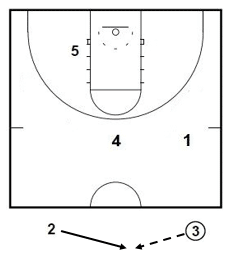
This was designed for a post player who needed to stay in the lane. It won’t work for everyone, but the three player entry is the best way to keep from turning the ball over at the 10 second line that I have seen.

Hopefully you can pick up a couple of principles to apply when you are attacking a 1 3 1 half court trap.

We want to attack the trap to score, not to just keep from losing the ball.

Always have three available receivers 15 feet from the ball and 15 feet apart from each other. Available to the ball means where the player with the ball can see you and can pass to you. Being unguarded is not enough.

We want to pass the ball to the player in the middle of the defense any time we can.

When the ball is above the free throw line #5 is on the block on the opposite side from ball at all times. He can step to the ball if a release is needed. The number 5 in this diagram is an inside player only. If you have a player who can make plays you can allow him or her more freedom.

Fake a pass to make a pass. Meet every pass.

Always see the basket when you catch the ball. If the defense leaves the basket unguarded to gamble for traps, you need to get a layup.

Our objective is to get the ball in the middle as often as possible and attack from there.

The numbers are just for identification, not as identifying characteristics of the players. The #4 is not necessarily a “Power Forward”

Diagrams created with FastDraw

We would rather pass the ball across the time line than dribble it so that the player with the ball has a live dribble when trapped, rather than have a dribbler pick the ball up when trapped. We do have a dribble entry as our last option to get the ball across the timeline and avoid a 10 second count.

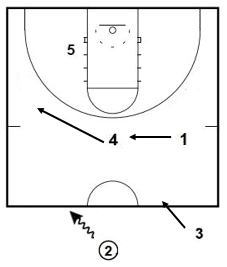
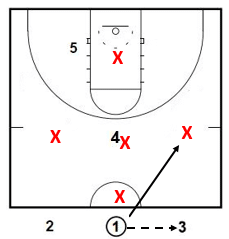
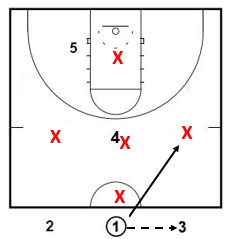
1 can pass to either side–in the diagram the pass is made to the right side.

1 then cuts through to the ball side as one of the three available receivers.

It is important that 1 not cut to the sideline, but stays off the sideline when completing the cut.

I am going to leave off the defenders in the remaining diagrams. You are going to face different rules for the defense when you are attacking a 1 3 1 half court trap.

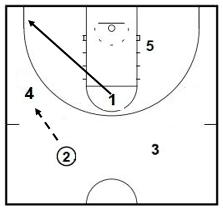
2 then replaces 1, not crossing the timeline yet. #4 is the third available receiver. Anytime a player is open in the middle, we want to get it there.

If we can pass to 1 on the cut, we will, but if he is not open pass back to #2.

If #1, and #4 are covered, reverse the ball to #2 who dribbles the ball across as there is no one to trap him and the side he is dribbling to should have no defenders.

attacking 1 3 1 half court trap

At worst, 2 will be dribbling one on one to get the ball across half court.

Once the ball is across the timeline, everyone crosses the timeline immediately to avoid being in a spot to throw a pass that would result in an over and back violation.

If #4 is open in the middle at any time, we give him the ball. This player must be very active in working to get open in the middle.

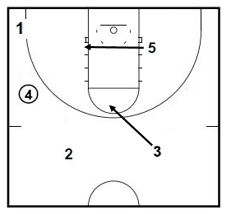
Now 1 is in the middle and the middle player continues to be the top option.

If we can get the ball moving and move the defense, we can use dribble penetration as long as we are not dribbling into traffic and trouble.

If the ball goes to 4 on the wing, 1 cuts through to the corner.

The corner 3 is a great shot against a 1-3-1 trap, but is also a place where you don’t want to get trapped. Only put the basketball in the corner when you have a shot.

If the ball does go to the corner, 5 will come across to the ball side to set up the 3 available receivers.

The ball can be reversed to the other side (continually working to get the ball to the player in the middle).

The Starfish Story

By Brian Williams on March 29, 2008

A young boy walked along a stretch of beach skimming shells into the waves, The boy noticed the distant figure of an old man. Curious to see what, the man was doing, he dropped his shells and ran through the sand.

As he approached, the boy noticed the man repeatedly stooping to pick up objects and throw them beyond the breaking surf. The boy also noticed that the sand was strewn with thousands of starfish, washed ashore by the out going tide.

The boy watched the man repeat his actions to returning starfish to the cool waters before the became lifeless, baked by the noonday sun.

The boy spoke. “I see you throwing starfish into the ocean old man. Why are you doing that?”

“To make a difference,” replied the man.

‘Surely,” said the boy, with thousands of starfish all over the beach what possible difference could you make?”

The man smiled knowingly as he reached for yet another starfish. As he tossed it far from the shore, he said,”It makes a difference to this one, son – it makes a difference to this one.’

The boy left the old man and thought about his words. As he walked along the -beach, once again alone, he began picking up objects – tossing them into the sea. However, instead of sea shells this time, they were starfish. The boy was returning them to their home.

He learned a powerful lesson that day. He discovered that he too could make a difference.

Basketball Poems If

By Brian Williams on March 1, 2008

by Rudyard Kipling

If you can keep your head when all about you
Are losing theirs and blaming it on you,
If you can trust yourself when all men doubt you,
But make allowances for their doubting too;

If you can wait and not be tired by waiting,
Or being lied about, don’t deal in lies,
Or being hated, don’t give way to hating,
And yet don’t look too good, nor talk too wise;

If you can dream – and not make dreams your master,
If you can think – and not make thoughts your aim,
If you can meet with Triumph and Disaster
And treat those two impostors just the same;

If you can bear to hear the truth you’ve spoken
Twisted by knaves to make a trap for fool,
Or watch the things you gave you life to, broken,
And stoop and build ‘em up with worn-out tools;

If you can make one heap of all your winnings
And risk it on one turn of pitch-and-toss,
And lose, and start again at your beginnings
And never breathe a word about your loss;

If you can force your heart and nerve and sinew
To serve your turn long after they are gone,
And so hold on when there is nothing in you
Except the Will which says to them: “Hold on!”

If you can talk with crowds and keep your virtue,
Or walk with Kings – nor lose the common touch,
If neither foes nor loving friends can hurt you,
If all men count with you, but none too much;
If you can fill the unforgiving minute
With sixty seconds’ worth of distance run,
Yours is the Earth and everything that’s in it,
And – which is more – you’ll be a Man, my son!

Basketball Poems I’d Rather See a Sermon

By Brian Williams on March 1, 2008

From our basketball poems file… We have more basketball poems, prose, basketball quotes, and inspirational articles in our FILING CABINET.

Edgar A. Guest

II’d rather see a sermon than to hear one any day;
I’d rather one should walk with me than merely show the way.
The eye’s a better pupil and more willing than the ear;
Fine counsel is confusing, but examples are always clear.

And, best of all the preachers are the men who live their creeds;
For to see good put in action is what everybody needs.
I soon can learn to do it, if you’ll let me see it done;
I can see your hands in action, but your tongue too fast may run.
And the lectures you deliver may be very fine and true,
But I’d rather get my lesson by observing what you do;
For I may misunder­stand you and the high advice you give;
But there’s no misunderstanding how you act and how you live!

  • « Go to Previous Page
  • Page 1
  • Interim pages omitted …
  • Page 285
  • Page 286
  • Page 287
  • Page 288
  • Go to Next Page »

Primary Sidebar

  • Twitter
  • Facebook
  • Linkedin
coachestoolbox
personaldevelopmenttoolbox
basketballplayerstoolbox
basketballtrainer
athleticperformancetoolbox
coachingbasketball

© Copyright 2026 Coaching Toolbox

Privacy Policy