• Skip to primary navigation
  • Skip to main content
  • Skip to primary sidebar

  • Basketball Plays
    • Ball Screen Sets
    • Horns Sets
    • Man to Man Post Up
    • Man to Man Isolations
    • Backdoor Plays
    • Man to Man 3 Point Shot Plays
    • 2-3 Zone Attack
    • Baseline Inbound Plays
    • Sideline Inbound Plays
    • Combination Defense Attack
  • Drills
    • Defensive Drills
    • Offensive Drills
    • Competitive Drills
    • Passing Drills
    • Rebounding Drills
    • Shooting and Scoring Drills
    • Toughness Drills
    • Transition & Conversion Drills
    • One on One Drills
  • Blueprint
  • Practice
  • Mental Toughness
  • Skill Development
  • Offense
  • Defense
  • Store

Shared Leadership on Basketball Teams

Shared Leadership on Basketball Teams

By Brian Williams on June 20, 2016

By Juan Pablo Favero, Associate Head Coach, Women’s Soccer, San Diego State University. The leadership insights apply to basketball teams as well.

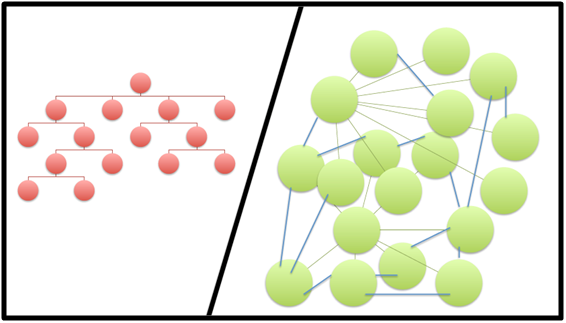
Traditional leadership models, often hierarchical in nature, are changing and evolving.  One of these models is the captain model, which tends to be too rigid and centralized, especially for modern-day athletics.  Even the military, where the shift to special operations teams is prevalent in fighting today’s wars, is not organized with a traditional commanding officer, top-down hierarchical model.  Instead, a group of leaders giving input and making joint decisions is the way that these elite teams have the required flexibility and synergy to make them successful in high stakes situations. Yes, there is an ultimate decision maker, and there always has to be, but many trained and competent voices are better than just one solitary one.

The key is to develop many leaders in a team who can be incrementally given more responsibility and decision-making ability as they are exposed to leadership principles.  Given ample opportunity to apply these principles and grow in confidence to make decisions, they are then able to take action in critical moments.

Most athletics teams start developing leaders in their junior or even senior year, depending if they are a fall or spring sport, often expecting these captains to have learned by osmosis and with limited training:  maybe a book or two and some conversations with the coach.   It is presumed that with this limited information, they will be able to carry the burden of knowing how to best influence their teammates and lead the team.  In most cases in my experience, this is just too much responsibility for one young person to have.  Yet, the model of having multiple captains does not make sense either because it can actually cause the opposite effect than intended by creating a type of bystander effect of sorts. .  Shared leadership on the other hand is not exclusive or limited in its numbers and creates increased buy-in and commitment.  Think of it as leaders in different areas of strength who can pass the baton to each other and support one another’s leadership efforts.

According to Jeff Spahn of the Leading Leaders consulting group, “the emerging question in leadership today is not about how to develop leaders, but rather how does a team of leaders lead each other.”  He goes on to say that this goes beyond collaboration and is more how people actually lead and follow simultaneously. This sounds like shared leadership.

What is it?

In his best-selling book Linchpin, Seth Godin shares the example of the fast and complex Japanese transit system.   It operates on schedule and on budget, not by top-down directive, but by a large pool of empowered employees making the best decisions as the challenges present themselves. “Letting people in the organization use their judgment turns out to be faster and cheaper—but only if you hire the right people and reward them for having the right attitude.”

It’s not rocket science; it is basically a way to include ALL your players and personnel in the leadership development and implementation processes.  Why limit it to just a few hand picked players, who will undoubtedly be looked upon as favorites?  Why leave it to chance?

If you wait until players are upperclassmen, they will graduate before they can learn their leadership craft through both successes and mistakes, and unfortunately, your program will miss out on the full impact they could have. We need to start to expose, train, and encourage all of our players to lead, yes, even as young freshmen.  What is the worst that could happen? Even if they choose to pass on the call to lead, at the very least they may become better followers since they will better understand the difficulties and challenges associated with leading.  In other words, this is a clear way we can not only teach leadership principles but also create buy in and a higher level of team cohesion and common purpose.

The idea that there can be too many “chiefs and not enough Indians” or too many “cooks in the kitchen” is a common objection to this model.  Part of the key in teaching shared leadership is exactly that they can also learn how to become better followers and more supportive team members when it is not their turn to lead or in an area of someone else’s strength.  Personally, I would rather have too many leaders on my team, all pulling in the same direction, than not enough.

The Traditional Hierarchical, top-down athletics captain model vs. Shared Leadership model:
favero1How does Shared Leadership fit in to this?

SINGLE LEADERSHIP: One leader figure (coach and/or captain) and many followers results in control and predictability.  Also creates average results, and high risk of monotony and burnout.

FOLLOWERSHIP: All as followers results in lack of initiatives, no or few new ideas, limited forward movement and lack of buy-in/shared ownership.   Also creates low energy, apathy, burnout and average results.

MULTIPLE LEADERSHIP: Many leaders attempting to lead all the time (coaches and/or captains) results in a power struggle, perpetual chaos, work never gets done efficiently. Also creates poor performance, conflict, and bad results.

SHARED LEADERSHIP: Leading and following simultaneously in a true shared responsibility model, leveraging the depth of experience, expertise, and oppositional points of view of every member required to truly create and execute at a an optimal level. The openness and humility of all involved to lead in this way creates a higher level of performance, team unity, and better results.

Why is it better?

The traditional leadership hierarchical model is quickly becoming archaic.  Today’s athlete wants to know the why behind what they are being asked to do.  When we let them in behind the curtain and start to show them the inner workings of team life and what is required to lead, some of the following benefits can occur:

  • Increased commitment and buy-in
  • Increased team unity and cohesion; improved team environment
  • Developed future leaders
  • Implemented successfully=less stress
  • Better “followship” is created
  • Shared leadership work load, diminishing the burden
  • Increased performance on the field due to creating more confident decision makers
  • Increased enjoyment of the process
  • Higher resilience to face challenges, obstacles, and failure: Losing teams panic and are paralyzed, winning teams with shared leadership raise their performance making up for a deficit in talent
  • Improved synergy which comes from using everyone’s strengths
  • Easier leadership transitions when leaders are absent (injury, suspension) or when they depart (graduation).
  • Minimized impact when mistakes are made

Challenges in implementation

Like any change in paradigms, the most difficult aspect will be to navigate the team through change.  You may receive some resistance from your players, especially from those who believe it is their “due time” and have an expectation to be captains.  Of course, these are the people who need to learn the most about true leadership principles, including the servant-leadership model and not the self-serving leadership fallacy (the difference between these two is stark: being a leader is not about what I can gain, it is about how can I serve as a leader for the benefit of others and the team).

You may have to overcome the biggest obstacle of all which may be your own leadership dogma.  It usually sounds like this: “This is the way it always has been done” or “I was a captain” or “my team had captains, and it is the right of passage to seniors.”  I just want to encourage you to ask yourself … is this the best model for today’s athletes and for their current and future development?  Even if it has worked for you in the past, is it working now?  Will it work in the future?

Ideas on how to implement it

  • Leadership Education
  • Small Leadership Groups
  • Allowing your leaders to make leadership mistakes and learn from them
  • Self-Discovery assessments: Personality assessments, TAP (Troutwine Athletic Profile), leadership styles assessments, 5 love languages, et al.
  • Discussion on what they believe leadership is, and what a shared leadership team should look like
  • Reward independent thinking, enveloped within a team-first concept
  • Recruit the right kind of people for your team, not just the most talented players. The value of positive, responsible, accountable, and team-first members who are confident to make decision is critical in competitive athletics and in the world
  • Team sessions to create mission statement, team goals, and team process to achieve those goals
  • Reinforce any of the aforementioned behaviors and attitudes
  • Encourage player-led initiatives and projects

Shared leadership is not about competition, ego, or jockeying for position.  It is instead about collaboration, cooperation, and a shared purpose and direction.

It is about servant leadership and doing what is best for the team, even when it may not seem like it’s in my best personal interests.  It is servant-like, team-first oriented, but it is also driven, focused, and purposeful action.  Finally, it also requires the attitude of knowing when and how to follow as well as when and how to lead.  This ying-yang type of balance is what makes this type of leadership environment difficult to attain but so powerful when it is reached.

To find out more about and order Sport Leadership Books from the Academy for Sport Leadership, including a Leader in Every Locker, Click this link: The Academy for Sport Leadership Books

© JPF Coaching & Consulting (Posted on the Coaches Toolbox by permission)
Princeton Offense Chin vs. 2-3 Zone

By Brian Williams on June 19, 2016

Coach Vonn Read has submitted several plays from his playbook series The Basketball Encyclopedia of Plays to the Coaching Toolbox.

Vonn is the an assistant coach at Houston.

He has also served as an assistant coach in the WNBA with the Phoenix Mercury, Orlando Miracle, and San Antonio Silver Stars.

He was an advanced scout for the Orlando Magic as well as The Charlotte Sting.

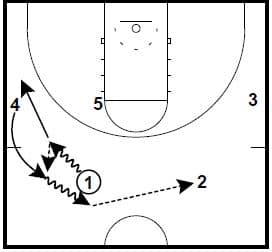
This is a Princeton Offense set against a 2-3 Zone.

Diagrams created with FastDraw


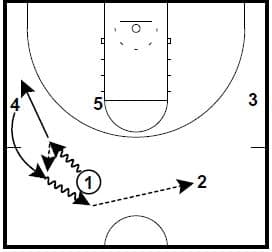
princeton-offense-zone-set1

The 1 player will DHO to the 4 player to start the set.

The 4 player will pass it to the 2-player.


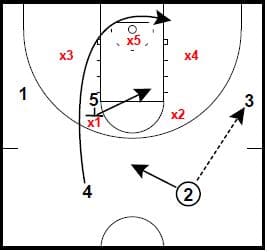
princeton-offense-zone-set2

The 5 player will set the Chin screen for the 4 player cutting to the block.

After setting the screen, the 5 player will flash into the high post.


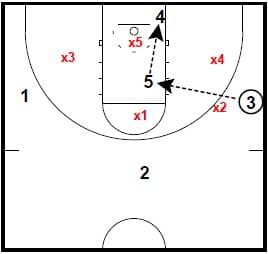
princeton-offense-zone-set3

The 3 player will look to hit the 5 player for the jump shot or high low action.


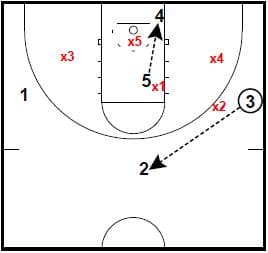
princeton-offense-zone-set4

If X1 sinks down to stop the pass to the 5 player, the 2 player should be open for the 3-point shot at the top of the key.


Coach Read has also put together The Basketball Encyclopedia of plays. You can check them out here: The Basketball Encyclopedia of Plays or read more about the books:

Any coach looking for the latest and innovative plays from the Professional, College, or High School levels can stop looking. With a compilation of over 7,700 different plays, you will never need to purchase another basketball playbook again. These playbooks can be used as a great reference tool for years to come. This 2 Volume Book includes plays from 19 different play categories, and they are the most extensive playbooks on the market.

The Basketball Encyclopedia of Plays (Platinum Series) contains over 7,700 Plays (Both Volumes combined) from the NBA, WNBA, USBL, and College levels from someone who has worked as an Advanced Scout or Coach on each level!!! This book has been intensely compiled over the last 21 years, with plays taken from a lot of NBA Coaches (past and present), WNBA coaches, and College coaches (Men’s and Women’s) from around the country.

Any coach that is serious about improving their knowledge of the game from an X and O standpoint will benefit tremendously from these books. These Books can be used to discover New Quick hitters, add a New Package to your playbook, or develop an entire Offensive System. There are a lot of new ideas and concepts in these books to study, and the Basketball Encyclopedia of Plays can be a great resource for coaches on all levels!!! This book is definitely for those X and O junkies who are always looking to improve as a Coach.

“THE GAME IS ALWAYS CHANGING? ARE YOU?” Vonn Read

Here is the link: The Basketball Encyclopedia of Plays

Howard Garfinkel Basketball Clinic

By Brian Williams on June 16, 2016

This post contains several videos from Howard Garfinkel’s 2014 Basketball Coaching Clinic.

Make sure your sound is on as you watch.

All videos are You Tube videos.

Make sure that you are on a server that allows You Tube access.


John Calipari One More Drill

A shooting drill to work on the extra pass concept with a few extra wrinkles to make it more game-like a couple of minutes into the video.

If you are interested in finding out more about the 2014 Howard Garfinkel Coaching Clinic DVD that these video samples came from, click here: 2014 Howard Garfinkel Coaching Clinic DVD

Mike Fratello “Automatic”

A play to run when your opponent is attempting to keep the ball out of your point guard’s hands.

If you are interested in finding out more about the 2014 Howard Garfinkel Basketball Coaching Clinic DVD that these video samples came from, click here: 2014 Howard Garfinkel Coaching Clinic DVD

Billy Donovan Press

Short segment from Billy Donovan on working to make the inbounds press against a press tough.

Getting Better at Getting Better

By Brian Williams on June 13, 2016

These are some of the notes presented by Mike Neighbors at a PGC/Glazier Basketball coaching Clinic in Chicago.

Mike is the Head Women’s Coach at Arkansas. He gave this talk when he was coaching at Washington.

The topic of his presentation was how coaches can “Get Better at Getting Better”

You have to take the time to consciously think about and consciously plan how every important aspect of your program is going to get better.

Getting Better does not happen on its own without a coaching staff being intentional about it.

To achieve your potential, you must have a 5:1 ratio of practices to games.

For every minute you spend in practice/meetings, it takes 2 minutes to prepare and plan.

Practice makes permanent, not perfect, so as coaches, we must set up systems so that our players are practicing the right way.

    • What do you care about?
    • Can your players verbalize what you care about?
    • At Washington, we play with 2 goals in mind.  Get a quality open shot every possession on offense.  On defense, don’t give up a quality open shot.
    • If you ask our players about how we play, they should be able to tell you those two things.
    • You either coach it or you tolerate it.
    • Be good at the things that you do a lot in your system.
    • We play packline defense, so we have to execute 350 to 400 closeouts per game.  That is something we need to be very good at.  What are those areas for your program?
    • For those important precision skills, we employ a coaching technique called “Front of the line, back of the line.
    • Using closeouts as an example, we require that a player closes out exactly as we teach it in a closeout drill, with zero error every time.
    • If the closeout is executed perfectly, the player goes to the back of the line in the drill and the drill continues.
    • If they did not do it perfectly, the next player in line goes and the player who just went goes to the front of the line for some instruction from the coach who is running the drill.
    • After the first week of practice, the players decide if the performance is front of the line or back of the line.  You will find that the players are harder on each other than you are on them.
    • You can see a more detailed description of Coach Neighbors front of the line/back of the line concept at this link:  Front of the line/Back of the Line
    • In our peer passing drills, the passer won’t feed the post if the post player doesn’t shape up properly.
    • Ghost defensive drill.  5 defenders no offensive players.  Give the players a scenario or an offensive play that your upcoming opponent runs.  They must talk each other through the whole play/action.  Great drill for players to learn what you need to defend and a great drill to force players to communicate on defense.
    • Keep in mind at the start of each season, you have not taught until your players have learned it.  You know your offenses, defenses, drills, and entire system.  It will be new to new players on your team and your veterans will not know it as well as you.  Take the time to re-teach until they learn!
    • Properly prepare so you don’t have to repair.
    • Players cannot access the creative side of their brain unless they are comfortable with what is going on.
    • It takes your best players 5 seconds to reconnect their concentration to the action when you yell their names during a live ball.  It takes average players 10 to 15 seconds to reconnect.
    • Washington coaches only talk during dead balls.
    • Exercise in helping players to develop  the next play mentality.  When Kelsey Plum was a freshman (Kelsey became the all time leading scorer in Women’s Division I history in February, 2017), and made a mistake in practice, Coach Neighbors could tell that her mind would be on that mistake for the next several possessions.  To help her learn, he started a stopwatch as soon as she made a mistake and stopped it once she had refocused.  It showed 2 minutes and 36 seconds.  He took her out of the scrimmage, called her over and showed her the time on the stopwatch.  She asked him what the represented.  He said it was the amount of time that it took you to get you concentration back after you made a mistake.  He told her that he would need to take her out of the game every time that she made a mistake for 2 minutes and 36 seconds so that she could regain her focus unless she was able to improve that on her own.  The improvement  in her next play mentality over the next few days of practice was remarkable.
  • Find ways to help narrow your players’ focus in practice.
  • Examples of ways to narrow your player’s focus:  If you are practicing half court defense.  Put a score on the clock and set the time at 3:00 to go in the game and play that defensive segment with the last 3 minutes of a game intensity.  Count free throws in practice only if they swish.  A miss is minus one for the shooting team.  You can be creative and come up with ways that narrow the focus of your players
  • Send the players home with 3 bright spots and 1 deficiency to work on.
  • Feedback is huge for today’s players.  Make it immediate, honest, and actionable.
  • During practice, he has an assistant coach taking iphone videos and then emailing them to players when there are specific teaching points so that the players have them right after practice and can see themselves doing or not doing the teaching point.

Many of these concepts came from a book called “Practice Perfect” You can find out a little more about the book (and read a part of it and/or listen to a segment by clicking on the image to the left:

Here are a few more concepts from the book:

  • Never mistake activity for achievement–John Wooden
  • Measure success by the results and your players’ improvement, not how much energy is expended in your activities
  • A high rate of activity isn’t enough–coaches must be intentional about what their athletes do.
  • Practice isn’t only worth re-engineering when it is bad, it is also worth re-engineering when it is merely good.
  • To be significantly better, you need to be significantly more productive for every minute you practice.
  • “Even relatively small, but significant changes, can increase the rate at which people develop by a striking degree”

Beilein 50 in 5 Shooting Drill

By Brian Williams on June 13, 2016

I received these two shooting drills in an email from Dennis Hutter, Head Women’s Basketball Coach at Mayville State University. His website, www.coachhutter.com . The website has more shooting, individual development workout, and leadership videos.

The remainder of the post contains what Coach Hutter said about the drills:

Here are a two more perimeter shooting drills for your player’s summer skill development. Both of these drills are competitive shooting drills. We love to add competition to all of our shooting drills to try and create as much “game pressure” and “game pace” as we possibly can. We add competition to our shooting drills by adding either time and score or both. By just adding time, score or both to a shooting drill, you can add competition to the drill and also increase their pace during the drill.

Another thing that we do all summer is we chart all of the shots for all of our players during all of their summer workouts, and hang their scores in our locker room. We feel that by charting their shots the player is able to see their progress, and when they see their progress their motivation to get in the gym and workout will increase. I hope you enjoy the drills. As usual, please feel free to contact our Women’s Basketball Office if we can ever help with anything. Here are both drills:

Both of these videos are YouTube videos, so please be sure to be on a server that allows you to access YouTube.

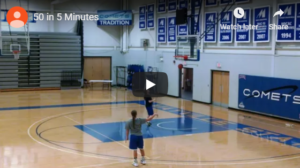
John Beilein 50 in 5 Minutes Drill

We got this drill from the John Beilein at the University of Michigan. This is a five minute continuous drill. This is a great drill to work on conditioning as well as to get your players to shoot shots while they are fatigued. The drill is executed in four shot segments, and the player will use the entire floor. The player will shoot four shots from a spot, and then move to the next spot. At each spot, the shooter will shoot three 3 Point Shots followed by one stop and pop jumper off the dribble. After the stop and pop shot off the dribble the shooter will move to another spot and execute the same four shot sequence. The shooter can move to wherever they want on the floor, when moving from spot to spot. There is no pattern. The goal is to make 50 total shots in five minutes.

Click the play arrow to start the video

Make 10 Shots in 75 Seconds

This drill is a GREAT drill to use at the beginning of a workout as a warm up or a “heat up” to the rest of the workout. This drill is great to get the player to elevate their heart rate as well as get them to work out as a game pace. The object of the drill is to have the shooter make 10 shots in 75 seconds. Because of the way we play, and the fact we shoot quite a few three point shots, we have our players shoot all three’s for this drill. You can have your players shoot game shots that are relevant to their games to get the most out of this drill.

Click the play arrow to start the video

What if Everything You Learned is Wrong?

By Brian Williams on June 12, 2016

Cory Dobbs, Ed.D.

“I want the truth!”
“You can’t handle the truth!”

So goes the memorable exchange between Tom Cruise and Jack Nicholson in the 1992 movie A Few Good Men.  We, at least most of us, sympathize with Cruise’s character, a hotshot attorney, going face-to-face with the hard-core lifer Colonel Nathan R. Jessep (Nicholson).  Cruise is relentless in his pursuit of the truth, risking his reputation and career, challenging the “system.” Pushed to the limit by the young buck, the testy Jessep throws down the gauntlet; Do we really want the truth?

THE GALILEO EFFECT
Aristotle was smart, a legendary genius.  But he was wrong about one thing.  The wise old Greek philosopher taught that heavier objects fall faster than lighter ones.  In the context of his day, this “observation” seemed obvious.  Aristotle attributed the speed of a falling object to its proportional weight, with heavier objects falling faster than lighter ones.

Galileo, and the advancement of science, proved Aristotle wrong.  We now know that the equivalence principle proves all objects fall at the same rate within a gravitational field. Aristotle was big time wrong. Such overthrows of science, certainly not trivial, are powerful course changers.  Armed with scientific principles, it is an expectation that science, both at the periphery and the core, finds itself challenging a many conventional and accepted thoughts.  In fact, right now, in a classroom somewhere in the world, a student is preparing to challenge some formula, doctrine, or axiom.  Armed with a theory and solid research, this dedicated scholar might just create a power struggle between what was once assumed to be true, and what has become clearer and course altering.

Galileo, one of the greatest scientific minds of all time, was willing to challenge the status quo of the day. Galileo challenged the Catholic Church’s view—and the contemporary perspective—of the earth’s role in the cosmos.  He dared to contest the position of a geocentric world with the “new” truth of a heliocentric model.  The Church at that time couldn’t handle the scientific truth.

I want you to try a thought experiment.  Find a quiet and comfortable spot where you can close your eyes and imagine that you believe leaders are made, not born, and that you’ve implemented a leadership developmental program for all your student-athletes.  Invest two minutes of thought.  No more, no less.  What does it feel like nurturing and cultivating the seed of team leadership?

Okay, back to reality.  You just spent two minutes defying conventional wisdom.  Nearly all “captain” training programs are grounded in the assumption that we only need a few team leaders.  What I know is that many of you struggled with the idea of a leader in every locker.  After all, the world presents the framework for developing only the chosen few to assume leadership roles and responsibilities.  It is, at least at the outset, much more efficient.

But today we know so much more.

AN ALTERNATIVE PERSPECTIVE
Let’s face it; a leader in every locker is heresy to most coaches. Remember the lesson from Galileo; genuine challenges to established wisdom cause turmoil.  They discredit the establishment and its undeniable “truths.” When Galileo, telescope at his side, publicly challenged the geocentric view of the universe, he was arrested, tried, and imprisoned for this act.  Heresy said the masses.

So, the traditional practice of team captains marches on.  Most coaches focus on the selection process rather than the development process.  I’ve heard great stories of how coaches select team captains.  Some hold interviews, others rotate captains for games, and some let the team select team captains.  But however you slice it the focus is on selection rather than development.  Moreover, a selection perspective, focused on player attributes, conflicts with the developmental perspective and its focus on possibilities and opportunities.  Does the selection process work?   Maybe.

But what if everything you learned is wrong?

Fortunately, objecting to new ways of thinking and acting in the world are less dangerous today.  My research findings are clear; a leader in every locker trumps a few leaders in a few lockers.  After years of investigation into “doing leadership development,” I am convinced that team sports demonstrate that you can take the approach of a leader in every locker from a thought experiment into a real-world competitive advantage.

Today, we know that everyone can, and will, become a leader; even if it’s simply in their own household as a parent.  The other known is that leadership can be taught—and learned.  While everyone comes to the table, locker if you will, with a different set of personality traits, it is the ability to learn from experience and the desire to be open to continuous learning that helps each student-athlete find their “hidden” talents. Rather than classifying student-athletes as “leaders” or “non-leaders,” why not change your driving assumption to everyone can learn and grow in ways that will make them more effective in the various leadership roles they might take on.

About the Author
 Dr. Cory Dobbs is a national expert on sport leadership.  An executive, speaker, consultant, and writer, Dr. Dobbs has established The Academy for Sport Leadership as a leader in curriculum and program development for developing student-athletes into team leaders.  A former basketball coach, Dr. Dobbs basketball coaching background includes experience at the NCAA Division II, NJCAA, and high school levels of competition. The Academy for Sport Leadership’s model for development is a road-tested results driven framework for helping coaches coach for leadership and student-athletes learn how to lead. Dr. Dobbs has taught at Ohio University, Northern Arizona University, and Grand Canyon University.

The Academy for Sport Leadership is a leading educational leadership training firm that uses sound educational principles, research, and learning theories to create leadership resources.  The academy has developed a coherent leadership development framework and programs covering the cognitive, psycho-motor, emotional and social dimensions of learning, thus addressing the dimensions necessary for healthy development and growth of student-athletes.

“Tell me and I’ll forget. Show me and I may remember. Involve me and I will care.” -Your Student-Athlete The world of coaching is changing. In Coaching for Leadership you’ll discover the foundations for designing, building, and sustaining a leadership focused culture for building a high-performance team. To find out more about and order Sport Leadership Books authored by Dr. Dobbs including Coaching for Leadership, click this link: The Academy for Sport Leadership Books

The Academy for Sport Leadership’s underlying convictions are as follows: 1) the most important lessons of leadership are learned in real-life

situations, 2) team leaders develop best through active practice, structured reflection, and feedback, 3) learning to lead is an on-going process in which guidance from a mentor coach helps facilitate learning and growth, and 4) leadership lessons learned in sport should transcend the game and assist student-athletes in developing the capacity to lead in today’s changing environment.

To find out more about and order Sport Leadership Books authored by Dr. Dobbs including Coaching for Leadership, click this link: The Academy for Sport Leadership Books

  • « Go to Previous Page
  • Page 1
  • Interim pages omitted …
  • Page 117
  • Page 118
  • Page 119
  • Page 120
  • Page 121
  • Interim pages omitted …
  • Page 288
  • Go to Next Page »

Primary Sidebar

  • Twitter
  • Facebook
  • Linkedin
coachestoolbox
personaldevelopmenttoolbox
basketballplayerstoolbox
basketballtrainer
athleticperformancetoolbox
coachingbasketball

© Copyright 2026 Coaching Toolbox

Privacy Policy