• Skip to primary navigation
  • Skip to main content
  • Skip to primary sidebar

  • Basketball Plays
    • Ball Screen Sets
    • Horns Sets
    • Man to Man Post Up
    • Man to Man Isolations
    • Backdoor Plays
    • Man to Man 3 Point Shot Plays
    • 2-3 Zone Attack
    • Baseline Inbound Plays
    • Sideline Inbound Plays
    • Combination Defense Attack
  • Drills
    • Defensive Drills
    • Offensive Drills
    • Competitive Drills
    • Passing Drills
    • Rebounding Drills
    • Shooting and Scoring Drills
    • Toughness Drills
    • Transition & Conversion Drills
    • One on One Drills
  • Blueprint
  • Practice
  • Mental Toughness
  • Skill Development
  • Offense
  • Defense
  • Store

Thad Matta Defensive Notes

Thad Matta Defensive Notes

By Brian Williams on August 8, 2016

These notes are from Bob Starkey’s Basketball Coaching Blog, hoopthoughts.blogspot.com. He has been posting for several years and there are hundreds of posts with ideas to make your program better.

Transition Defense:

Post Rule: “Get your butt ahead of your opponent’s butt.”

Goal: Force at least 2 passes when offense has numbers

Don’t allow a skip for a 3

Rule: Deep man never leaves paint until post comes to release.

Dribble Penetration:

Toughest thing to defend in basketball

Rule on Closeouts: “We don’t force the ball anywhere- we tell them don’t get beat.”

Coach Matta: “if you give up catch and shoot too much, you’ll lose your scholarship.”

TP: Don’t allow ball to get to the shot pocket when defending a shooter.

On non-driver, we will defend the passing hand (scouting)

Post Play:

OSU fronts the post

TP: Want quick feet like a boxer

Ball up top: up the line, on the line

Will front LP always, even if the low post takes a step off the lane

Show hands… sit down.. push him under basket

TP: if you are late fronting, don’t front.

Off Ball Screens:

TP: Jump to the ball- OSU wants jumper to extend far enough to swipe at the ball

Objective: get S guarding the ball

Down Screen: Trail all cutters- no sliding them

1st Rule: don’t get screened

“If you are constantly getting screened you are not going to be able to play for us.”

TP: Must start when the ball is in the air.

TP: “If my man is screening, play to help.”

On Ball Screens:

TP: On ball screen you don’t have a man.

Ball Defender Rule: Must make him use the screen (no rejection)

Ball defender must go once the screen (not behind)

Want defender on screener to recover (through to ally) between the ball defender and screener.

Basket Cuts:

Jump hard to the ball- stay in stance

No face cuts

Offensive Rebounding:

You can’t spend too much time blocking out

OSU likes bubble to work on rebounding

Screen the Screener:

Flex Cut

Jump low and take away low cut

Screen defender will bump high cut

On 6-to-6 pass, jump to the ball and swipe

Thru on down screen (swipe creates lane to cut thru)

Shooters with Great Range:

Vs. Shooter, OSU exaggerates denial- force back out.

In transition defense, OSU teaches to run the lane- vs. shooter, run to the shooter.

3 Pointers in Late Game Situations:

Contact switch on dribble hand. Offs vs. Shooter on late game shot

TP: player switching on shooter should have high hands

5th Defender Principle: Defender whose man is out of the play-your goal is to mess up the play.

During walk thru, Matta makes sure player knows- “you are the 5th defender on this play.”

Four Basic Guidelines to Switching

And a few more defensive notes from Coach Starkey’s Blog. These are from retired NBA Head Coach Del Harris:

Switch with teammates of equal or near-equal size on screens and crosses.

Switch to keep big players inside and small players outside on screens. Do this on changes and crosses away from the ball when possible, and on matching up in transition defense, as well as in recovering on rotations. Any communication that can allow a switch to accommodate the big in-little out concept is usually worthwhile.

Switch within fifteen feet of the goal.

Use the “emergency switch rule.” That is, switch whenever a situation arises in which a switch will challenge an open shot, regardless of the mismatch as X2 does for X5 in D-60.
Leadership Musings: Because Thoughts Have Consequences

By Brian Williams on August 6, 2016

 by Dr. Cory Dobbs

Location Matters
Several years ago I was field testing a leadership development program with the San Francisco Giants Rookie League team headquartered in Arizona.  During spring training I read an article in the local newspaper highlighting the movement of Jeff Kent’s locker.  The article explained that Kent moved his locker to be mixed in with the rookies and inexperienced players.

Kent, a seasoned veteran and all-star player at the time, was acting in the role of team leader.  Hall of Fame baseball player Maury Will said “You’re not going to get followers just because you say you’re the leader.  The followers come because they have respect for you, and they have respect for him.”

I once heard leadership expert Warren Bennis tell of his experience in the dorms while attending MIT.  Seems Bennis observed that the floor leaders in the dorms tend to be those in rooms closest to the common shower or bathrooms.  Bennis suggested that the students in these rooms tended to interact with other members more often because of their room location.  These students were most likely to leave the door open as an invitation to conversation.

Competence or Excellence?  It’s a Matter of Deliberate Choice
In Gita Mehta’s novel, A River Sutra, the daughter of a master musician tells of her experience learning from her father:
[thrive_leads id=’36827′]
My first music lesson extended several months.  In all that time I was not permitted to touch an instrument. . . . Instead my father made me sit next to him in the evenings as the birds were alighting on the trees.  “Listen,” he said in a voice so hushed it was as if he was praying.  “Listen to the birds singing.  Do you hear the half-notes and microtones pouring from their throats? . . . Hear?  How that song ended on a single note when the bird settled into the tree?  The greatest ragas must end like that, leaving just one note’s vibration in the air. . . .

Still an entire year passed before my father finally allowed me to take the veena across my knees. . . .  Morning after morning, month after month he made me play the [scales] over and over again, one hand moving up and down the frets, the other plucking at the veena’s strings, until my fingers bled. . . .

I had been under my father’s instruction for five years by now.  At last my father felt I was capable of commencing the performance of a raga. . . . 

The father understood that excellence is a deliberate choice and guided the daughter along a path that nurtured her understanding and appreciation for the process.  Shouldn’t we do the same?  Or is doing just enough, enough?

Scrimmage: A deliberate practice
Deliberate: Intentional.  Do you provide a space where your players can practice leadership?  That would be deliberate, if you do.

To Say It is Not to Do It
“Step up!” said the coach.  “Sure thing coach.  But whadda ya want me to do?”

Taking the Long View
We live in a society that has become increasingly short-sighted.  Today, a lack of vision permeates the life of most Americans and seemingly all young people (and perhaps it always has).  Pot shot?  Not really.  Ask your student-athletes to tell you how much time they’ve spent thinking about their lives ten or twenty years from the present.

We talk all the time about changing the lives of our student-athletes.  Yet rarely do we examine how effective we are in instilling life lessons.  Sure, some players return a couple of years later to thank us for teaching them a thing or two.  Simply put, in certain respects we hardly ever see the long-term effects we have on our student-athletes.

I’ve run into many ex-athletes in the corporate world.  In far too many cases I’m not able to tell the difference between them and the non-athlete at the next desk.

It’s Simple, Really, If You’re Serious
The Ritz-Carlton Hotel chain is serious about empowering each employee to make a difference.  Everyone in the organization—bellhops, valet, and maids—can spend up to $2000 to fix a guest’s problem on the spot.  No approval necessary.  Now that’s serious commitment to excellence.

When was the last time you gave valuable resources (such as practice time!) to your student-athletes to solve a problem on the spot?

Why a “real world” example?  Aren’t we supposed to be preparing students for the real world?

The Bystander Effect
In 1964 Kitty Genovese was attacked in the middle of the street near her building in New York and again in her building.  The attack was witnessed by many, though no one tried to stop the attack.  She yelled for help.  Yet no one called the police.

Such acts of apathy have been coined by social scientists the “Bystander Effect.”  When people in a crowd look and see that everyone is doing nothing, then doing nothing becomes the norm.

When witnesses in the building were questioned by police after the incident about why they remained silent and did not take action, one man spoke for all the witnesses.  According to a New York Times article at the time, he answered, “I didn’t want to be involved.”  And neither did the others who witnessed this crime.

Okay, so a player on your team violates a team rule and you don’t know about the incident.  However, team member’s do.  And they don’t tell you nor do they confront the teammate.  The norm has quickly become doing nothing.  The players are creating an apathetic culture of going along to get along.

The Honor Code
Norms are important.  Not because they generally sit at the end of the bar drinking beer, but because they shape behaviors.  The purpose of an honor code is to foster commitment to the ideals of an institution or team and to shape interpersonal interactions.

A cadet will not lie, cheat, steal, nor tolerate those who do. –West Point

Can you imagine, and it takes imagination on this one, what life would be like if every member of your team lived this code.

Small Nudges Can Lead to Big Changes
Change the context and change the attitudes and actions.  According to Richard Thaler and Cass Sunstein, authors of Nudge: Improving Decisions about Health, Wealth, and Happiness, people “can be greatly influenced by small changes in the context.”

The idea of “nudge” is that there is “no such thing as a ‘neutral’ design.”  Thaler and Sunstein elaborate on how “choice architects” organize (and thus influence) the context in which people make decisions.  Context does influence behavior.

A little push in the “right” direction can have a huge systemic impact.  Isn’t that what the invisible hand of an honor code does—nudge people to do the right thing.

Practice nudgery.

Your Move
Imagine yourself in a chess game where after every half-dozen moves, the arrangement of the pieces stays the same but the capabilities of each piece changes.  Isn’t this what happens with your team?  Random thought?  Not really.  The point is…

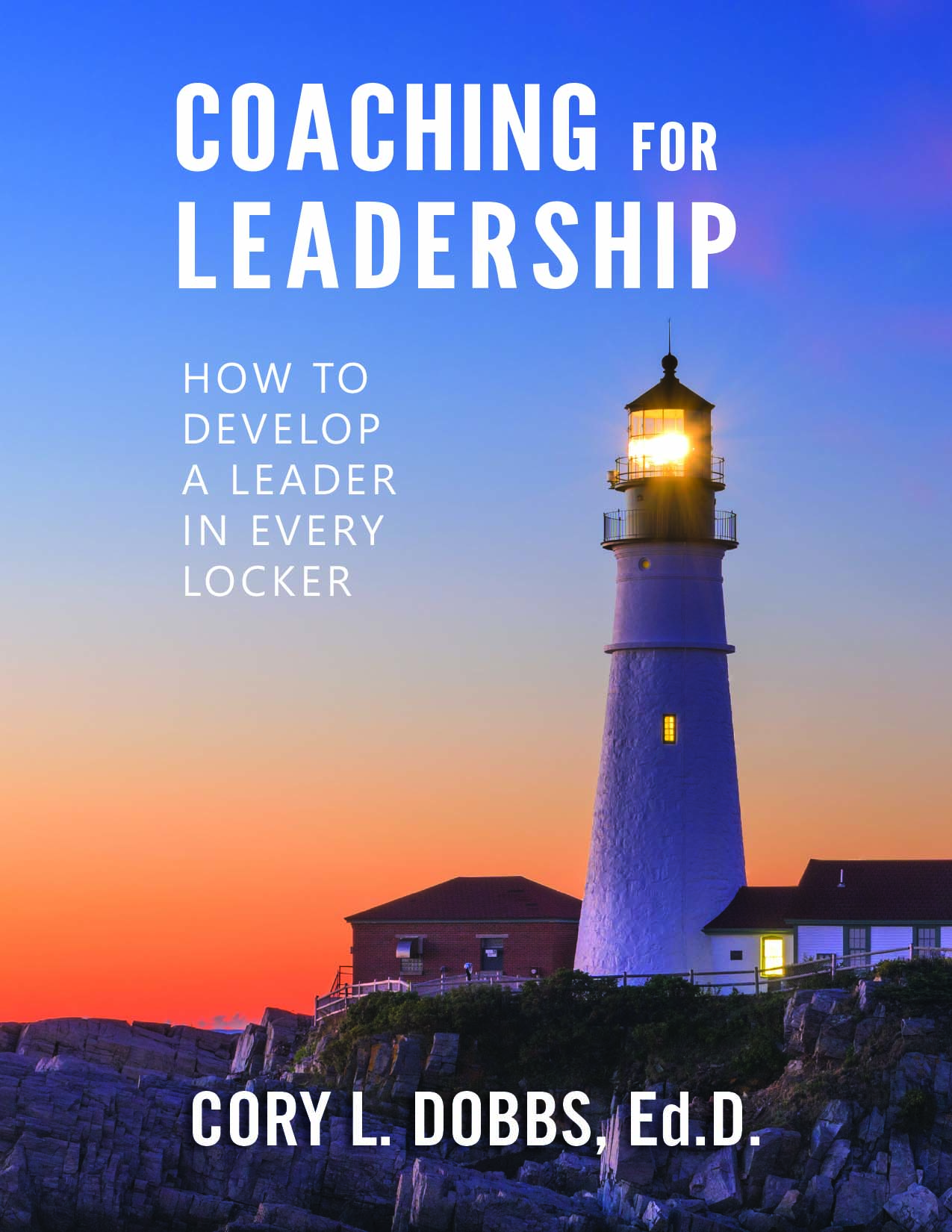
“Tell me and I’ll forget. Show me and I may remember. Involve me and I will care.” -Your Student-Athlete The world of coaching is changing. In Coaching for Leadership you’ll discover the foundations for designing, building, and sustaining a leadership focused culture for building a high-performance team. To find out more about and order Sport Leadership Books authored by Dr. Dobbs including Coaching for Leadership, click this link: The Academy for Sport Leadership Books

About the Author
Dr. Cory Dobbs is an accomplished researcher of human experience–a relentless investigator always exploring “how things work.” He is the founder and president of The Academy for Sport Leadership and A Leader in Every Locker and has written extensively on leadership development of student-athletes.

Alan Stein on Pre-Season Conditioning

By Brian Williams on August 4, 2016

These are some of the notes that I took from a presentation by Alan Stein at a PGC/Glazier Basketball coaching Clinic in Chicago.

Alan Stein on Basketball Performance Training

  1. Players have higher priorities than training. They can remember about 3 things on training, then it is overload.
  2. As coaches, we must exercise selection in our administration of our training programs.
  3. Basketball Performance Skills are built brick by brick, not in a short period of time.  If every brick is laid perfectly, you have a sound wall.  If they aren’t laid correctly, all you have is a pile of bricks.
  4. Every rep of every drill and every workout is a brick.
  5. Stay focused on the important areas.
  6. Screen, prioritize, prescribe
  7. Be time efficient with your program, training is a small piece of the puzzle.
  8. There is no such thing as perfection, but that is the goal.
  9. Basketball isn’t a perfect game.
  10. Basketball is a game played with bursts of high intensity and then brief rests (fouls, timeouts, dead balls, free throws, etc..).  Your workout regiment should mirror that.
  11. Make your workouts productive.  Get your players to buy in, then get them results that they can see and feel.  Once you have them hooked, they will give you high focus and high effort.
  12. Age appropriate.  Evaluate stages (of physical development) rather than ages.
  13. Basketball training is not just lifting weights.
  14. Training is much bigger than only strength and conditioning
  15. Young players need training on how to start, stop, jump, and land most quickly and safely.
  16. The movement patterns are similar in youth basketball all the way up to professional basketball.
  17. The training program must be comprehensive–Alan is a performance coach, not just a strength and conditioning coach.
  18. A comprehensive program involves testing & assessment, improving performance, reducing injury, inspiring progress
  19. In basketball, it is not important to determine who the strongest player on the team is.
  20. Players who have the highest level of strength aren’t the best basketball players.  Kevin Durant was 68th out of 70 in bench press at the NBA combine prior to being drafted.  Short arms are an advantage in weightlifting.  Long arms are an advantage in playing basketball.
  21. We are all born with different abilities
  22. The goal is to determine where they are at the start of the program and track the improvement of each individual.
  23. Assess and Identify each player’s needs and monitor their progress
  24. Asymmetry (For example, one leg is stronger than the other leg.  Another example is the front being stronger than the back) is a leading cause of injury.
  25. The #1 cause of injury is a pre-existing injury.
  26. Proper training evens out asymmetry
  27. In basketball, skill is king.
  28. To improve strength and power, Alan recommends body weight squats, and front loaded squats.  Do not do back squats.
  29. Improving athleticism–running, jumping balance.
  30. FG% is tied to balance.
  31. Alan believes that pre-season programs should be time efficient.  Get them in, get them a great workout, and get them out.
  32. Work on starting, stopping, changing direction, accelerating, and decelerating.
  33. Steve Nash was a great athlete regarding balance, deceleration, and hand/eye coordination.
  34. Alan’s Complete Player Pyramid (click the link for an article he wrote on it) is Body-Skill-Brain-Hear/Motor.
  35. We can model heart, but that is not something that can be controlled.
  36. Your training program is a foundation.
  37. Purposeful, Practice, Progressive (and Regressive)
  38. Purposeful--Does it bulletproof players’ bodies against injury? Does it improve players’ capacity to perform skill?  If you improve players athleticism, they can perform skills properly for longer periods of time.  Just because something is hard does not make it purposeful.  You can have a purposeful program and still have some fun.   In Alan’s opinion, the 2 mile test isn’t purposeful.  It requires different energy demands than basketball does.
  39. Practical–Do what you can with what you have.
  40. Progressive–To foster continual improvement, and regressive to help players who struggle.
  41. Your training program must be safe.  You can’t prevent injuries in basketball, but you can take steps to reduce the number of injuries and the severity of those injuries.  Training injuries are unacceptable.  Alan is not big on the power clean or snatch.

Reverse Reaction Rebounding Drill

By Brian Williams on August 2, 2016

This rebounding drill is among the thousands of resources for both coaches and player available from basketballhq.

They have several more videos as well as basketball coaching resource articles.

Make sure that your speakers are on to hear the narration and that you can access YouTube to see the videos.

Like everything I post on the site, you will need to tweak the drill to fit your philosophy and needs.

You might want the rebounder to simulate the movements of a defensive possession rather than doing lane slides.

You might want them to simulate boxing out, hit and get, or whatever technique you use.

You also can make the shots miss off the rim rather than the backboard.

Click the play arrow to begin the videos.

Reverse Reaction Rebounding Drill

3 Defending 4 Contest Drill

By Brian Williams on August 1, 2016

This post contains three videos of two defensive drills.

The first video is with Tad Boyle of Colorado and his version of the 3 on 4 contest drill.

The second video is with Joe Dooley, Kansas Men’s Assistant, running his version of the 3 on 4 contest drill.

The final video is of Steve Prohm, former Head Men’s Coach at Murray State.

Make sure your sound is on as you watch.

All videos are YouTube videos.

Make sure that you are on a server that allows You Tube access.

Tad Boyle Colorado 3 on 4 Contest Drill

This first video is with Tad Boyle, Head Men’s Basketball Coach at the University of Colorado.

Use the drill to improve communication, ball pressure, active hands for deflections, and closing out at full speed. The offense cannot dribble. The purpose is to get 3 stops in a row. Players get 3 chances to get 3 stops in a row or they run.

You can make adjustments to the rules and requirements of the drill that fit your team.

If you are interested in finding out more about the DVD that the video sample came from, click here: Tad Boyle: Game-Like Defensive Practice Drills

Joe Dooley Florida Gulf Coast 3 on 4 Contest Drill

If you are interested in finding out more about the DVD that the video sample came from, click here: Joe Dooley: 7 Seconds or Less Early Offense

Steve Prohm Rebel Drill

Coach Prohm is currently the Head Men’s Coach at Iowa State. When this drill was filmed, he was at Murray State.

The drill allows you to work on several defensive techniques in short succession and develop some energy for practice.

If you are interested in finding out more about the DVD that the video sample came from, click here: All Access Murray State University Basketball Practice with Steve Prohm

3 on 3 Seven Seconds to Score Drill

By Brian Williams on July 31, 2016

These drills were contributed by Marc Skelton, Head Coach for Fannie Lou Hamer Freedom High School in the Bronx, NY to the FastModel Sports Basketball Plays and Drills Library.

You can also find out more about FastModel Play Diagramming software by clicking this link: FastDraw

The premise of this drill is to mimic quick action in early offense.

This will improve your screening, how your guys/girls catch and shoot and read the defense.

On the flip side your defense will be able to not let cutters cut without being bumped and improve communication.

We play a game to seven.

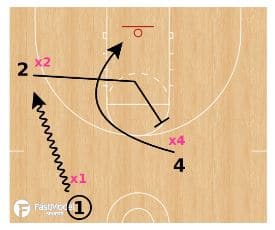
There are three options to this drill outlined below. Drill #1 is a UCLA cut. Drill #2 works on the Ghost Screen and drill #3 has a backdoor option.

Editor’s note from Brian: The purpose of my posting this drill is to give you an idea for a drill to make your players’ more aggressive in your early offense if that is something that you emphasize. You probably run different movements than these and will need to change the movements to fit what you use.

Drill #1

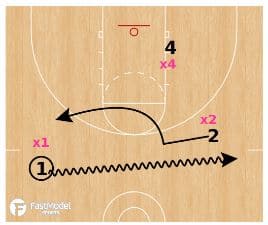
3on31

Offense must score in seven seconds or less.

Start this drill at half-court on the point guard’s weak hand.

1 dribbles hard at 2.

2 cuts to the basket and makes a L-cut to screen for 4.

4 dives hard and 2 pops to the 3-point line.

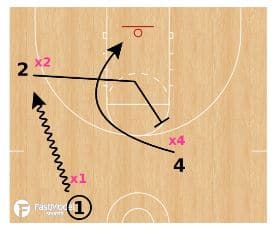
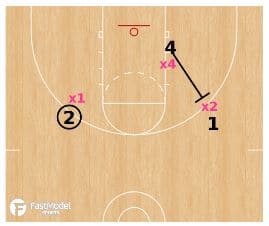
3on32

If you play against teams that like to switch this is a great drill to put into your offense.

4 and 2 both have mismatches to exploit.


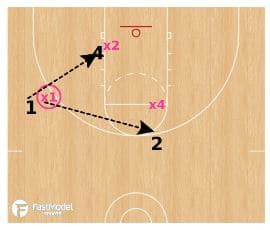
Drill #2

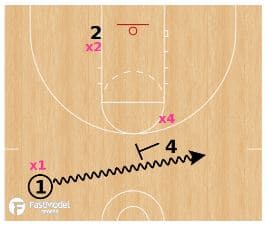
3on33

Drill # 2 has the same premise, score in seven seconds or less.

1 starts at half court and dribbles at 2.

2 sets a Ghost Screen, the kind Golden State uses.

1 passes to 2.

From here 2 can catch and shoot, catch and go, or hit 1 cutting to the hoop. (see next frame)

3on34

After 4 sets the back screen he/she pops to the 3-point line.


Drill #3

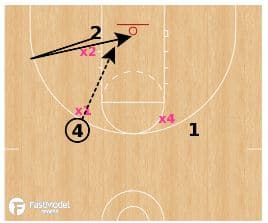
3on35

Drill #3 in my 3 on 3 seven seconds or less series is a backdoor option.

This drill helps your 4 become a better passer.

2 can work on different types of finishes-reverse lay-up.

Ball fake. Up and under move. Left and Right hand finishing.

3on36

On the catch 2 sprints out the the 3-point line and then cuts backdoor.


  • « Go to Previous Page
  • Page 1
  • Interim pages omitted …
  • Page 113
  • Page 114
  • Page 115
  • Page 116
  • Page 117
  • Interim pages omitted …
  • Page 288
  • Go to Next Page »

Primary Sidebar

  • Twitter
  • Facebook
  • Linkedin
coachestoolbox
personaldevelopmenttoolbox
basketballplayerstoolbox
basketballtrainer
athleticperformancetoolbox
coachingbasketball

© Copyright 2026 Coaching Toolbox

Privacy Policy