• Skip to primary navigation
  • Skip to main content
  • Skip to primary sidebar

  • Basketball Plays
    • Ball Screen Sets
    • Horns Sets
    • Man to Man Post Up
    • Man to Man Isolations
    • Backdoor Plays
    • Man to Man 3 Point Shot Plays
    • 2-3 Zone Attack
    • Baseline Inbound Plays
    • Sideline Inbound Plays
    • Combination Defense Attack
  • Drills
    • Defensive Drills
    • Offensive Drills
    • Competitive Drills
    • Passing Drills
    • Rebounding Drills
    • Shooting and Scoring Drills
    • Toughness Drills
    • Transition & Conversion Drills
    • One on One Drills
  • Blueprint
  • Practice
  • Mental Toughness
  • Skill Development
  • Offense
  • Defense
  • Store

100 Point Shooting Drill

100 Point Shooting Drill

By Brian Williams on November 28, 2016

This video is from the great resources available from basketballhq. They have several more videos as well as basketball coaching resource articles.

The Coach in the video is Brian Baudinet, formerly an assistant coach with the NBA D-League Tulsa 66ers. Since the video was made, Coach Baudinet has taken a position with the Duquense University Men’s Staff and the Tulsa 66ers are now known as the Oklahoma City Blue.

I hope you might be able to take this video and modify it so that it is useful within your program.

You can always change the types of shots or the rules (such as shooting until you make) to make the shooting game fit the abilities of your players. You can also change the number of points to get a win.

Players can compete against a team best, against their personal best, or against players at other baskets.

It is also a drill where you can make the standards more challenging as your players get better at playing this shooting game.

Please make sure your sound is on to see the video.

Click the play arrow to see the drill.

The drill is a YouTube video, so you will need to be able to access YouTube to see the drill.
100 Point Shooting Drill

Team Free Throw Shooting Game

By Brian Williams on November 20, 2016

Mike Neighbors, Women’s Coach at Arkansas (Previously at Washington) is one of the best coaches around to learn from.  Hopefully you were able to see his 2016 Women’s Final Four team play, or see him at a clinic, or both.

He sends out a weekly basketball coaching newsletter. If you are interested in being added to his list, let me know and I will pass along your email address. His newsletter is on hold at this time while he is transitioning jobs.

The name of this Free Throw Shooting Game/Drill is “What’s Up?”

What’s Up Team Free Throw Shooting Game

Editor’s Note from Brian: The object of the game is, like golf, for the shooters to accumulate as few “Up Points” as possible.

This description was provided by Coach Neighbors

As a result of having a larger team than we have had the last few years, we have had to become a little more creative in our use of space/goals/time.

This seems to be most true in how we use our time with free throw practice. This is one we came up with this week. It’s a morph of several other shooting drills we have utilized in the past.

All six goals. Each goal being scored individually.

Shooter will attempt two shots then rotate to the next goal.

If the shot is made…it puts 1 point up.

If the second shot is made… that would increase the UP total to 2. The score at that goal continues to rise every made shot as the various players are rotating through.

When a shot is missed, the player who misses GETS THE NUMBER THAT is UP added to their score.

You have scores building at each goal as the players rotate through. We rotate rebounder to shooter, shooter to next goal so that the UP count can be relayed.

As you do this a few times you will see that your “smart’ kids will learn NOT to follow the best FT shooters, so it will be up to you to place shooters accordingly.

We keep a running total score for the week/year so that we can strategically order the shooters to best keep it competitive for all!!

The first time we did it, we did for 10:00 total. Once the time expired, we kept each goal going until there was a miss at all of them and all the total UP points went to someone. That keeps all players rotating around one goal until there is a miss. Creates one last chance to hang a big number on someone.

So far this drill has been able to create some pressure situations and also give us best possible use of our free throw time. We also use this as water break and a catch breath time before we head into most physically and/or mentally challenging part of practice.

How to Coach Winning Shot Selection

By Brian Williams on November 17, 2016

—Excerpted from the book, “Stuff Good Players Should Know” by Dick DeVenzio

Posted with permission from PGCBasketball

PLAYERS OFTEN TAKE SHOTS IN PRACTICE THEY CAN MAKE AGAINST THEIR SECOND LINE, BUT NOT AGAINST THE BETTER PLAYERS THEY FACE IN BIG GAMES.

I invented the term LONHOBIRAT some time ago to indicate what I thought was most important about shot selection. It means, get a Lay-up Or a shot with No Hand up, On Balance, In your Range with Adequate Time to shoot.

The word covers most of what is important in selecting shots but, over a period of time, I found myself changing my own way of teaching shot selection. Yes, those are still the ingredients to be considered, but now I use a numbering system. I begin by simply watching a scrimmage and requiring that my players find a shot that elates me.

When they get a shot that elates me, I call it a 7. If we get a wide open lay-up—a shot we will literally make 99 times out of a hundred, I give that a 9. There is no such thing as a perfect 10. Even an NBA superstar with a wide open dunk can miss. So the best shot possible is a 9.

During a practice, when I call something as not a particularly good shot, a player is likely to argue, “Coach, I can make that shot.”

Indeed, he may very well have just made it. But the problem is, too many shots that athletes choose in practice may score against the second team defense but not against the better players they will face in big games. In other words, the so-so shot that manages to go in during practice too often misses during a game.

As a result, you look back after a big game that you lost by a few points and you have to admit that you chose your way to failure. The other team didn’t beat you. You chose shots that were so so and it’s no big surprise that you missed them.

You cannot let your team choose the very shots in practice that will assure them of losing big games for you. Therefore, other than wanting my players to know that being on balance, being within their range, and having adequate time are all important, I want them—during the action of practice scrimmages—to realize that I’m not interested in arguing about details. I just want to be elated. If the shot was taken a bit off balance, a bit too fast, or a bit too far out, who cares which bit it is? I’m just not elated with that shot, and so taking that shot in practice is not leading us to the promised land.

I give these so-so shots that most teams toss up willingly everyday in practice a 5. They go in fairly often, but they don’t lead to wins in big games, which is precisely what you practice for. (You can win easy games without practice.)

SO HERE’S MY RATING SYSTEM:

9 = A VERY EASY, UNCONTESTED LAY-UP

7 = A GOOD SHOT; I’M ELATED WITH IT

5 = A SO-SO SHOT; IT WORKS OFTEN—IN PRACTICE

3 = A BAD SHOT; A VERY LOW PERCENTAGE SHOT THAT EVERYONE REALIZES SHOULD NOT BE TAKEN—YOU JUST CAN’T HAVE THESE.

When watching practice, I can yell out instantly what a shot is worth. Anytime I’m not sure, I yell the number in between. Am I elated? Then 7. Not sure, but it’s better than a so-so 5? Okay, I give the shot a 6.

When you start thinking about shots in this way, and get your team thinking about them in this way, it becomes a lot easier to get everyone on the same page about shot selection.

Should everyone be allowed to shoot an open shot? Of course not. Everyone should be allowed to shoot a shot that elates me.

The more you practice and the better shooter a player becomes, the more I am likely to be elated by his choices. But every player has the same requirement: elate me.

The reason I have gotten away from talking much about LONHOBIRAT is the L part, the lay-up. I find one of the most common problems teams have is the number of lay-ups they choose and miss, particularly by post players inside.

You work hard teaching guards to look inside and get the ball inside to your big men, and then your big men toss up some whirling loopty-doo shots and—Hello? We’re supposed to all be happy with them?

Sorry. Just because a shot is taken close to the basket does not mean it’s a good shot. In fact, most big men have a habit of turning potential 7s and 9s into 5s and even 3s by tossing up shots that have very little chance of going in.

Often they are going to their weak side, tossing up shots over the hands of defenders who are taller, stronger, and better than the players they face in practice each day. Small wonder that they miss these shots.

Your big men have to be taught to go strong to the basket with their strong hand; otherwise, there is a very good chance they will take a shot that will go in only occasionally when it really matters.

Even more important, big men are very likely to shoot too fast, a problem most young coaches fail to recognize because they think the shot must be taken quickly to avoid nearby defenders.

Yet the best big men in the world take their time and take the shot they want. They don’t hurry. They rely on strength and technique, not speed and surprise.

You must make sure your big people take high percentage shots, just as you have to assure it in your guards who want to stand beyond the three-point arc and toss up prayers. If you don’t demand great shot selection during your practices, you are very unlikely to find yourself elated with your shot selection after your games.

Get the shots you want by making them a requirement in your daily scrimmages

Click To Tweet

The best way I know to get the shots you want is by making them a requirement in your daily line game scrimmages. When you see a shot that fails to elate you, you don’t need to bother with explanations that irritate your players. Blow that whistle.

Get them to the line, and let some of your players say it. “You weren’t exactly elated with that shot, were you, Coach?”

No, you weren’t elated. The shot went in. It wasn’t terrible, but it wasn’t great. It wasn’t what you wanted your player to select. It was so-so, and you were glad the team recognized it.

You could use a shot like that some day, at the end of a quarter or when a shot clock violation is about to occur. But you don’t want your players choosing that shot in practice; and it makes things a lot easier to have some of them telling you, rather than you constantly having to correct and criticize them.

—Excerpted from the book, “Running the Show”

To learn more about PGC Basketball, including additional training tips and videos, you can visit their YouTube Channel

Improving Execution in Basketball Practice

By Brian Williams on November 10, 2016

One of the many challenges we face as basketball coaches is to create an environment and develop systems in practice that lead to constant improvement in both team execution and individual development.  I have always subscribed to Chuck Knox’s philosophy that “Practice without improvement is meaningless.”

One way to emphasize specific points of execution is to make special rules in practice.  Each year, revisit your special rules and make adjustments and adaptations that fit your current team.  The rules should force players to develop the habits that you want in your drills and scrimmages that will carry over to the game.

The idea is to put the players’ focus on the execution (the process) and not on the results or outcome of the play.

You can also use them to create more competition between your first and second teams.  With their implementation, the second team gains the opportunity to score more points and possibly win the scrimmage on the scoreboard, which forces the starters to compete.  This serves to make your practice much more competitive which is crucial to the improvement of your team.

Your players must understand the purpose of the rules.  It must make sense how your rules will develop practice habits that will carry over to games.  Players don’t have to agree with everything, but if they understand the reasons by the practice rules, there is a much higher likelihood that your system will produce the intended improvement.

The rules should be simple to implement and easy to track.  They should not interfere with the flow of the scrimmage if they are confusing and take time to think through and score.

Run the clock and the scoreboard like a game when you scrimmage in practice.  Make every special rules violation either result in a turnover, adding points to the score of the other team, or both.  It is too difficult for the individual who is keeping score to take points away from a team.  If you just yell, “Two points for the red team because the white team did not chin the defensive rebound,” the players know why the points were lost and the scoreboard operator can just add them to the score of the second team.  The point differential is the same regardless of whether you add to the second team’s score or subtract from the first team, so it makes sense to make it easier on your scorekeeper.

If you have enough managers or assistant coaches, keep a possession chart and record what violation resulted in the points so that you can analyze what rules you are violating the most frequently and then work to improve those areas.  If you don’t have access to a scoreboard, you can still designate a coach or manager to keep a possession chart on a clipboard and call out the score.

Here are some suggestions for special practice rules.  The key is to keep them pertinent to how your team plays and to make practice scrimmages competitive.

In my opinion, it would be too big of a distraction to use all of them at once.  Too many extra rules disrupts the flow of the scrimmage when you award points.  Pick no more than 3 at most each day that fit the way you play.  It could be a different group of rules the next day.

Here are some ideas for special practice rules, but the most effective special rules will be the ones that you create that encourage your players to play the way you want and need them to play.

  • 2 points to second unit for a shot that isn’t contested by the first team, regardless of whether it goes in or not.  You can still award the points if the shot goes in, putting even more emphasis on the need to challenge every shooter.
  • Regular rotation players cannot dribble to encourage players who don’t have the ball to screnn and cut to get open.
  • Any foul by first team is automatic 2 points for second team to emphasize the need to stay out of foul trouble and to keep your opponent off the free throw line and out of the bonus.
  • Every turnover by 1st team is 2 points for the 2nd team
  • Anyone on the first team not chinning a rebound is a turnover—loss of possession and the two points that are the result of every turnover.
  • If a player takes what you define as a bad shot, award two points to the defense.
  • 2 points to the offense for every player not sprinting back when converting to defense.
  • 2 points for the defense for an offensive player dribbling without a purpose

The most meaningful special rules for you will be the ones you create to fit your systems and areas of emphasis.

The purpose of the rules—to make practices competitive–must be understood by all of your players.  Most second units can’t match the first team in size, skill, and experience the way that the other schools you play will.  It keeps them from getting away with mistakes that will cost them on game night and allows your reserves some hope of winning your practice scrimmages.

This is one of the ideas in our 130 Great Ideas Practice e-book.

You can download the first chapter for free at the link below:

Click here for  information on the complete basketball practice e-book
“130 Great Ideas to Get a Lot More Accomplished in Practice”

3 Team Rebounding Drill

By Brian Williams on November 7, 2016

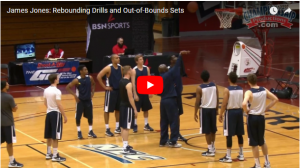
This competitive 3 team rebounding drill is presented by Coach James Jones.

You will need 3 color jerseys to run the drill.

Each player has to score to get out of the drill. If a player commits a foul, he or she has to score twice to get out of the drill.

The team that wins the drill is the first team to have all of their players score and get out of the drill. You will either need to have the same number of players on each team or have one player go twice on the teams that have fewer players.

There is sound with these videos, so please make sure that your sound is on.

The videos are You Tube videos, so you will need to be able to access that site.

Click the play arrow to play the video with the drill.

If you are interested in learning more about the Championship Productions Basketball Coaching DVD that this drill came from, you can click the following link: James Jones: Rebounding Drills and Out of Bounds Sets

Basketball Plays from Brad Stevens

By Brian Williams on November 6, 2016

These plays were contributed by Jon Giesbrecht, Assistant Coach with the University of Winnipeg Men’s program.

You can see several more plays from Brad Stevens as well as other Coaches from various levels and from all over the world by clicking on this link:

to the FastModel Sports Basketball Plays and Drills Library.

You can also find out more about FastModel Play Diagramming software by clicking this link: FastDraw


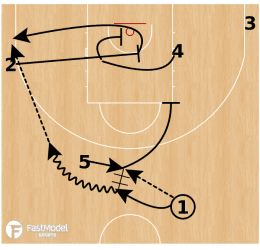
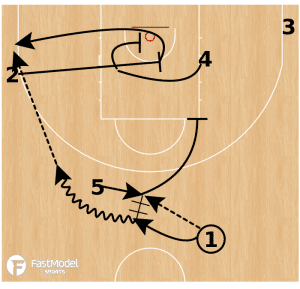
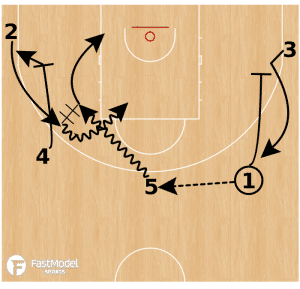
Guard Get Trap

brad-stevens-plays1

Looks as if the action will get into STS (Little-Big Cross Screen, Big-Little Down Screen) except defender guarding 2 cheats the screen… 2 comes off of the same side and is wide open…

1 and 5 get into guard get as 2 goes and set cross screen for 4.

2’s defender cheats action, 2 then receives screen from 4.

Pin Pistol Sweep

brad-stevens-plays2

4 sets wide pin-down for 2, 1 and 2 get into pistol action.

2 keeps ball takes a bounce and reverse to 3.

On the air time of the pass, #5 pins in help.

3 drives to the rim.


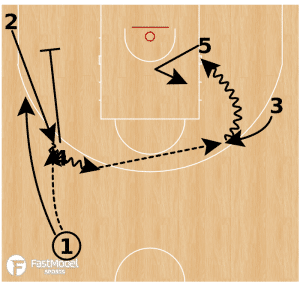
5 Out Reverse Motion

brad-stevens-plays3

1 reverses through the trail.

As the 5 looks at the 4, 4 sets a wide pin-down for 2.

As this is happening, 5 goes into a DHO with 2.


  • « Go to Previous Page
  • Page 1
  • Interim pages omitted …
  • Page 105
  • Page 106
  • Page 107
  • Page 108
  • Page 109
  • Interim pages omitted …
  • Page 288
  • Go to Next Page »

Primary Sidebar

  • Twitter
  • Facebook
  • Linkedin
coachestoolbox
personaldevelopmenttoolbox
basketballplayerstoolbox
basketballtrainer
athleticperformancetoolbox
coachingbasketball

© Copyright 2026 Coaching Toolbox

Privacy Policy