Robi Coker, Asst Men’s Basketball Coach, McNeese State
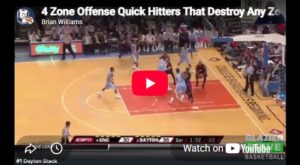
This video is a segment from one of the 120 Videos in Glazier Drive Basketball.
Explore coaching clinic replays, practice plans, skill development videos, and more. Click here to see all that’s included.
The full video that this clip came from is available on Glazier Drive: Zone Offense: Quick Hitters
OVERVIEW
This transcript covers a series of zone offense actions designed to create numbers advantages (2-on-1 or 3-on-2 situations) against 2-3 and 3-2 zone defenses. The core philosophy running through every play: identify the defender who ends up “guarding nobody” (guarding wood) and attack away from him to manufacture an outnumbered scoring situation, whether that’s a post touch, a driving lane, or an open three.
PLAY 1: HUGGINS ACTION (CINCINNATI)
A set with a point guard, two wings, and a post on the block, designed to spring the “5” player for a right-hand layup. Point guard enters to the left wing and cuts through to the opposite corner; the weak-side wing dribbles up top and reverses the ball. This creates a 2-on-1 against the low zone defender — a cross screen frees the post player for the layup. The coach notes this was used to start a game and later re-run in a tie-game, late-game situation with the same success.
PLAY 2: DOUBLE-GUARD SAME-SIDE SET
Both guards line up on the same side with the post on the blocks, which tells the defense the weak side is empty. This forces the bottom defender to guard the ball while two screens are set on the bottom defenders, creating a numbers advantage and an easy “5-man” layup. The coach cautions that a well-coached defense may bump/adjust to cover it, so the play needs to be run quickly. Rated as good for roughly one basket per game.
PLAY 3: DAYTON ACTION (VS. NORTH CAROLINA)
Borrowed from a Dayton game (the game after they upset the coach’s team, later playing UNC in the NIT championship). A stack look with block-block screening action outnumbers the defense 4-on-3. The ball is dribbled over to spring a shooter, forcing the defense to help and opening a numbers advantage.
PLAY 4: MISSISSIPPI STATE “TILT” ACTION (VS. SYRACUSE ZONE)
Credited to Rick Stanbury’s Mississippi State teams; used to overload one side of the floor via a ball screen. Once the screener’s defender is engaged with the ball, the offense “ducks in” a post player while playing 2-on-1 with the corner and wing shooters against the remaining defender. Key coaching points:
- Against long/athletic zones (like Syracuse) that take away the corner three, the ball can be swung to run the identical action on the other side.
- The action essentially creates a 3-on-2 (or effectively a 2-on-1) read: if the post defender extends to help, a shooter (even a 6’8″ post) should be ready to shoot the open three.
- Emphasis on players catching the ball “shot ready” so they can capitalize immediately when the defense fails to guard someone.
- Shown working versus a 3-2/1-2 zone in a state tournament game, where screening the top defender isolates the post player one-on-one for a hook shot.
COUNTER FOR A SHOOTING BIG (“TILT” VARIATION)
Because one team’s personnel included a post player who could also shoot, the coach flipped the alignment — moving the post player to the ball-side block and placing a shooter on the opposite block — while keeping the same overall action. The screener rolls to occupy the middle defender, again creating a 2-on-1 with the backside wing for a three-point look. The same “make him guard wood” principle applies.
KEY COACHING PRINCIPLES (RECURRING THROUGHOUT)
- Against zone defense, the constant goal is manufacturing a numeric advantage (2-on-1 or 3-on-2) somewhere on the floor.
- Identify which defender will be left “guarding wood” (guarding no one) and attack that gap.
- Ball reversals, cross screens, and ball screens are the primary tools to shift and confuse zone coverage.
- Personnel matters — actions can and should be adapted based on whether the roster’s post players can shoot, allowing counters to the same base action.
- Speed of execution matters, especially against well-coached teams that may adjust or “bump” their zone matchups.